Black Manta
Far beneath the surface of the Pacific Ocean, where the light from above has thinned to a distant gray suggestion and the pressure would crush most things without thinking about it, something moved.
It was sleek and dark and purposeful, with two enormous glowing red eyes that swept the darkness ahead — not eyes at all, really, but the lenses of a deep-sea helmet designed with precision and care. Black Manta moved through the deep water the way a thought moves through a mind: directly, efficiently, without hesitation.
He was looking for something. He was always looking for something. The ocean floor held secrets that most people had no idea existed — ancient technology sealed in volcanic rock, artifacts from civilizations that had gone under the water long before written history began, the wreckage of things that had been extraordinary once and were still extraordinary now, just less vertical about it.
Black Manta had no powers. Not one. He had never been struck by lightning or given a mystical gift or blessed by any god of any ocean. What he had was a mind that built things — intricate, extraordinary, improbable things — and the patience to make those things work. His suit had jet thrusters that could match an Atlantean's swimming pace. His helmet fired energy beams capable of cracking open volcanic basalt. His mechanical arms could lift things that no ordinary person could lift.
He had built all of it himself.
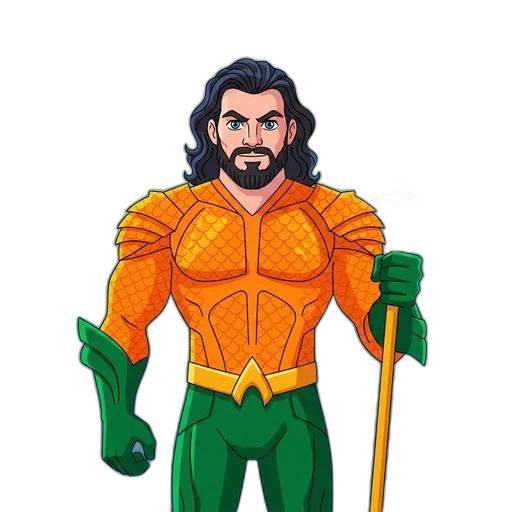
Arthur Curry, who had grown up calling fish friends and could sense the mood of the deep by the pressure of the current, felt the disturbance in the water before he saw Manta. Something displaced and purposeful, moving wrong for anything natural. He put his hand on the Trident of Neptune at his hip.
WHOOOOSH — he dove.
The Trident was a weapon of authority as much as a weapon of power — carved from gold-colored metal that had never rusted in ten thousand years, inscribed with symbols that went back further than Atlantis itself. It could control water: summon a current, push a wave, forge a path through the sea in any direction Arthur wanted to go. It was, in the hand of someone who genuinely knew the ocean, one of the most powerful tools in existence.
Manta heard him coming. Manta always heard him coming — he had instruments for that. He turned, jets firing, and the red lenses flared — ZAP ZAP — twin energy beams carved the water in bright lines. Arthur dove sideways, rolling through the dark water with the fluid ease of a creature born to it. KRANG — the Trident sent a pulse of water pressure sideways, throwing Manta off balance.
They circled each other in the deep dark.
"Curry," Manta said through his helmet comm, neutral and conversational. "What did you think I'd find down here?"
"I don't know yet," Arthur said. "That's what worries me."
The thing Manta had found was in a volcanic ridge about a quarter mile ahead — an artifact sealed in rock that was older than Atlantis and generating a signal that Manta's instruments had tracked across three thousand miles of ocean floor. He wanted it. Arthur wanted to study it. Neither of them had any intention of simply letting the other have it.
The battle moved through the deep water with the particular three-dimensional quality of underwater combat — no floor to stand on, no ceiling to avoid, just the dark in every direction and two figures moving through it. Arthur called a great white shark to his left flank, its white belly ghostly in the dark, its movements calm and precise at his direction. Manta's mechanical arm grabbed for it — CLANK — the shark twisted free and circled back. A pod of bottlenose dolphins materialized from the murk and began their own contribution to the proceedings.
Manta was very good. He had the technology to match almost any advantage Arthur had in the water, and his precision was genuinely extraordinary. But Arthur had the water itself — its currents, its creatures, its moods. The ocean was not a medium Arthur moved through. It was a partner he moved with.
The volcanic ridge erupted with a pulse of geothermal heat — Arthur had put the Trident in the rock and channeled just enough energy to trigger a minor release, nothing dangerous, just enough to fill the water around the artifact with a cloud of particulate that blinded every instrument Manta had.
When the water cleared, Manta was alone.
Arthur had the artifact. He also had a specific signal from the artifact — old Atlantean frequency, which meant it needed to go to the scholars of Atlantis, not to the surface world.
Manta surfaced. He sat in his boat in the wide Pacific and looked at the water.
Arthur came up twenty feet away, Trident in hand, and looked at him across the surface.
"You know," Arthur said, "that mind of yours could do things in this ocean that nobody has ever done."
Manta looked at him without expression. The red lenses gave nothing away.
"Conservation," Arthur said. "Research. Recovery. There's more down there than anyone has catalogued. You have the instruments for it."
A long pause. The Pacific rolled between them.
"Go away, Curry," Manta said.
Arthur dove.
He thought about it, though. As he swam home through the deep blue dark toward the lights of Atlantis, he thought about it. The day Black Manta turned his extraordinary tools toward something the ocean needed.
He hadn't given up on that day yet.