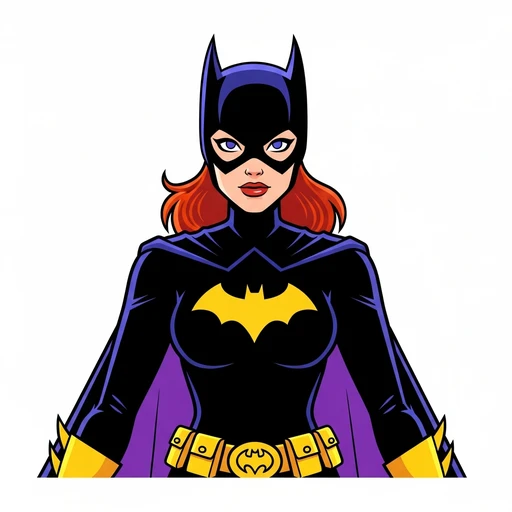
Justice League Investigation
High above the Earth — higher than clouds, higher than weather, higher than the cruising altitude of any airplane — there is a station the size of a small city, turning slowly in the silence of space.
It is called the Watchtower. It is the home base of the Justice League, and from its enormous windows you can see the whole planet below, turning gently in blue and white and green.
Batgirl had been to the Watchtower twice before when the call came in on a Tuesday morning.
Something was wrong with every screen on Earth.
Televisions. Computers. Satellite phones. Radio transmitters. All of them were flickering, buzzing, cutting in and out — not all at once, but rolling across the planet like a wave. A city in South America would lose its communications for twenty minutes, and then it would come back, and then a city in Central Asia would flicker. Then the eastern coast of North America.
Superman and Wonder Woman were already in the field, keeping the panic from spreading — Superman steadying an aircraft that had lost its navigation signal over the Pacific, Wonder Woman helping air traffic controllers coordinate landing patterns by hand. They were strong and brave and absolutely essential. But they could not solve this particular problem.
This problem needed a different kind of hero.
Batgirl was already at the Watchtower's main console when Cyborg arrived, his optical sensors scanning all frequencies simultaneously. The Flash was pacing in restless circles. They had not yet found the source.
"It's not random," Batgirl said, pulling up her analysis on the main screen.
The Watchtower's big screen lit up with a map of Earth covered in small white dots — each one marking a communications disruption. Batgirl had plotted all of them, timed them, and connected them in sequence.
The dots formed a line. Then a spiral. The spiral originated from one point.
"Ocean floor," Cyborg said, his head snapping toward the screen. "Eastern Atlantic Trench."
Batgirl nodded. "Approximately four thousand meters down. There is a structure there that does not appear on any geological survey I've ever seen." She pulled up the deep-sea satellite scan she had run while everyone else was still reading the alert. "Someone built something down there and kept it very quiet."
She did not just find the base. She got them inside it without a single alarm being triggered.
Working alongside Cyborg — who, she had discovered, thought about systems problems in a way that was startlingly similar to how she did, only about five times faster — she ran a remote-access sequence through the ocean station's outer communications array. She slipped past its first security layer the way you might slide a coin through a narrow slot: gently, at exactly the right angle, at exactly the right speed.
Then she found the floor plans. The station had seven levels, two pressurized access shafts, and three power cores — one of which was broadcasting the interference signal like a lighthouse beacon, sweeping across the planet in a slow, deliberate rotation.
"Can you shut it down from here?" the Flash asked, looking over her shoulder.
"I can do better than that," Batgirl said. "I can make it shut itself down."
She built a holographic map from the floor plans and transmitted it to every Justice League member's communicator. When Superman arrived at the underwater base twenty minutes later, he had a complete picture of what was inside before he opened the first door. There were no surprises.
The interference generator was disabled. Communication systems around the world flickered back on, city by city, like lights coming back after a storm.
Afterward, in the Watchtower's main hall, Superman shook Batgirl's hand and said, "You saved us six hours of trial and error."
"Possibly more," she said.
Wonder Woman smiled. "You remind me of Athena."
Batgirl filed the complete mission report that evening — every step documented, every decision explained, every weakness in the ocean station's security logged and analyzed. She included a section at the back titled "What We Should Do Differently Next Time."
Cyborg read it and sent her a message: "This is better than our standard debrief format. Can I use this as the new template?"
"I already sent it to the Watchtower filing system," she replied.
That was the thing about Barbara Gordon. She did not wait for someone to ask. She saw what needed to be done, and she did it.
She was Batgirl, and the Justice League was better because she was part of it.
And somewhere deep below the Atlantic Ocean, a very quiet piece of machinery sat completely still — and Gotham's daughter had been the one to silence it.