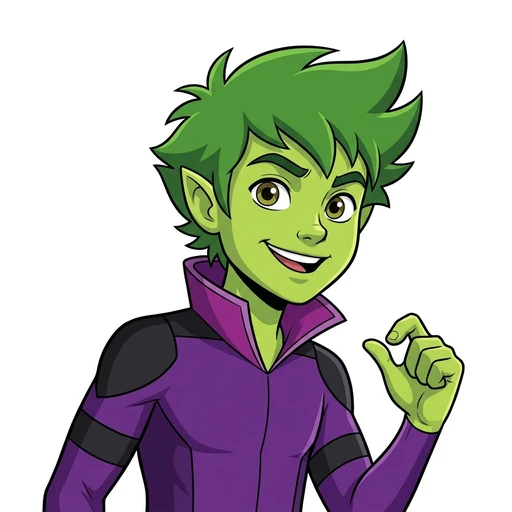
Villain Brotherhood Of Evil
Once upon a time, the Teen Titans had a very bad Tuesday.
One by one, alerts had pulled each Titan away to different corners of the world. Robin had gone east. Starfire had gone south. Cyborg had followed a signal along the coast. Raven had slipped into a dimensional disturbance above the city. The Tower was quiet in the way that towers only get when all the noise has been called away.
Garfield Logan was alone. He was eating cereal — the kind with the little marshmallows — and watching the last half of an adventure film. He had not yet felt worried. Not yet.
Then the outer doors shook. Not like a knock. Like something enormous had decided the doors were not worth respecting.
Garfield sat up.
The doors gave way.
Into the entrance hall walked a gorilla. Not the kind Garfield had met in Africa, the quiet ones with gentle eyes. This gorilla wore a bandolier across its chest and spoke in a voice that was calm and measured — not at all the sort of voice you expected from something with those shoulders.
"Garfield Logan," said Monsieur Mallah. "The Brain sends his regards."
The Brain. A disembodied criminal mind floating in a glass dome, directing the Brotherhood of Evil like a chess player who had never lost a match. He had decided that young heroes were a threat. Mallah — the strongest, cleverest creature in the Brotherhood — had been sent to handle Titans Tower.
Behind Mallah, a squad of Brotherhood soldiers moved through the doorway like grey water.
Garfield put down his cereal.
He became an elephant. A very large green elephant, which took up most of the entrance hall and charged with the kind of sound that fills every corner of a room and the chest of everyone who hears it. The soldiers scattered. Every single one of them.
But Mallah did not scatter. He was waiting for the charge. He caught the tusk with both hands and used the momentum — all of it, every pound — and redirected. Garfield hit the equipment bay wall. The wall lost. He slid down the metal grating to the floor. He scraped his elbows. He took a breath.
He got up.
A pterodactyl — green and fast — cutting across the bay to knock soldiers away from the computer systems before they could copy the Titans' files. But Mallah's hand came up and the pterodactyl became a boy again, tumbling across the floor.
Bear. Wolf. Anaconda, trying to wrap Mallah's arms back and hold them still. Each form, Mallah had an answer. He was as strong as anything Garfield could become, and he had clearly been thinking about each option before Garfield even picked it.
Garfield lay on the floor, staring at the ceiling.
He thought about his mother. Marie Logan, who had sat for hours in the tall grass outside Nairobi watching a group of chimpanzees the way other people watch films. She never said: look at how strong the big one is. She said: watch how they listen to each other. Watch the patterns.
The pattern here was this: the soldiers always regrouped. Every gap Garfield opened, they filled. They were trained and disciplined and they expected him to keep trying to be bigger.
He became a starling.
A small green starling, the size of a fist. He flew to the ceiling where nobody looked and found the fire suppression panel. He had passed it every day on the way to the cereal cabinet.
He tapped it with his beak.
WHOOOOOOSH. White foam poured from every vent at once. The room went white and loud and confused. Garfield dropped to the floor as himself, slapped the emergency beacon — BEEP BEEP BEEP — and hit the security blast door controls.
The heavy doors thundered shut.
He could hear Mallah's fists against the metal. He sat on the floor in the corridor and waited.
Mallah broke through eventually. He always would. But the beacon had done its work, and the Titans had a trail to follow. The Brotherhood of Evil would not be finished with them — not by far. But Garfield had learned something about the Brain's organization that day: it was disciplined, and disciplined enemies required thinking, not just transforming.
He filed that lesson very carefully away, went back to the foam-covered kitchen — one boot somehow missing, elbows scraped — and poured himself three bowls of cereal with the little marshmallows.
He sat at the table and ate slowly, thinking about his mother, and about patterns, and about how the starling had done what the elephant couldn't.
Small and clever, he thought, beats big and obvious.
He had always known that, somewhere. Now he knew it all the way through.
He felt he had fully earned all three bowls.