Origin
In the city of Detroit, on a street lined with brick buildings and tall oak trees that turned gold every autumn, there lived a boy named Victor Stone.
Victor was fast. He was so fast on the football field that coaches from three different universities had already sent letters to his school, and he was only seventeen. He was tall and strong and smiled so easily that people just felt better when he walked into a room.
But Victor also had a hollow place inside him that football couldn't fill.
His father, Silas Stone, was a scientist — one of the most brilliant scientists in the world. He worked at S.T.A.R. Labs in Detroit, a gleaming research facility full of equipment that hummed and crackled and glowed with energies that most people could barely imagine. Silas was brilliant. And Silas was almost never home.
Victor had grown up learning to talk to an empty house.
"Come see my game, Dad," he asked, again and again, year after year.
"Soon, Victor," said Silas Stone, again and again.
But soon never quite came.
On the afternoon it all changed, Victor went to S.T.A.R. Labs himself. He had won the regional championship the day before. He wanted to tell his father in person, to make it real by saying it out loud to someone who mattered.
He walked through the tall glass doors, past the security desk — the guards knew him by name — and into the corridor that led to his father's main laboratory. From behind the door he could hear a strange sound: a deep, resonant hum, high and low at the same time, almost like a heartbeat that wasn't quite human.
His father's team was studying something extraordinary — a Mother Box, an alien supercomputer from a distant world called New Genesis. The Mother Box was small, roughly the size of a hardcover book, covered in symbols that shifted when you looked at them from different angles. It sang. That was the only word for it. It sent out a frequency that made the bones in your chest feel warm.
Victor pushed open the door.
He said, "Dad, I have to—"
Then the Mother Box detonated.
The explosion was white. White and silent and total, filling every corner of the room at once. When the light cleared, the other scientists were scattered across the floor, unconscious. The equipment was in ruins.
And Victor Stone was critically injured — more than any person could survive by ordinary means.
Silas moved faster than he ever had in his life.
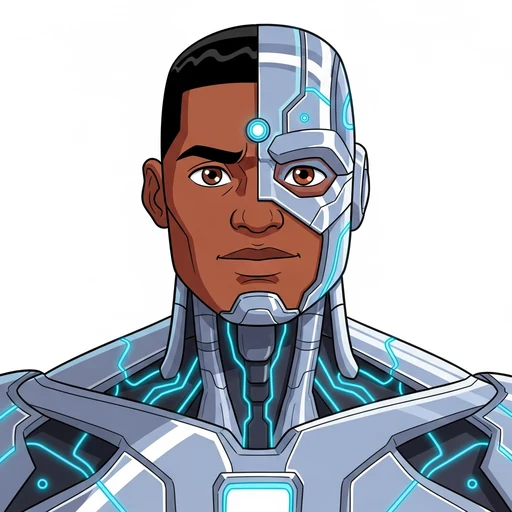
He was a man who had sometimes forgotten to come to football games. But he was also a man who had spent twenty years studying technology that could do impossible things. He used everything he had — cybernetic limbs, a neural-interface processor, a built-in supercomputer more powerful than anything previously installed in a human body, and pieces of the shattered Mother Box itself, fused carefully, miraculously, into the framework.
When Victor woke up, the world looked different. He could see in multiple spectrums. He could hear frequencies too high for human ears. He could reach out with his mind and feel the hum of every computer network within a hundred miles — S.T.A.R. Labs' servers, the city's traffic systems, the satellite signal bouncing down from orbit.
He raised his right arm and it transformed — gears and panels shifting with a CLUNK and a WHIRR — into a sonic cannon. He tested it gently, aimed at the wall, and fired a pulse so precise it knocked a pencil off a shelf without touching anything around it.
"Victor," his father said quietly, from the chair beside his bed.
Victor looked at him. Silas Stone had not left the room in three days.
"I'm sorry," his father said. "I should have come to your games."
Victor was quiet for a very long time. When he spoke, his voice had a new resonance to it — still warm, still his, but layered with something deeper. "Are we going to be okay?" he asked.
"Yes," said Silas. And he meant more than just the injuries.
Victor Stone stood up for the first time. He was different now. He would always be different. Half of him was the boy who loved football and autumn in Detroit. The other half was living technology, alien intelligence, the hum of a universe's worth of data.
But he had learned something important, lying in that hospital bed: being different doesn't mean being less. It means being more.
He looked down at his arm, at the gleaming panels and circuits, and something settled in his chest like a key turning in a lock.
He was Cyborg.
And he had a lot of work to do.