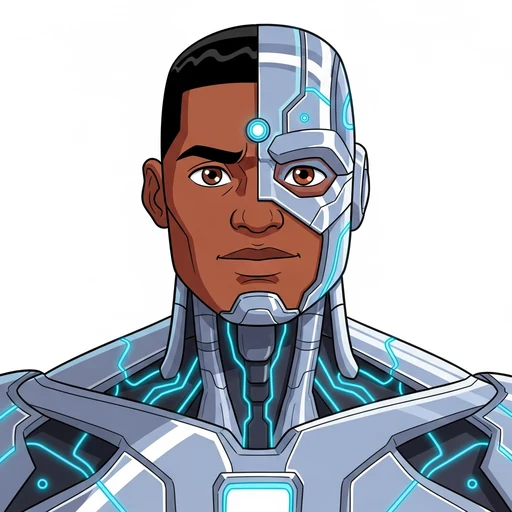
Justice League Communications
Imagine a telephone that could connect every superhero on Earth at once — and in space, too.
Now imagine that telephone is not a device you can hold in your hand. It is a person. A living, thinking, caring person who runs faster than any computer, listens to a hundred signals simultaneously without losing any of them, and somehow manages to also make sure nobody is scared or alone when things go terribly wrong.
That person is Victor Stone.
The Justice League had existed for years before Victor joined them, and it had been extraordinary — Superman and Wonder Woman, Batman and the Flash, heroes of staggering power working together to protect a planet. But there had always been a problem that nobody liked to admit: they could not always hear each other.
In the middle of a crisis — a battle in Antarctica while something erupted in Tokyo while Batman tracked a villain through Gotham's subway tunnels — the team's communication technology would lag, glitch, or simply fail at the worst possible moment. Superman would make a decision without knowing that Batman had already addressed it from a different angle. Wonder Woman and the Flash would overlap their responses to the same threat because neither knew the other was already there.
Victor fixed this on his first week.
He reached out with his digital mind, mapped every piece of communication hardware the Justice League was using, identified eleven separate points of weakness, and replaced the entire architecture with something new — a network that ran through him. His cybernetic systems became the central hub, and every hero's communicator, earpiece, and battle system synchronized to his frequency.
When they were connected to Victor, they were not just hearing each other. They were sharing information at the speed of thought. Superman could feel where Wonder Woman was without looking. Batman could receive Victor's real-time analysis mid-swing, no delay, no gap.
The first time they ran a full team exercise connected this way, the Flash stopped in the middle of it and said, "Has it always been this quiet? Like, the good kind of quiet? Where you know exactly what's happening without anyone yelling?"
"It's called coordination," Victor said.
"It's fantastic," said the Flash.
But Victor was more than a communications hub. He was the team's problem-solver for problems that muscles alone could not answer. When the League encountered alien machinery — a crashed ship, a rogue satellite, an automated defense platform left behind by a civilization that no longer existed — Victor was the one who interfaced with it, read its logic, and spoke its language.
He built things for his teammates. A set of shielding constructs for Wonder Woman's battle stance, calibrated to her fighting style, so that defensive moves could layer over offensive ones without losing momentum. A teleportation positioning system so that when the Mother Box opened Boom Tubes in a combat situation, team members could step through into precisely the right location rather than approximately the right location. A signal protocol that let Batman's cowl camera feed directly to the Watchtower's main screen so that backup could see exactly what Batman saw, second by second.
He spent three weeks building a communications array for the Watchtower that could pick up signals from the outer solar system, because he had asked Superman once whether there were threats they weren't currently watching and Superman had been quiet for just a moment too long.
The array picked up three anomalies in the first month. None of them were immediate threats. One of them was something that still needed watching.
Victor added it to the monitoring schedule.
Off the battlefield, he discovered something he had not expected: he was good at being everyone's friend. Not in a surface way — in a real way. He knew, without always knowing how he knew, when someone was struggling. The Flash moved just slightly too fast when he was anxious. Batman's response latency dropped by a third when something was bothering him. Wonder Woman looked at the stars instead of the screens when she missed home.
Victor had not planned to notice these things. His systems just noticed them.
And so he showed up. With a question, or a task, or sometimes just by sitting nearby and letting the hum of his systems fill the silence like the world's most understanding company.
He was the team's digital glue. That was how the mission reports described him, and he had decided he didn't mind the description, as long as people understood that glue, done right, is the thing that makes the whole structure hold.
Victor Stone was Cyborg, and the Justice League — the world's greatest heroes — was held together partly by strength and courage and lightning speed.
And partly by one boy from Detroit who learned that the best version of himself was the one who made sure nobody was ever out of reach.