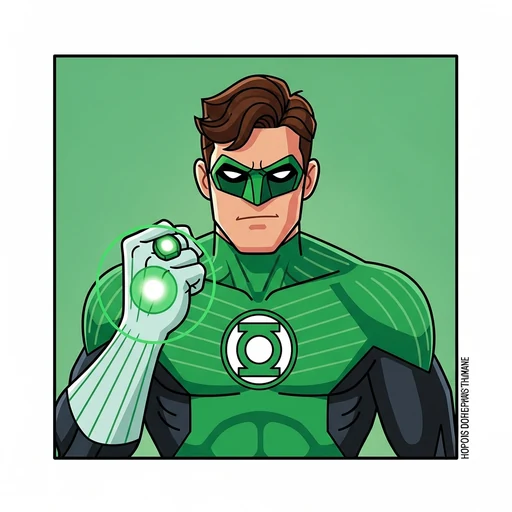
Sinestro
There was once a Green Lantern who was considered the greatest of them all.
His name was Sinestro. His home world was Korugar, and when the Guardians of the Universe assigned him his sector, he brought it to order so completely, so swiftly, so effectively, that the other Lanterns spoke about him the way people speak about someone they want to be.
He was the best. Hal Jordan knew this, because Sinestro had been Hal's own teacher.
In Hal's early days at Oa, when he was still fumbling with constructs and learning to hold his focus under pressure, Sinestro had been the one standing beside him — precise, demanding, brilliant. He had shown Hal how to make a construct hold under impact, how to layer shields, how to move through space at maximum speed without burning through the ring's charge. He was the finest teacher Hal ever had.
Which made what happened next even harder.
Because Sinestro had a flaw. Not a small one, buried deep — a fundamental one, running through everything he did.
He had decided, at some point along the way, that people could not be trusted to protect themselves. That they needed to be controlled. Not encouraged. Not inspired. Controlled — through fear, if necessary.
The Guardians discovered it when citizens of Korugar sent word to Oa: their Green Lantern had become a ruler, not a guardian. His constructs were not tools of protection but instruments of enforcement. The people of Korugar feared Sinestro the way they feared a storm.
The Guardians expelled him from the Corps.
Sinestro did not accept this gracefully.
He built something new. A ring — not green, but yellow. Not powered by willpower, but by fear. Yellow, the color that had always been the one weakness in a Green Lantern's armor — the one shade that made the green light falter. He founded the Sinestro Corps, and he came back.
The first time Sinestro and Hal faced each other after that, the California desert was lit up like noon at midnight.
Sinestro's constructs were things designed to frighten — enormous, angular, edged, shaped to suggest threat and menace and the certainty of defeat. A giant yellow fist descending from the sky. A cage of yellow light, bars sizzling. Walls of yellow that made Hal's ring pulse with uncertainty, the green flickering at the edges.
Fear is not the same as bravery. But it works on bravery. It works on the part of you that says maybe you should just stop.
Hal Jordan felt it. Of course he felt it. The ring on his finger dimmed slightly, just once, just for the space of one breath.
And then he remembered what Abin Sur had told him. The ring chose him for the ability to overcome great fear. Not the absence of fear. The overcoming of it.
He took that breath. He breathed the fear all the way out.
And then he built.
A jet — because Hal always built jets when he needed to be fastest. Green and blazing, roaring through the yellow-lit desert air. He flew directly at the fist construct, not around it — through the pulse of fear it radiated, straight through it, watching the yellow light scatter — and then he was past it, and Sinestro had to turn, and in that turning, Hal built a net of interlocking green beams that snapped across the air like a cage made of light.
CRACK. CRACK. CRACK.
Sinestro pushed back. They went three rounds — constructs shattering, new ones rising, the desert sand spinning up in the wind of their fight. A yellow tower. A green dam. A yellow spear. A green catcher's mitt the size of a building that caught the spear and held it.
And then Hal built something Sinestro had never taught him. He built it because he thought of it just now, in the fight, the way a test pilot adjusts the landing approach with three seconds to decide. A green spiral — not a weapon but a vortex, swirling inward, not toward Sinestro but around his constructs, unraveling their angular certainty with something flowing and unpredictable.
Fear cannot account for the unexpected. That is its fundamental weakness.
Sinestro's constructs dissolved.
He was gone before Hal could secure the containment. He always escaped — he was too skilled not to. But the sector was safe, and the yellow ring's shadows had been pushed back.
Hal hovered in the quiet desert, the green light steady on his hand.
He understood something now that he had not understood when Sinestro was his teacher: the greatest Green Lantern in history had been great. Had been genuinely, remarkably great. And even greatness, without mercy — without the willingness to trust people, to hope for them, to guard without controlling — becomes something cold and hollow.
Courage beats control every time.
Not because courage is louder. Because courage believes in something bigger than fear.
And that belief, steady as a ring on a finger, never runs out.