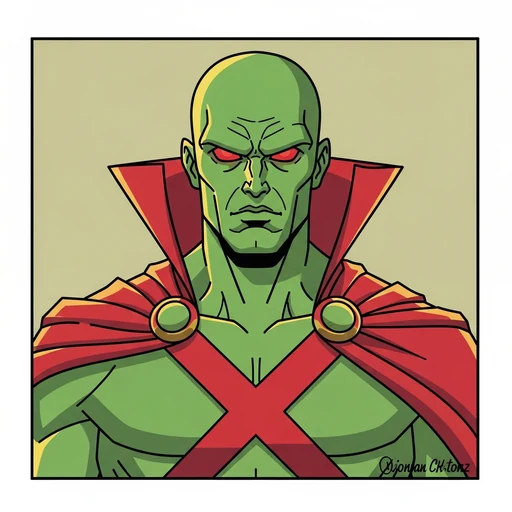
Martian Heritage
When the Watchtower was quiet — not the busy quiet of people doing their work, but the deep quiet of a station between crises, with most of the team resting and only the hum of instruments in the air — J'onn J'onzz would sometimes stand at the observation window and go somewhere else.
Not physically. Physically he was still there, green-skinned and solid, his broad hands resting on the window frame, his eyes seeing the stars but seeing through them.
What he did was remember.
The word is not quite right. Human memory is a little like looking at a photograph — you see a captured image of something that happened. Martian memory, for J'onn, was something closer to visiting. He could reconstruct, from the billions of psychic signatures he had absorbed over a lifetime, a version of Ma'aleca'andra so complete that he could walk its streets.
He would stand at the window and walk home.
The streets of his city rose up in his mind with total clarity: the psionic towers, built not from construction but from concentrated thought, their surfaces smooth and warm, humming faintly at a frequency that matched the background pulse of the Great Song. The markets, where Martian traders shared not just goods but the feelings that went with them — the pride of a craftsperson, the pleasure of a customer, all of it open and transparent because in a telepathic culture, pretending was difficult and considered poor form anyway.
He walked past the Hall of Memories — a building that functioned as both a library and a living archive, where young Martians would sit in contemplation and, guided by teachers, telepathically experience the lives of their ancestors. History was not read. It was felt. You could spend a morning knowing what it was like to be your great-grandmother solving a mathematical proof. You could spend an afternoon knowing what the person who built your neighborhood was hoping for when she raised the first psionic resonance.
J'onn had spent many hours in the Hall of Memories. He knew the lives of people who had been dead for centuries with a closeness that most living people never achieve about each other.
All of that lived inside him now. Every lesson taught in that Hall, every life experienced there, every piece of art and philosophy and science and quiet daily living — it was his to carry. He was a living archive of a civilization. The last one.
This was sometimes very heavy.
He remembered his daughter K'hym's voice. Not a sound — Martians communicated in sensation and image as much as sound — but the particular quality of her attention when she was learning something new, the way her mind felt when she was delighted, which was like a small bright warmth spreading outward. She had loved the small flowering plants that grew along the walls of their home in colors that had no human names.
He remembered M'yri'ah teaching her the names of the flowers by sharing the memory of learning them herself, so that K'hym received not just the name but the whole chain of everyone who had ever known it.
He held these things very carefully.
What he had come to understand, in the years of living among humans, was that his civilization had not only died. It had been preserved — in him. Every choice he made, every moment of patience and understanding and care, was a continuation of what his people had been. The Great Song could not play across a planet's minds anymore. But it could play, quietly, in every action of its last singer.
He carried a piece of it into human lives all the time, without ever announcing it. The way he sat with the Flash when the speedster was too restless to rest and could not explain why. The way he always knew what Batman was worried about and never said it aloud but made sure the conversation went somewhere useful. The way he offered a cookie sometimes at exactly the right moment.
Small kindnesses, ancient kindnesses, the inherited practice of a world that had believed connection was the most important thing there was.
He turned from the window one night to find Superman standing beside him.
"You were gone for a while," Superman said — not accusatory, just noting it.
"I was on Mars," J'onn said. "Walking in my city."
Superman was quiet for a moment. He had his own lost world, in a different way. He understood something about carrying a home you cannot return to.
"Was it good?" he asked.
J'onn considered. "It was what it was," he said. "Real. Complete. Very far away." He paused. "And still mine."
Superman nodded.
They stood together at the window and watched the stars, and the Watchtower hummed around them, and J'onn held the Great Song in its archive of one — ancient and safe and remembered.