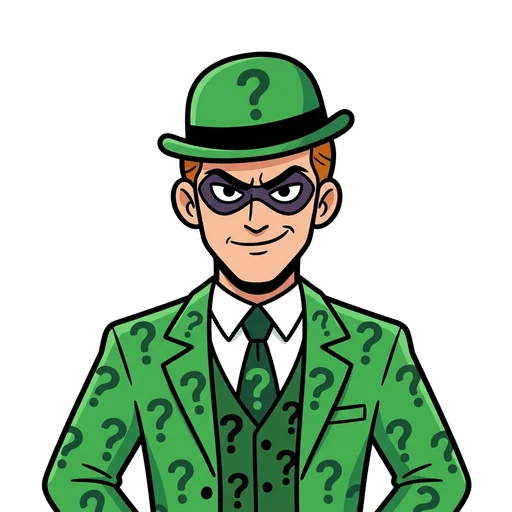
Arkham Rivals
Once upon a time, in a tall stone building on the edge of Gotham City, lived some of the trickiest troublemakers anyone had ever met. The building was called Arkham Asylum, and among its many residents was Edward Nygma, who quietly believed, deep down, that he was the cleverest one there by far.
In the recreation yard, under a wide gray sky, Edward spent his afternoons trading friendly-not-so-friendly barbs with two of his neighbors, the Penguin and Two-Face. Each of them was utterly convinced that his own scheme was the smartest Gotham City had ever seen.
"Riddles are just games for children," the Penguin liked to sneer, twirling his umbrella with a little smirk.
That was always a mistake. Edward would fire back a puzzle so wonderfully tangled that even Two-Face — flipping his silver coin thoughtfully between his fingers, heads for one choice, the scarred side for another — would eventually have to admit defeat, shaking his head and pocketing his coin with a grumble.
But there was someone at Arkham who saw something in Edward that the others always seemed to miss. Her name was Dr. Joan Leland, and she ran the asylum's gentle, patient treatment programs. During their quiet sessions together, she noticed that Edward's puzzles were never really about greed, the way some of his neighbors' schemes were. They were never about hurting anyone, either. They were about something much simpler and much sadder: wanting, needing, to be noticed.
"You could solve real problems, you know," she told him one afternoon, sliding a newspaper article about unsolved mysteries in Gotham City gently across the table between them.
Edward looked at it for a long moment. Then he folded it carefully, smaller and smaller, and tucked it into his sleeve without saying a word. He would never admit it, not even to himself, but her words had landed somewhere deep and quiet inside him.
Then, one perfectly ordinary afternoon, something happened that nobody expected.
Old wiring near the asylum's records room sparked, and a small fire crackled to life, curling smoke up along the ceiling. Alarms blared through every hallway. Guards scrambled in every direction, shouting instructions, trying to keep everyone calm.
And right in the middle of all that chaos, something surprising happened. Edward Nygma — yes, that very same Edward — found himself calmly guiding two frightened, coughing guards toward the safest exit he knew. He had memorized every single hallway and vent in that entire building, purely for the fun of solving puzzles, never once imagining it would actually help someone.
Across the yard, watching quietly through a window, Dr. Leland was not surprised in the slightest. She had always suspected that a mind as clever as Edward's could point in more than one direction, if it ever got the chance.
By evening, the fire was out, the records room was saved, and one grateful guard leaned close to Edward and thanked him quietly, just between the two of them, never mentioning it to anyone else.
Word got around anyway, the way it always does in a place like Arkham. The Penguin scoffed when he heard about it. "Means nothing," he grumbled, waving a dismissive hand. Two-Face merely flipped his coin, unsure exactly what to make of the whole thing, and said nothing at all.
But that night, alone in his small, quiet cell, Edward Nygma sat turning Dr. Leland's newspaper clipping over and over in his hands, the paper soft now from so much folding and unfolding. And for just a moment — one small, unfamiliar moment — he wondered what kind of riddle a good deed might actually solve.
The next morning at breakfast, everything looked ordinary again. The Penguin was already bragging loudly about his next big Gotham City scheme. Two-Face flipped his coin the way he always did, deciding which rule to break first. Edward said nothing about the fire at all, not one word.
He simply folded that little clipping smaller and smaller still, and tucked it close to his heart, where nobody else could see it.
And somewhere in Gotham City's cleverest, most puzzle-loving mind, a brand-new question had quietly begun to take shape — one that had nothing at all to do with riddles, and everything to do with what kind of person he might someday choose to become.
Goodnight, Edward. Even the trickiest minds get to wonder sometimes.