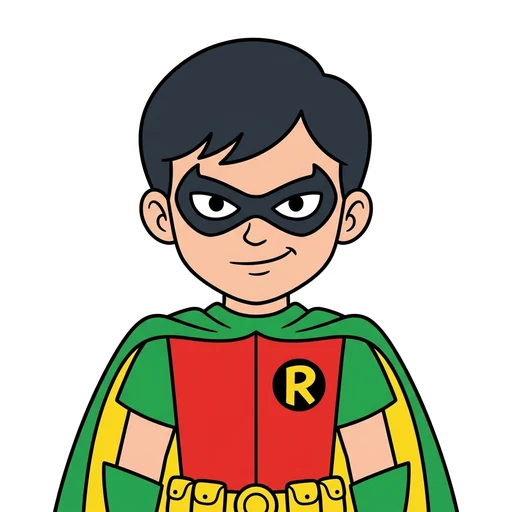
Bat Family Leader
This is the story of the night Dick Grayson became Batman.
It is not a triumphant story. Or rather — it is, but only at the very end. It begins with something sad. It begins with the day Gotham City lost its Batman.
There had been a crisis. The exact details are complicated and involve time travel and a very bad god named Darkseid, and we will not get into all of it here, because you are seven and there is plenty of time later for the long version. The short version is this. Bruce Wayne, who had been Batman for nearly twenty years, had been hit by an Omega Beam — a kind of energy weapon — and instead of being hurt, he had been knocked LOOSE in time. He was gone. The Justice League searched. The Bat-Family searched. The world's smartest detectives and most powerful heroes searched. Nobody could find him.
For months, Bruce Wayne was missing.
And without Batman, Gotham began to come apart.
It happened slowly at first. The Joker, who had been quiet for a while, started writing letters to the Daily Globe again. The Penguin, who had been hiding in an Iceland villa, came back to Gotham and reopened his casino. Smaller crime bosses, who had always been afraid of Batman, began carving up the city into territories. Police officers who had been holding the line for years got tired. Innocent people began locking their doors earlier in the evening.
Every single night, faithfully, Commissioner James Gordon walked up to the roof of the Gotham City Police Department headquarters. Every single night, he checked the Bat-Signal projector. Every single night, he switched it on. The great yellow circle with the black bat shape lifted up into the low Gotham clouds.
And every single night, for the first time in nearly twenty years, nothing answered.
The clouds were empty. The rooftops were empty. The shadows were just shadows.
Gotham, very quietly, began to lose hope.
That was the night the Bat-Family gathered in the Batcave.
Alfred Pennyworth was there. He had set up tea on the conference table near the great computer — a full pot, the good biscuits, real linen napkins. He was pouring it out into cups with his usual perfect manners, but if you looked closely, you could see his hands were shaking, just very slightly, around the teapot. Alfred was the one person in this whole crisis who had truly believed Bruce would walk back through the cave door any minute now, and Bruce had not, and Alfred was beginning to be afraid.
Tim Drake was there. Tim was the third Robin — a brilliant young detective, only sixteen at this point — who had figured out Batman's secret identity all by himself when he was a kid and had earned his way onto the team through sheer cleverness. Tim was certain, in his quiet stubborn Tim way, that Bruce was alive somewhere in time and could be brought home. He was running calculations on three computers at once.
Damian Wayne was there. Damian was ten years old. He was Bruce's actual biological son — his mother was a complicated woman named Talia al Ghul, but that is also a story for another day. Damian had been raised by the League of Assassins until he was eight, then sent to live with his father. He was fierce, brilliant, arrogant, lonely, and impossible. He had a small sword strapped to his back. He stood by the wall with his arms crossed, scowling. He was scowling because his father was missing and he did not know any other facial expression for the feeling of being scared.
Barbara Gordon was there. Barbara had once been the original Batgirl. She had been injured years before in an attack by the Joker, and she could no longer walk. She had reinvented herself into Oracle — the greatest information broker in the superhero world. From her wheelchair, in front of a wall of screens, she could see almost any camera in Gotham and most of the world's databases. She was monitoring the city tonight, switching between cameras, looking at everything.
They were all there. And they all turned, one by one, to look at the figure standing in the doorway of the cave.
Dick Grayson. In his Nightwing suit, the blue wings across his chest catching the cave light. The escrima sticks crossed behind his back.
He had flown up from Blüdhaven that morning. He knew, just from the way Alfred had said his name on the phone, that this meeting was coming.
He stood very still in the doorway for a moment, looking at each of them. Alfred at the teapot. Tim at the computers. Damian by the wall. Barbara in front of her screens.
They were all waiting.
He understood what they were waiting for.
Somebody had to be Batman.
Not forever. Not as a replacement. But until Bruce came home. Gotham could not survive much longer without one. Hope was running out. And of all the people in this room, in this Bat-Family, only one person had been in the cave long enough, trained well enough, and earned the right.
Dick walked slowly to the conference table. He sat down in the great stone chair that Bruce had built — the one in front of the giant computer. He had sat in that chair only twice before in his life, both times as a small boy, when Bruce had been letting him try out the workstation. It felt larger now than it had then.
He was very quiet. He did not look at the others. He looked at his hands.
He thought about his mother, Mary Grayson, braiding his hair before a circus show. He thought about her whispering mio piccolo robin. He thought about the moment the trapeze ropes failed. He thought about Bruce — Bruce in his quiet dark wool coat — kneeling down beside him in the empty sawdust ring after the audience had gone home, and saying, very simply, "I know."
He thought about the night Bruce had shown him the cave for the first time.
He took a slow breath.
Then he stood up. He walked over to the long glass cases at the back of the cave — the cases that held every Batsuit Bruce had ever built. Each one was different. Some had heavier armor. Some had lighter gear. Some had been built for arctic missions, others for desert work. Bruce had been very methodical about his suits. He had kept them all.
Dick looked through them slowly.
He stopped at one near the end of the row.
It was a newer suit. Bruce had built it about a year ago, an experimental design Dick had helped him fit. It was sleek, modern, slightly lighter than Bruce's main suit. It had been intended as a Batman suit for missions requiring more acrobatics. It had never been worn in the field. It was almost — but not quite — exactly Dick's size.
Dick pulled the suit out of the case. He laid it on the workbench. He looked at it for a long, quiet moment.
Then he did something the others did not expect.
He went and got his Nightwing chest emblem. The royal blue bird, wings spread wide. The one Alfred had hand-sewn three years ago.
He sat down at Alfred's small sewing machine, in the corner of the cave, and he carefully — very carefully — stitched the Nightwing bird onto the chest of the new Batsuit, just above where the black bat emblem normally went. He did it with neat, even stitches. Alfred came over and watched him do it without saying a word. When Dick was finished, Alfred put a hand briefly on his shoulder and squeezed.
The new suit had two emblems on the chest. The dark bat. And, just above it, the bright blue spread wings of Nightwing.
It was a Batman who used to be Robin.
Dick stood up. He looked at the suit on the bench. He looked at the others — Alfred, Tim, Damian, Barbara — and he said, very simply:
"Until he comes back."
Tim nodded. "Until he comes back."
Barbara, from her wheelchair, said softly, "Welcome home, Boss."
Damian did not say anything. He was staring at the suit. His scowl was, for the first time in a long time, a little less sharp.
Alfred said, "Master Dick. I have laid out a fresh pot of tea. Drink it before it gets cold."
Dick smiled. Very small. Very Bruce.
"Yes, Alfred."
He put the suit on that night.
The first time he stood in the full Batman cowl in front of the mirror, he did not look quite like Bruce. He was about the same height — Bruce was a little broader in the shoulders — but the build was different. Dick stood lighter on his feet. The cape hung the same way, but the way he held his arms was different. Bruce had always been a statue of a man, planted heavy on the rooftops. Dick was an acrobat. Even standing still, he looked like he was about to lift off.
When Gordon flipped on the Bat-Signal that night — for what must have been the hundredth straight night with no answer — Dick was already crouched on the roof of the GCPD, in the cape and cowl, waiting.
Gordon turned around from the projector and stopped dead.
He stared at the figure on the gargoyle.
He stared.
Then, very, very slowly, he smiled. It was a different smile than he wore for Bruce — softer somehow, more relieved than awed.
"You came," Gordon said.
Dick — in Batman's voice now, the low growl Bruce had used for twenty years, but with just the faintest brighter undertone, a Dick-Grayson undertone — said, "I came."
He had brought somebody with him.
A small fierce ten-year-old boy in a brand-new Robin costume, scowling out at Gotham. Damian Wayne.
Damian had not wanted to be Robin. He had said, at the cave, that Robin was a "childish color scheme" and that he was "a ninth-degree assassin, not a sidekick." He had complained for an entire afternoon. But Dick had been patient. Dick had said to him, very gently, "Damian. Your father is missing. You and I are going to find him. And while we do that, Gotham still needs to be protected. I am going to be Batman. I am asking you to be my Robin. Not because you are a child. Because you are the only person in this city who is fierce enough to make the bad guys actually worry."
Damian had stopped complaining. He had stood very still for a moment. Then he had let Alfred dress him in the red tunic with the yellow R and the green leggings.
He had not smiled. But he had not scowled, either, when he saw himself in the mirror.
Now Damian was standing on the roof of the GCPD beside the new Batman, in the bright Robin colors, his small sword strapped to his back, looking out over Gotham City with his arms folded.
Dick reached over. He put one large gloved hand on Damian's small shoulder.
"Holy first night, partner," Dick said.
Damian rolled his eyes. He muttered something in Arabic that Dick suspected was not polite. But he did not shrug the hand off. And — Dick saw it, just barely, the corner of his mouth — Damian almost smiled.
The Bat-Signal lit up the clouds.
The new Batman and the new Robin swung off the GCPD rooftop together, capes flying out behind them, into the dark Gotham sky.
And down in the streets — in the warehouse districts, in the docks, in the corners where the gangs had been getting bolder by the week — somebody looked up and pointed.
The Bat-Signal was answered.
For the first time in months, the watch was being kept.
Dick Grayson, who had once been a small bright Boy Wonder in a yellow cape, was Batman now. He would not be Batman forever. Bruce would come home. Bruce always came home. But until then, the Bat-Family had a leader.
And Gotham, very quietly, lifted its head.