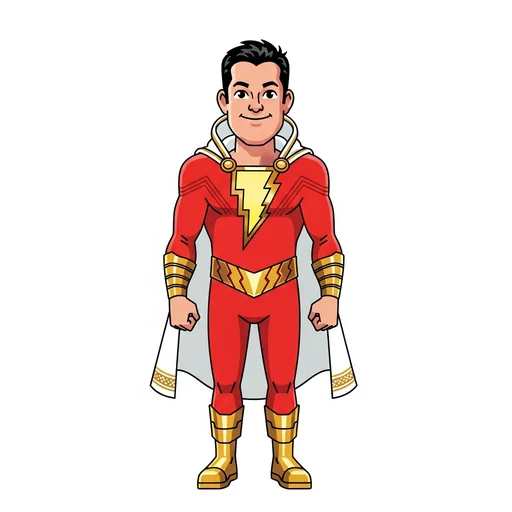
Black Adam
Before Billy Batson, before the Wizard Shazam gave his power to a boy in a Philadelphia subway station, there was another champion.
His name was Teth-Adam. His homeland was Kahndaq, an ancient kingdom in the desert, and when the Wizard chose him, three thousand years ago, Teth-Adam had been a man of genuine greatness — brave and devoted, willing to sacrifice everything for his people.
He had been a good man.
But power is a long road, and grief is a long road, and when both roads lead in the same direction and there is no one to tell you to stop, sometimes a person travels further into darkness than they ever intended.
Teth-Adam lost his family. His people were threatened, again and again, by rulers and conquerors who believed that strength meant the right to take. He used the Wizard's power — his power, which he had earned and held faithfully for a century — and he used it the way a person uses a hammer when they are very, very tired of using a broom. He struck. And struck. And the striking changed him.
The Wizard eventually took the power back. This was, perhaps, the only moment in the Wizard's three thousand years that caused him real regret.
Now Teth-Adam was Black Adam. He did not wear Billy's red. His colors were black and gold, ancient and severe, and when he said the name of his power — his word was not "Shazam" but a different word, drawing from different ancient gods, the Egyptian gods who had sanctioned him before Rome or Greece had any champions at all — the thunder came in a different register. Lower. Older.
He found Billy because he was looking for the Wizard's heir. He had expected someone formidable. He had not expected a ten-year-old.
"You," he said, the first time they met, with a weight in that single word that carried about three thousand years of opinions. "You are what the Wizard chose."
"Hello," said Billy.
"You are a child."
"Yes," agreed Billy, who was very aware of this.
Black Adam looked at him for a long moment, and something in his ancient, grieving face was working through a set of complicated feelings. He had come expecting to take the power back — to reclaim it, to argue that a child could not possibly be worthy of what a three-thousand-year champion had lost. He had come with reasons and history and a legitimate case, by any standard of justice that predated Billy's birth by centuries.
Then he looked at the boy.
Not at the power — at the boy. At Billy, who was standing in an alley in Fawcett City in the rain with his sneakers soaked through and his golden lightning bolt shining on his red chest, not afraid of Black Adam but not pretending not to be scared either. There was something in Billy's face that Black Adam recognized from a very long distance, from a version of himself he had not been in a very long time.
Pure intent. No angle. No plan. Just: here I am, doing what I believe is right.
The fight, when it came, was the loudest thing Fawcett City had ever heard.
BOOM. CRACK. ZAP. Lightning — black and gold meeting white and red — lit up the sky over the Delaware River. Buildings shook. The river surface rippled in concentric circles from the blasts. Black Adam's ancient strength against Billy's new power, three thousand years of history against ten years of goodness.
Black Adam was stronger. By nearly every measure, he was more skilled, more experienced, more formidable.
But Billy fought with something Black Adam had lost — the certainty that the fight was worth having for its own right reasons, not for old scores or old pain.
When the lightning finally settled and Black Adam stood looking at the boy who had matched him blow for blow and had not once fought dirty, not once used something cruel, something crossed his face.
"The Wizard made a strange choice," he said.
"He made the right choice," Billy said. And then, after a moment, "He could have made the same one with you, once. You know that, right?"
Black Adam was very still.
"Whatever happened — whatever was lost — you were good, at the beginning," Billy said. "The Wizard wouldn't have chosen you otherwise."
He did not win that argument. Black Adam had too many centuries of reasons behind him for a ten-minute conversation to shift. But he left. He did not destroy Fawcett City. He did not take the power.
And sometimes, very rarely, in the months that followed, when a genuine threat arose — one that was about Kahndaq, about the innocent, about something ancient and worth protecting — Black Adam appeared on the same side as Shazam, wordless and powerful, as if he had simply decided to be there.
Billy never commented on it. He just nodded, and let it be.
Wisdom, as it turned out, included knowing when not to say "I told you so."