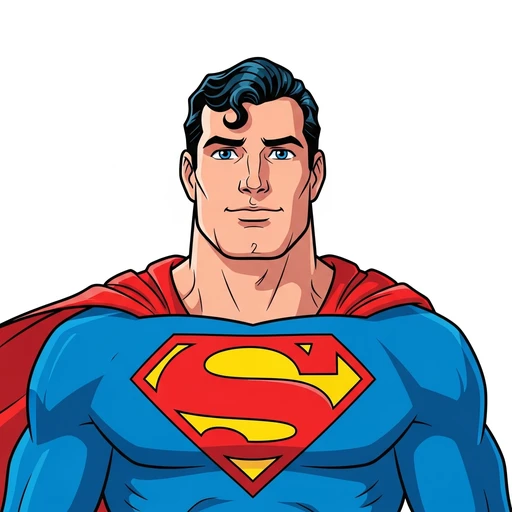
Doomsday Battle
There was no warning. There never was, with Doomsday.
One moment the highway east of Metropolis was quiet — a Tuesday afternoon, the kind where the clouds are soft and people are listening to the radio on their way home. The next moment, something landed in the middle of it from somewhere overhead, and the sound was KRAKOOM, like the world had been struck with the world's largest hammer.
And Doomsday rose from the crater.
He was ancient. He was huge. He was covered in bony protrusions — spikes and ridges and armor that had evolved across millions of years of pain, each iteration harder than the last, a creature that had been destroyed and reborn so many times that death itself no longer applied to him. He was from Krypton's prehistoric past, from a time before cities and science, when survival meant becoming the most indestructible thing that existed.
The Justice League responded first, because the Justice League always responds first.
Aquaman held the sea wall. Wonder Woman moved civilians out of the impact zone in great sweeping arcs, her golden lasso clearing paths through the crowd. The Flash ran supply lines and evacuation routes faster than any bus or truck could manage. Batman coordinated from the air in the Batwing, voice calm in every earpiece, redirecting resources.
One by one, they threw everything they had at Doomsday. One by one, they fell back.
He adapted to every blow. That was his terrible genius — not intelligence, not strategy, but something older and more frightening: the ability to become unbeatable by whatever had hurt him last. Wonder Woman's Lasso of Truth could bind him once. After that, his grip simply broke it. The Flash's vibrations rattled him for three seconds, and then his joints locked to absorb them. He was evolution in overdrive, and the League was running out of options.
Superman arrived above Metropolis in a streak of red and blue, moving faster than he usually did, and the sight of him — even from miles below — made a crowd of frightened people watching from a parking structure exhale as one.
He found Doomsday on the outskirts of the city, already moving toward downtown. He could see the Daily Planet globe in the distance. He could see the apartment buildings, the parks, the streets he had walked a thousand times. He could see, in a flash of super-vision, Lois's car parked in the garage on Forty-Third.
He set his feet.
BOOM — the impact when they met was a shockwave that shattered every window for three blocks in every direction. Glass fell in cascades, catching the afternoon light like rain. Superman held his ground, driving Doomsday back, pushing him away from the city with everything he had. Doomsday pushed back.
The fight was immense and terrible and — up close, in real time — almost impossible to follow. They moved at speeds that left glowing trails in the air. The pavement buckled beneath their feet. Buildings along the path trembled. Superman hit Doomsday with force that would have leveled a mountain, and Doomsday stood up and grew three new bone ridges where the blow had landed and came back harder.
But Superman did not give up.
He did not give up because he could see the frightened faces at the windows of the apartment building on Elm Street. He did not give up because he could hear, through all the sound and fury, a small child crying in a basement two blocks away and a parent's voice saying it's okay, it's okay, Superman is here. He did not give up because giving up was not something he knew how to do.
The final exchange happened in the shadow of the Daily Planet. Both of them battered, both of them slowing. One cataclysmic blow from each — KRAKOOM — a shockwave that flattened the cars in the street and cracked the road and blew the windows of the Daily Planet inward in a thousand sparkling pieces.
And then it was quiet.
Superman lay still on the pavement. Lois was there in moments — she was always there, always brave, always first. She held him in her arms in the silent street.
But the spirit of a hero does not end like that. It can't. Because a hero is not just a person — a hero is an idea. An idea of what is possible. An idea that you run toward the thing that frightens you, that you place yourself between the storm and the people you love, that you do not stop.
That idea does not have a last breath.
In the weeks that followed, something happened across Metropolis. New volunteers appeared at shelters. New donors called the hospital. Young people stood up straighter, spoke more kindly, stepped in when someone needed help. Something had caught in the air of the city like a warm wind, and it spread.
Superman returned.
He always returns. The spirit of a hero is eternal — and everywhere — because it lives in every person who looks up at that red and blue streak in the sky and thinks: yes. That is what courage looks like. And then turns, and tries.