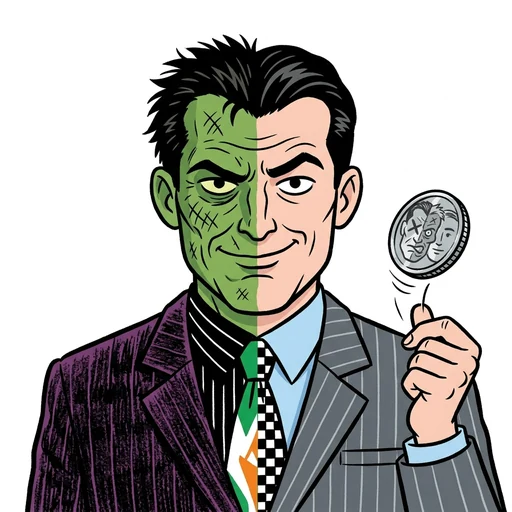
The Split Suit
Once upon a time, in a tailor's shop somewhere in Gotham City, the strangest suit anyone had ever seen was carefully stitched together.
It was split exactly down the middle. One half was a sharp, elegant charcoal-grey — the very same color Harvey Dent used to wear when he stood up in court, fighting for what was fair. The other half was a deep, unsettling purple — a color chosen for a different half of him, the half that no longer followed the rules the way it once had. Even his shoes did not match. Even his tie was cut clean in two, grey on one shoulder, purple on the other. Tailors around Gotham City whispered that he had it made the very same week he chose his new name, refusing to hide behind an ordinary disguise the way some villains might.
But this suit was never simply a costume. It was a message, sewn into every seam.
Two-Face wanted the whole world to see both halves of him at once, right there in plain sight. The man who had once fought for justice in a courtroom. And the man that a terrible accident had left behind. He kept his scarred silver coin tucked into the purple side's breast pocket, close to the half of him that flipped it before every decision. And on the other side, tucked quietly into the charcoal pocket, he kept something else entirely: a small, folded photograph from his old life as Gotham City's district attorney, close to the half of him that still remembered who he used to be.
Even his hideouts followed the same careful pattern. Sometimes Two-Face ran his schemes from two matching warehouses, standing on opposite sides of the Gotham City docks. Sometimes from a single building split precisely down a long hallway — one side dressed up to look like a courtroom, with old wooden benches and a judge's stand, the other side left bare and cold, nothing but shadows and dust. Commissioner Gordon once joked, after raiding one of these hideouts with his officers, that it felt less like one crime scene and more like two, stitched carefully together at the seam.
Whenever Batman finally caught up with him, Two-Face was brought back, gently but firmly, to Arkham Asylum — a tall stone building standing quietly at the edge of Gotham City, a place built to help those who needed more care and patience than an ordinary prison could give.
Even his cell followed the same pattern. One half was tidy and calm, lined carefully with old law books he had specially requested from the library. The other half was scattered and restless, papers here and there, nothing quite settled. The doctors at Arkham Asylum worked with him for years, trying gently to help him find some kind of balance between his two halves. And though he always seemed to slip back into old patterns before too long, the doctors never once gave up trying. Not one single time.
Batman, more than almost anyone, had come to understand something important about that strange split suit. It told a truth that Harvey could not always say out loud himself: that he was not simply good, and not simply bad. He was a man still standing, however unsteadily, right there in the space between the two — the same space every person carries somewhere inside them, even if most people's halves don't show quite so plainly on the outside.
And here is a small, hopeful secret, the kind you might only notice if you were looking closely. Even Commissioner Gordon began to notice small changes over time. A charcoal cuff pressed just a little neater than before. A purple lapel left just a touch less sharp. Small things, easy to miss if you weren't paying attention.
But Batman believed, quietly and steadily, that in a life built so entirely around halves, small things were exactly where hope liked to hide — waiting patiently, the way hope always does, for the day it might finally be found.
Every night, as Batman patrolled the rooftops of Gotham City, he passed the tall stone walls of Arkham Asylum and thought about that split suit hanging quietly in a locked closet somewhere inside. One day, he told himself, someone might open that closet and choose only the charcoal-grey. Until then, he would keep watching, keep hoping, and keep believing that a man made of two halves could still, someday, choose to become whole again.