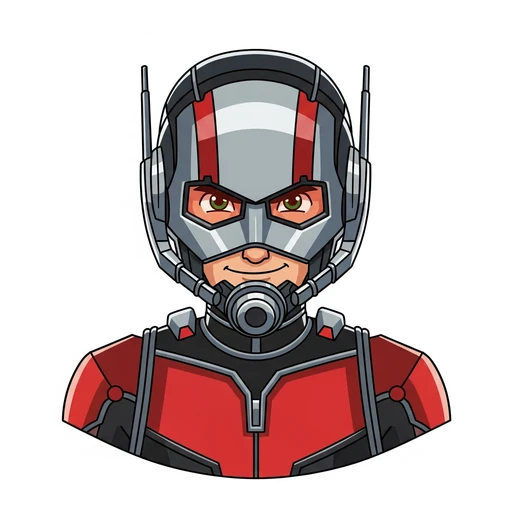
Yellowjacket
Darren Cross had spent years trying to become Hank Pym.
Not literally — not the person, the white hair and the decades of complicated history. But the achievement. The discovery. Hank Pym had done the impossible: he had found a way to change the distance between atoms while preserving the mass and density of whatever those atoms made up. The Pym Particle. The most extraordinary scientific discovery of the twentieth century, and Hank Pym had kept it locked in a vault instead of sharing it with the world.
Cross was going to do better.
He had been Hank's protégé — smart, driven, capable of doing the work. Hank had seen something in Cross's ambition that eventually worried him, and he had withdrawn from the mentorship in the way experienced people sometimes withdraw when they recognize that a talent is paired with a character they cannot trust. Cross had never forgiven this.
He built a corporation from the foundation of skills Hank had given him. He filled it with researchers. He gave them resources. And he pursued the Pym Particle with the absolute focus of someone who needed to prove something more than they needed to understand it.
The Yellowjacket suit was his answer. Sleek, armored, green and black, with plasma cannons built into the gauntlets and mechanical stingers extending from the back — designed not for protection or stealth, but for military application. For sale to the highest bidder. Hank Pym had said the particle was too dangerous to weaponize. Darren Cross intended to weaponize it and get very, very rich in the process.
But the shrinking formula was not quite stable. This turned out to matter.
Can you picture Scott Lang's first glimpse of the Yellowjacket suit — locked in its display case in the center of Cross's headquarters, green-lit and humming — and understanding immediately that if it left that building, there would be consequences that wouldn't be undone easily?
The mission: get in, steal the suit, destroy the technology, get out. Do not let this exist in the world.
Cross was ready for him, because Cross had been tracking unusual activity in his building for days. When the confrontation came, it was personal in a way that most battles aren't — Cross carrying twenty years of resentment at Hank Pym, and Scott standing between Cross and what he wanted.
The battle went small.
Not as a metaphor — literally small. Into a briefcase. Inside that briefcase, at the scale of an ant, a corporate briefcase became a maze the size of a house. The floor was canyons. The zipper was a mountain range. Two suited figures — one shrunk by design, one by a technology not quite fully controlled — fought through this impossible architecture, each trying to find the angle that ended it.
Then they were in a child's bedroom. At full scale? Toys were toys. Ant-sized? A toy train was a locomotive thundering toward them with CRASH-CRASH-CRASH impact. The model railway set was a real railway, and the impact of tiny bodies against model cars at speed was not, from the inside, model-sized at all.
Cross targeted Cassie. In the chaos and fury of his complete loss of restraint, he went for the thing that would hurt Scott most, the small girl who was Scott's entire reason for doing any of this. Scott did not retreat. Scott went deeper than he had ever gone — smaller than the suit was designed to safely take him — into the subatomic place that existed below the quantum threshold, where the rules of physics became suggestions and matter itself became uncertain.
He found the gap in Cross's suit. He made it work.
Cross's unstable technology turned against itself. The Yellowjacket suit did what imprecise shrinking technology does when it goes wrong.
Cassie was safe. The suit was gone.
Character matters as much as power, Hank Pym had always believed. Cross had proven him right, in the worst possible way.
Scott came back from the subatomic void by replacing his shrinking regulator with an enlarger — improvising under conditions that should not have permitted improvisation.
He had no explanation for how exactly he'd managed it.
Sometimes that is the honest answer.