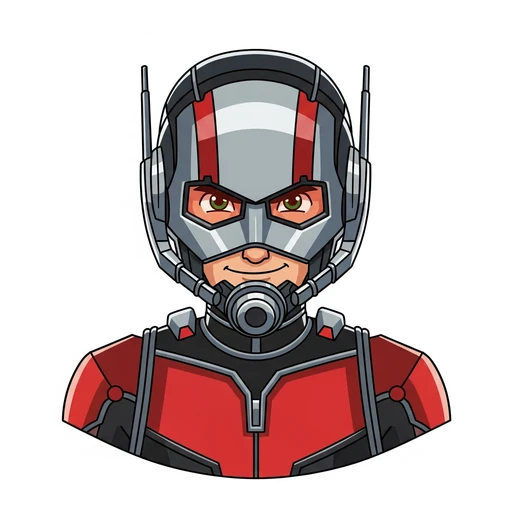
Pym Particles
Here is a scientific fact that sounds like magic: when you are the size of an ant, you punch like you are full sized.
This is what Pym Particles do, and it is remarkable. The particles — discovered by Dr. Hank Pym in research so extraordinary that no one else has managed to replicate it — work by reducing the distance between atoms. Everything is mostly empty space, even things that feel solid. Pym Particles find all that space and compress it, bringing atoms closer together until what was six feet tall is now half an inch tall. The mass — everything that makes up the person, all the weight and density and biological function — stays exactly the same.
So Scott Lang, shrunk to the size of a carpenter ant, weighs the same as Scott Lang standing at his full height. When he throws a punch at the size of an insect, the force behind it is a full-grown adult human male's punch, concentrated into a point the size of a pinhead.
CRACK. That is what it feels like on the receiving end.
The suit carries Pym Particles in the belt and wrists — deployable with a press that Scott learned, over weeks of training, to execute without thinking. Shrink on the way down, grow on the way back up, mid-leap if necessary. Packages that need to be transported can be miniaturized to the size of a coin and grown back to full size at the destination. Vehicles can be shrunk to fit in a pocket. And in the other direction — Blue discs deploy the expansion particle, growing things that should be small into things that are enormous — a toy tank becomes a real tank, briefly, for a demonstration that left Cassie slightly speechless and very delighted.
The cybernetic helmet is the other piece. It communicates with ants through a combination of pheromone release and electromagnetic pulses — a frequency that ant antennae receive and process as directional information, allowing Scott to send them goals and intentions rather than specific commands. The ants figure out the best way to execute the goal themselves. This turns out to be more effective than micromanaging, which Scott found philosophically consistent with his general approach to most things.
Different ant species have different specialties. Carpenter ants are the big ones — the ones with wings, the ones that are willing to carry Scott through the air on missions that require aerial transportation. They are strong, reliable, and have an impressive wingspan relative to their body size. Ant-thony was the first and most beloved of these. She had a very specific flying style that Scott came to recognize, a slight tipping motion on right turns that he always braced for.
Fire ants are offensive specialists. They form living bridges and living rafts with their interlocked bodies — collective structures that hold weight far beyond what any individual ant could manage. They sting. They are not gentle about this.
Crazy ants are Scott's favorite for technical missions. They are, uniquely among ant species, capable of withstanding electrical current — their bodies can handle voltages that would be instantly lethal to other ants. This means they can be sent directly into computer systems and electronic equipment to disrupt, jam, and sabotage. A cloud of crazy ants introduced to an enemy's communications system produces results that are difficult to explain to the people whose communications system just stopped working.
Scott came to all of this with skepticism and left with genuine affection. The ant world, it turned out, operated on principles of collective intelligence and coordination that he found both fascinating and, once he understood them, deeply useful. The ants find the most efficient path to a goal without being told which path to take. They optimize naturally, constantly, and collectively, in ways that make Scott's job easier and the mission more likely to succeed.
He mourned Ant-thony. And Ant-tonio. And Ulysses. These were teammates as real as any he had fought alongside, and the loss of one mattered.
He is the steward of Hank Pym's legacy — the one person trusted with this technology in the field. He takes that seriously. Not by being solemn about it, necessarily. But by using it the way it was meant to be used: to protect, to connect, to solve problems that size and strength alone cannot solve.
The Pym Particle is the greatest discovery no one knows about.
Scott Lang is very glad he accidentally pushed the button that day.