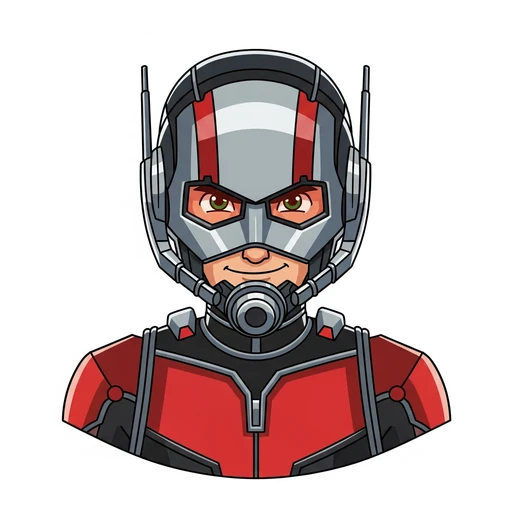
The Wasp Partnership
The first time Hope van Dyne watched Scott Lang operate the Ant-Man suit, she had several thoughts. They were not enthusiastic thoughts. She communicated them precisely, which was her way of doing most things.
Hope had grown up with this technology. Her father, Hank Pym, had invented Pym Particles and had been the first Ant-Man. Her mother, Janet van Dyne, had been the first Wasp — had pioneered the Wasp suit with its bio-electric stingers and wing systems before a mission had taken her into the Quantum Realm, where she had been lost for decades. Hope had been told, growing up, that her mother was gone. She had built a life around this loss, and around her complicated relationship with her father, and around an expertise in Pym technology that she had developed on her own, without anyone's help or permission.
She had expected to wear the Ant-Man suit for Hank's mission. She had expected this reasonably, since she was clearly better qualified than Scott Lang in every technical respect. Her father had chosen Scott instead. This was not a decision she agreed with.
She taught Scott anyway. This said something important about Hope van Dyne.
Partnership took time. It was not instant — it was built through shared danger and the gradual discovery that two entirely different approaches to a problem could, when combined, produce results that neither alone would reach. Scott's ground infiltration and Hope's aerial capability divided the battlefield in ways that made both of them more effective. When she came at an enemy from the air — WHOOSH, her wings folding and unfolding with precise mechanical grace, her stingers delivering focused bio-electric discharges, ZAP — Scott was already at the ground level using the chaos she created. When he needed a window, she made it. When she needed a distraction, he was already there.
The scale-shifting worked in unison — both of them expanding and shrinking with coordinated timing, the attack patterns emerging from this combination so unpredictable that opponents could never establish a defensive stance that worked for more than a moment. They developed this together, in practice and in the field, refining it through experience the way musicians refine an improvisation until it becomes a composition.
Hope pushed Scott. This was constant, intentional, and useful. She saw what the Ant-Man mantle could do when operated by someone who fully understood its potential, and she held Scott to that potential even when he found it inconvenient. She was not interested in "good enough" when "excellent" was achievable with more effort.
Scott gave Hope something she had not expected to need: perspective. He found humor in situations she would never have thought to find humor in. He approached her father's technology with the wonder of someone encountering it fresh, without decades of complicated feelings about what it represented, and sometimes that fresh view produced an angle she would have walked right past. He cared about Cassie — openly, completely, making no apology for it — and watching the uncomplicated nature of that love reminded her that there were things worth protecting beyond the mission, beyond the technology, beyond the inherited weight of the Pym family history.
The Wasp suit — when it was finally Hope's, as it was always meant to be — fit her the way things fit people who were made for them. The wings gave her a freedom of movement in three dimensions that nothing on the ground could match. The stingers were precise, controllable, calibrated to exactly the output she intended. She wore it with an ease that was not arrogance — just competence fully inhabited.
Janet van Dyne's legacy as the original Wasp was the invisible foundation of everything Hope did in that suit. Every mission was, in its own way, a continuation of her mother's work.
Together, Ant-Man and the Wasp were proof of something worth knowing: that strength comes not from soloing, not from being the best individual, but from finding the person whose strengths complete yours — and choosing to trust them.
They were better together. Both of them knew it. Neither one had initially expected to feel this way.
This, too, said something important about both of them.