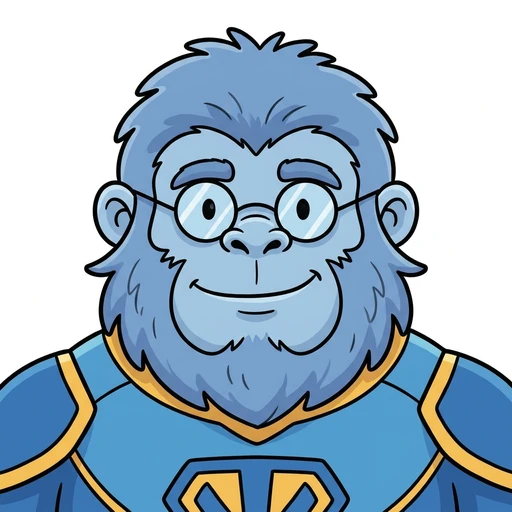
Origin
Once upon a time, in the small town of Dunfermline, Illinois, a baby was born with the biggest hands and the biggest feet anyone in the hospital had ever seen.
The doctors scratched their heads. The nurses whispered to each other. But his parents — Norton and Edna McCoy — just looked at their baby boy, and smiled, and said, "Hello, Hank."
As Hank grew, those big hands and feet turned out to be the most extraordinary things about him — except, perhaps, for his mind.
Because Hank McCoy was not one kind of extraordinary. He was every kind at once.
He could run faster than the school track team. He could leap over the gymnasium from a standing start. He could hang upside down from the monkey bars and solve mathematics problems in his head. And when the school day was done, he would curl up in the big armchair by the window and read — histories, and science, and poetry, and stories about the farthest corners of the world.
His father, Norton, had worked at a nuclear plant many years ago, and the radiation there had changed something deep in their family's future. Hank was a mutant — a person whose body could do things ordinary bodies could not. He didn't know the word for it yet. He just thought of himself as Hank: a boy with big hands, big feet, and a bigger curiosity about the world than he ever knew what to do with.
At Waukegan High School, he became a legend on the football field. His teammates could not believe the catches he made, the leaps he took, the way he seemed to fly across the turf without ever quite touching the ground.
And then one autumn afternoon, everything changed.
Some very bad men — a criminal group who called themselves the Conquistador — arrived at the football game. They took Hank's parents. They said they would hurt them unless Hank agreed to work for them.
Hank stood very still for one long moment.
Then he moved.
He leaped. He spun. He rolled and ducked and swung, faster than any of the Conquistador's men could follow. One by one they fell back, until every last one of them had been stopped. His parents were safe. The danger was over.
Hank stood there in the middle of the green field, breathing slowly, and understood something for the very first time. He was not just an unusual boy. He was a mutant — and his abilities were not just for football games and science fairs. They were for something much larger.
Far away, in a beautiful old building in Westchester, New York, a man named Professor Charles Xavier was already nodding to himself.
Professor Xavier had a gift of his own — he could sense the thoughts of others, gently and kindly, the way you might hear a song drifting through an open window. He had been watching young Hank McCoy for a long time. He knew what Hank was, and he knew what Hank could become.
He sent Hank a letter of invitation to his school — the Xavier Institute.
Hank read it twice. Then he packed his books.
The Xavier Institute was not like any school Hank had ever seen. Its halls were full of young people who could do extraordinary things — Scott Summers, who could fire beams of energy from his eyes; Jean Grey, who could move objects with her mind; Bobby Drake, who could cover the world in ice; Warren Worthington III, who had great white wings and flew like an angel.
And Hank McCoy, who could leap to the ceiling, swing between pillars, and recite Shakespeare while doing so.
Together, they became the X-Men.
Hank wore a blue-and-yellow uniform and chose the name Beast — not because he was frightening, but because it made him smile. He was the largest, the leapiest, the loudest laugher on the team. And when the battles were done and everyone was tired and glad to be safe, Hank would sit at the long wooden table in the Xavier Institute's dining room and tell stories, and quote poetry, and make everybody feel a little better about the world.
Professor Xavier would watch from the doorway and think to himself: yes. That is exactly who I hoped he would be.
And somewhere out in Dunfermline, Illinois, Norton and Edna McCoy would look up at the stars and whisper to each other, "That's our Hank."
He was. He always would be.