Scholar And Hero
Once upon a time, on a perfectly ordinary Tuesday at the Xavier Institute in Westchester, a new student named Petra arrived at the school for the very first time.
She had just found out she could move through solid walls. This was extremely alarming. She had fallen through her bedroom floor twice that morning and had to be helped back up through the kitchen ceiling by her very startled mother. Now she stood in the front hall of the Institute with her bag and her worried face and absolutely no idea what happened next.
And then, from somewhere above her, a cheerful voice said: "Ah! You must be Petra. Welcome. I'm Hank."
She looked up.
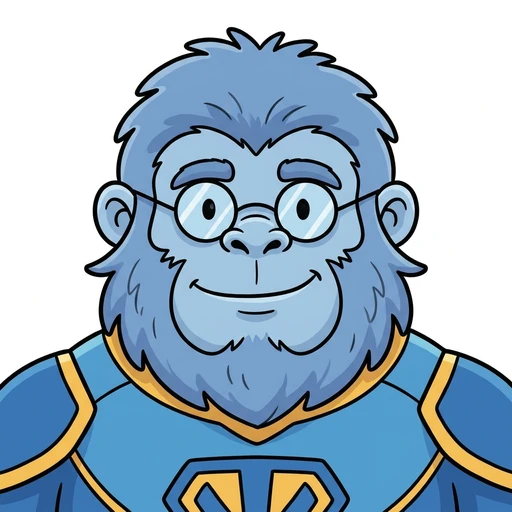
Hank McCoy was hanging upside down from the banister of the first-floor landing, holding a very thick book on solid-state physics. His blue fur was neat. His glasses sat slightly askew because they kept sliding when he was inverted. He was grinning widely, fangs and all, and did not look even slightly embarrassed about the situation.
"I find I think better this way," he explained, completely seriously. "Do you want some tea? I was just about to make some."
Petra blinked. Then, despite everything, she smiled.
This was the effect Hank McCoy had on people.
He climbed down from the banister — easily and smoothly, the way some people step off a curb — and led her to the kitchen, where he put the kettle on and pulled two mugs from the shelf with the gentle precision of very large hands that had learned, over many years, to be careful.
He asked about her old school. He asked what subjects she liked. He listened — really listened, the way adults sometimes forget to do — and when she said she loved art but wasn't sure she was clever enough for a school full of scientists, Hank looked at her over his mug with his bright yellow eyes and said:
"The most important thing I ever learned about science is that curiosity is far more useful than cleverness. The doctoral degrees come later."
He said this completely casually. As though everyone had two doctoral degrees. He had two.
Hank McCoy had spent his whole life being extraordinary in ways that didn't always look like ordinary gifts.
He could run, leap, and somersault with an agility that defied any reasonable expectation. He held doctorates in biophysics and in biochemistry, earned before the age of twenty-three. He could discuss genetics with Nobel laureates and then, in the same breath, recite long passages of Shakespeare and Walt Whitman from memory — and often did, in the middle of battles, which his teammates found both impressive and slightly startling.
He could build a biochemical antidote while simultaneously bouncing between two thirty-foot Sentinels and calling out their weak points to Cyclops. He kept his bookshelves organized by subject and by emotional weight: serious science on the left, poetry in the middle, detective novels on the right for Fridays.
He was also, quietly, an extraordinary cook. The Xavier Institute dining room was at its warmest on the evenings Hank offered to make dinner. He had once made a Moroccan lamb dish so extraordinary that Bobby Drake — Iceman, who had never in recorded history been at a loss for words — went completely quiet for nearly ten minutes.
Ten whole minutes of silence from Bobby Drake. Hank considered it one of his finest achievements.
When new students arrived at the Xavier Institute — frightened, uncertain, carrying their mutations like something heavy — it was Hank who sat down with them. Hank who asked what they loved. Hank who told them, from genuine experience, that the things about you that seem strangest are often the very things that make you rare.
Petra stayed at the Xavier Institute. She learned to walk through walls on purpose. She found out that she loved botany as much as art. Years later, she published a paper on the biology of mutant plant growth and dedicated it to Professor Xavier and to the large blue person who had been hanging upside down from the banister on the day she arrived.
In the acknowledgments she wrote: "He made me feel, in the space of one cup of very strong tea, that I had found somewhere I belonged."
There is, Hank McCoy had always believed, no more important work in the world than that.