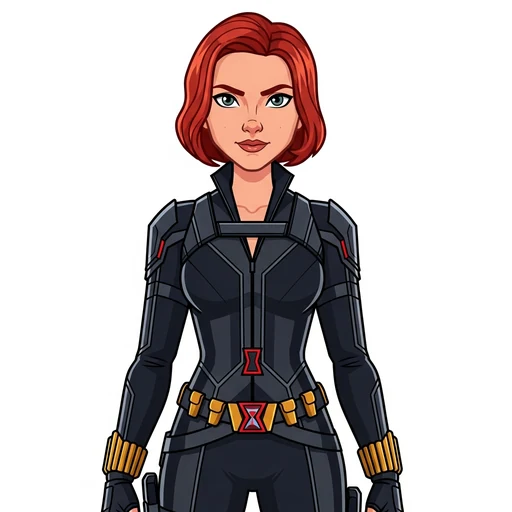
Taskmaster
Imagine fighting someone who fights exactly like you.
Every move you make, they have already made it. Every combination you throw, they are already countering before your fist leaves your shoulder. Every technique you practiced for a thousand hours in a training room — they watched it once and now they can do it perfectly. Perfectly. As if they had been there for every one of those hours right alongside you.
This is what it is like to fight Taskmaster.
Taskmaster is a mystery wrapped in a mercenary. He appears without warning at the worst possible moments, hired by the kind of organizations that prefer their problems solved quietly and completely. He wears armor that conceals every identifying feature, and behind the helmet, his face is as unknown as his real name. What he does have — what makes him perhaps the strangest fighter alive — is photographic reflexes.
Watch him fight once. Just once. And every move he observes is locked in his body as perfectly as if he had drilled it a thousand times himself. He watched Captain America fight from a recording and now he can throw a shield like Captain America. He observed a video of Black Panther in motion and now he can move with that same panther-fluid precision. He has absorbed combat styles from fighters across the world, and he deploys them on demand, switching between them mid-fight like a musician who has memorized a hundred songs.
When Natasha crossed paths with him — during the takedown of a covert smuggling operation, where Taskmaster had been hired to protect the people she was there to expose — it was unlike any fight she had been in before.
He mirrored her.
She threw a combination she had learned at age eleven in the Red Room — the one drilled into muscle memory over years until it happened before she consciously decided to do it — and Taskmaster was already in the defensive position before she completed it. She shifted to a technique from a different school entirely, one her S.H.I.E.L.D. training had layered over the Red Room's foundation. He shifted with her. CRACK, CRASH — the sound of a fight between two people who knew the same language, parsing faster and faster to find the word the other didn't have.
But here is what Taskmaster couldn't copy.
He could copy the physical motion. He could not copy the mind behind it. He couldn't copy Natasha's years of improvisation — the moments she invented a new technique because the old one failed, the times she combined two styles in a way that had never been done before simply because the situation required it. He couldn't copy the decision-making of someone who had operated in chaos for years and learned, in that chaos, to trust instinct over habit.
She stopped fighting the way she had trained to fight. She fought the way she had never been trained to fight — unpredictable, asymmetric, reaching for combinations that didn't have a name yet because she was making them up in real time. She talked to him while they fought: casual observations that pulled his attention half a degree off-center, that made his predictive system hiccup for the crucial half-second she needed.
The rhythm broke. She found the angle he didn't have a response for.
Every time she encountered Taskmaster after that, she came in differently than the time before. She never repeated. She evolved, deliberately and specifically, choosing the unpredictable because she now understood that unpredictability was a weapon he had no way to absorb.
He can copy what you have been, she understood. He cannot copy what you are becoming.
This is the advantage of a mind that learns over a body that merely mimics.
She used it every time.