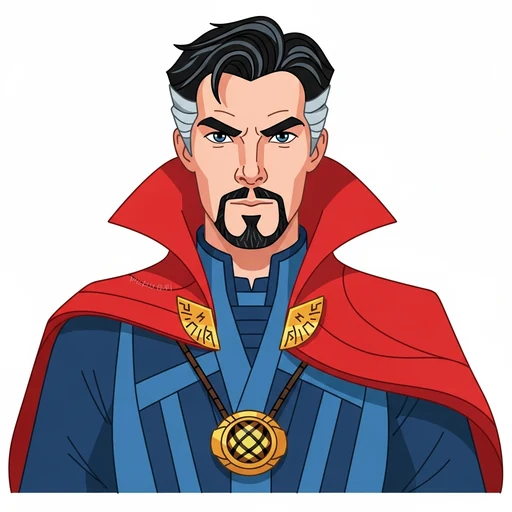
Kamar Taj Training
The first lesson at Kamar-Taj was not a spell.
It was a question: What do you think you know?
The students sat on stone floors in early morning, the Himalayan mountains rising in every direction beyond the courtyard walls, the air cold and sharp and very awake. The Ancient One walked among them slowly. She did not carry a book or a staff or anything that looked like it could teach magic. She just looked at each student for a long moment with those calm, fathomless eyes.
What do you think you know?
Because the first task at Kamar-Taj was not to learn. It was to unlearn.
The world most people grew up in had rules. Solid rules. Physics. Mathematics. The reliable behavior of objects under consistent conditions. These rules were useful. They described a large portion of reality accurately. They were also, from the perspective of the Mystic Arts, an almost comically small slice of what was actually true.
New students arrived at Kamar-Taj with heads full of what they were certain about. The Earth was solid. Time moved in one direction. Walls could not be walked through. Magic was a children's story. The Ancient One's first job was to gently, systematically take every one of these certainties and show the student the door behind it — the vast, humming, alive multiverse that their certainty had been blocking from view.
Strange arrived with more certainties than most. He was a neurosurgeon. He had spent his life in the most precise, evidence-based domain imaginable. He arrived at Kamar-Taj skeptical and impatient and demanding results. The Ancient One pushed his consciousness out of his body the first time they met — through seven or eight layers of reality in rapid succession — and Strange came back to himself on the courtyard floor, gasping, all his certainties temporarily scattered.
Then his surgical mind kicked in, and he started taking notes in his head.
He absorbed Kamar-Taj's curriculum with terrifying speed. The Book of Cagliostro — one of the foundational texts of the Mystic Arts — required students to memorize intricate symbol systems and their dimensional meanings. Strange did it in a fraction of the expected time. Every gesture for spell construction needed to be exact: the wrong angle of a hand could mean a protection spell became something else entirely, which was unfortunate for everyone nearby. Strange's surgical precision translated perfectly. His hands, which had lost their certainty as operating tools, found a new purpose.
The Sling Ring was early and essential. A simple-looking device worn on the fingers — it generated a spinning portal of golden energy, a WHOOSH of displaced space, connecting two points in the world in an instant. Most students needed weeks to open a stable portal. Strange had one open in days, which impressed his instructors and irritated Mordo slightly.
The Cloak of Levitation required a different kind of skill: not precision but presence. The Cloak didn't want to be controlled — it wanted a partner. Strange had to stop instructing it and start listening to it, which was not his natural inclination. But he learned.
And then there was dimensional combat: fighting on surfaces and in spaces that defied ordinary physics, battling in the mirror dimension — a parallel reality of fractured glass planes and impossible angles where buildings folded like origami and the sky was below and above simultaneously. Strange was thrown into the mirror dimension on a Tuesday and managed to find his way back out by Thursday, which the Ancient One noted with some approval.
Through it all, Kamar-Taj gave him something his surgical career never had: peace. Not the absence of difficulty — there was plenty of difficulty. But a sense of place, of belonging to a tradition larger than himself. Of knowing that the work mattered for reasons beyond his own achievement. Mordo was there, demanding and precise. Wong was there, steady and knowledgeable. The Ancient One was there, offering wisdom in small doses, letting Strange arrive at the important conclusions himself.
He found purpose in those Himalayan mountains that he hadn't known he was missing.
True mastery, he learned, requires both the intellect and the spirit — the precision of thought and the courage to abandon what you were certain you knew.
And then, quietly, to begin again.