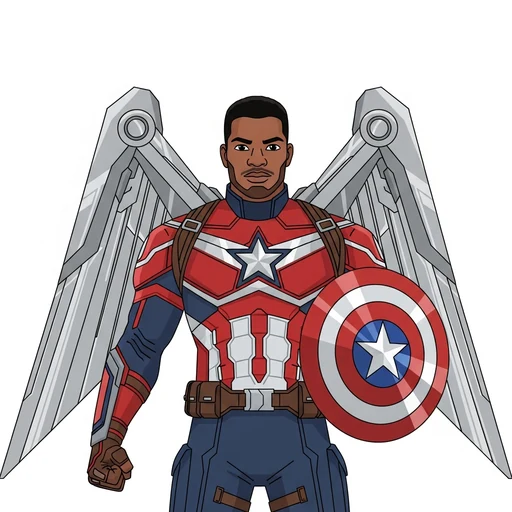
Facing Red Hulk
Sam Wilson had been Captain America for only a few months when the most difficult day of his career arrived.
To understand what happened that day, you have to understand the man at the center of it. President Thaddeus Ross had been a soldier for most of his life. He had spent years chasing Bruce Banner across continents, hunting the Hulk with helicopters and tanks and entire armored battalions, convinced — sincerely, urgently, completely — that the world would be safer if the green giant could be contained. The years had not been gentle to him. By the time Ross stood on a January morning with his hand on a Bible and was sworn in as the forty-seventh President of the United States, his hair was iron gray, his uniform had been traded for a tailored suit, and his temper, although mostly hidden behind state dinners and press briefings and carefully scripted speeches, was still the temper of a man who believed deep down that every problem could be solved by being louder than it.
Sam Wilson, in his very first months as Captain America, had to figure out how to work with him.
It was not easy. The two of them disagreed about almost everything. Ross wanted heroes registered, tracked, accountable. Sam wanted heroes free to act on their conscience. Ross wanted firm borders. Sam wanted gentle ones. But they were also both, in their own ways, men who loved their country and wanted to protect it. So they had a working relationship — tense, careful, civil — and they tried to keep the disagreements out of the press.
What Sam did not know — what nobody knew — was that a quiet, brilliant, dangerous man named the Leader had been planning something for years.
The Leader was a scientist with an oversized green head and an oversized green grudge. He had once been at the heart of the very first experiments that turned Bruce Banner into the Hulk. He had spent the decades since plotting. And during those decades, he had managed, very quietly, to plant a seed inside Thaddeus Ross.
It was a tiny piece of gamma-experiment technology, dormant for years, sitting deep in Ross's body and waiting for the right moment to wake up. The Leader's plan was simple. Push Ross. Push him. Push him. Engineer a crisis terrible enough to crack his temper open. And when the moment was just right — the seed would bloom.
That moment came on a single terrible evening at the White House.
There was a state dinner that night. Important guests. Long-stemmed glasses. A military band playing softly. Servers in white gloves moving between the tables. The kind of evening where every detail is planned three weeks in advance and nothing is supposed to go wrong.
And then several things went wrong at once.
There was an attack near the East Gate. There were rumors, sweeping across phones and into earpieces, that a war was about to begin. There were loud voices in the hallway and bright camera flashes through the windows and aides whispering urgent updates into the President's ear. Too much. All at once. Too much.
And deep inside President Thaddeus Ross, the Leader's old experiment quietly, terribly, woke up.
It started in his hands. They began to shake. Then his face flushed. Then his skin — slowly at first, then all at once — turned a deep, glowing crimson. His suit ripped at the shoulders as muscle tore through fabric. His eyes began to shine like the open doors of a furnace.
The President of the United States grew. And grew. And grew. Until he was eight feet tall and not a President at all anymore, but something the news cameras would, in the next hour, name on every screen in the country: the Red Hulk.
The state dinner became chaos. People ran for the exits. Glasses shattered. The military band, professional to the last, kept playing for about four bars before they too set down their instruments and ducked.
In the middle of all of this, Sam Wilson did not panic.
Sam had trained for impossible mornings his entire career. First as a pararescue specialist with the 58th Pararescue Squadron, lifting injured soldiers out of mountain valleys at night. Then as the Falcon, banking through skies that other pilots considered unflyable. Now as Captain America, with the shield on his arm and the weight of a country on his shoulders. Sam looked at the chaos. He took one deep breath. And he went to work.
First — civilians. He moved them. He directed the Secret Service to clear the dining room and the side halls and the lawn outside. He guided the band and the staff and the visiting diplomats down the back stairs to a secure sub-basement. He did this in under two minutes, calmly, without raising his voice once.
Second — cameras. He radioed Joaquin Torres, the new Falcon, who was patrolling D.C. airspace that evening. "Joaquin," Sam said, "every news helicopter in the sky. Push them off. Now." Joaquin acknowledged the order, banked into a clean dive, and within sixty seconds had personally escorted a dozen helicopters out of restricted airspace, away from the White House. WHOOOOSH. He did not want this fight broadcast as a spectacle. He wanted it to be quiet.
Third — the shield. Sam picked it up.
He walked, slowly and without running, out onto the South Lawn of the White House, where an eight-foot-tall red giant was stomping across what had been, until thirty seconds ago, a perfectly manicured rose garden.
Now listen carefully, because this is the most important part of the entire story.
Sam Wilson did not throw the shield at the Red Hulk.
He did not punch him. He did not try to take him down. He did not try to win.
He used the shield as a wall.
The Red Hulk swung. WHOMP — the vibranium caught the blow. The Red Hulk roared. CLANG — the shield deflected. The Red Hulk charged. Sam ducked, rolled, came up with the shield braced. BOOM. Sam absorbed. Sam slowed. Sam waited.
For thirty long minutes, Sam Wilson stood his ground on that lawn. He let the Red Hulk wear himself out. He never struck back. He never even raised his voice. He moved the way water moves around a boulder — patient, unhurried, undefeated.
Around them, the rose garden was wrecked. There was a crater near the South Portico. A statue had fallen sideways. But no one was hurt. No civilian. No Secret Service officer. Not even Sam himself. The shield had done what the shield was built to do. It had absorbed everything.
Eventually the Red Hulk slowed. He was panting. His chest heaved. The fury in his eyes flickered, just for a moment.
That was the moment Sam had been waiting for.
He stood up straight in the middle of the wrecked rose garden. He lowered the shield, just slightly. He raised one hand — palm open, not in surrender, but the way you raise a hand to a frightened horse.
"Mr. Ross," he said.
His voice was not loud. It carried the way a calm voice carries across a panicked room.
"Look at me. You can come back from this."
He said it the way he had said it, twenty years earlier, to grieving veterans in his small VA office in Washington. He said it the way he had said it to Karli Morgenthau, on a New York rooftop, in the last seconds before her life ended. He said it because he had been saying it, in one form or another, for almost his entire adult life.
The Red Hulk staggered. The Red Hulk breathed. The Red Hulk shook his huge red head, like a man trying to wake up from a dream.
And then — slowly, painfully, with the kind of effort it takes to climb out of a deep, cold pool — Thaddeus Ross began to shrink.
The crimson faded. The eyes dimmed. The muscle softened. The eight feet became seven, then six, then five-foot-nine again. The torn suit hung in shreds. The iron-gray hair stuck up at odd angles.
Thaddeus Ross sat down hard on the grass of his own ruined rose garden. His hands shook. He was breathing in long, ragged gasps. He could not look up.
Sam Wilson set the shield down on the lawn. He walked over. He knelt beside the President of the United States.
He did not gloat. He did not lecture. He did not say I told you so or you owe me one or even any of you should never have been allowed near this office. He just put one hand, very gently, on Thaddeus Ross's shoulder.
"It's all right, sir," Sam said. "I've got you. Take your time."
Above them, far above, Joaquin Torres circled in the dark sky with the news helicopters still firmly held at a distance.
A single White House camera, mounted on the roof, had caught all of it.
By morning, the footage was on every screen in the country. Not the fight — the moment after. A red, white, and blue figure kneeling on torn grass, beside a man in a ruined suit, with the wreckage of a rose garden behind them and a hand on a tired shoulder. There were no slogans. There were no headlines about a knockout punch. There was just the picture.
A lot of people in America had not understood, until that morning, what Sam Wilson had meant by picking up the shield. A lot of people had been waiting, suspiciously or hopefully, to see what kind of Captain America he was going to be. Now they knew.
He was not going to be a Captain who knocked his enemies down. He was going to be a Captain who called people back to themselves. Who refused to hurt the people who needed help. Who used the most famous weapon in the country as a wall instead of a sword.
That was the lesson Steve Rogers had handed him by the lake. That was the lesson Isaiah Bradley had been trying to tell him in Baltimore. That was the lesson Sam had spent his whole life learning, first as a pararescue, then as the Falcon, and finally as the man in red and white and blue.
The most powerful thing you can do for a person — and sometimes for a country — is stand patiently in front of them, refuse to harm them, and remind them, gently and clearly, who they are.
That is what Sam Wilson did on the South Lawn.
That is what real Captains do.