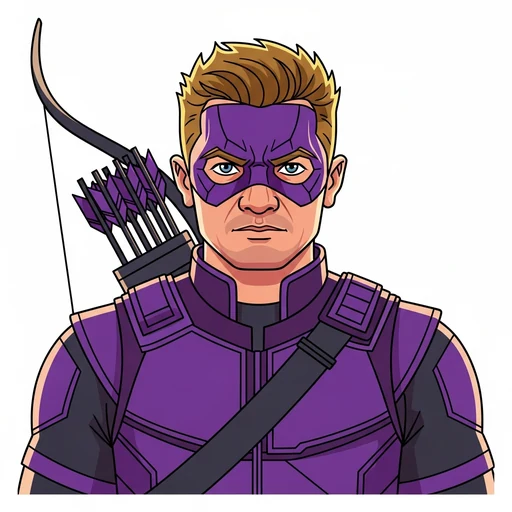
Avengers Marksman
From a rooftop, Hawkeye can see everything.
Not everything in the physical sense — a rooftop has its own limits of sightline and distance. But everything that matters: the shape of the engagement below, the direction the fight is moving, the moments that are about to become critical before they become critical. He spots them the way you spot a wave when you know the water — not by looking directly at the wave, but by reading the pattern of everything around it and knowing what it means.
He passes this information to the team. Constantly, efficiently, without ceremony. "Contact, your left, thirty meters, moving toward Cap." "Iron Man, the power coupling on the antenna above you. Take it out." "Black Widow, pause at the corner, one guard about to complete his circuit." The Avengers trust this data completely. It has been reliable too many times to doubt.
This is Hawkeye's role: the eyes in the sky. The silent guardian who makes the fight below go better without ever being where anyone thought to look for him.
He has stood on rooftops during alien invasions — the Battle of New York, when the Chitauri poured through a rift in the sky over Midtown Manhattan and the Avengers scrambled to meet something none of them had precisely trained for. Clint was on a building within sixty seconds of the engagement beginning. He did not ask permission or wait for coordination. He found the highest useful position, nocked an arrow, and went to work.
From that height, he could see what the people on the ground couldn't: that the Chitauri were moving in from the east, that the concentration was heaviest over Grand Central, that the pattern of attack would push civilians into a bottleneck two blocks north. He could redirect the team's attention before the bottleneck existed. He could protect the people who were about to be in danger before they were in it.
No margin for error. This is the constraint Clint lives with that the enhanced members of the Avengers don't experience quite the same way. Thor, struck by a blow that would level a building, gets up. Hulk, struck by essentially anything, gets up. Clint, struck wrong, does not have that margin. He has training and precision and a refusal to miss, and those things have to be enough.
They always have been.
But his role is more than fire support. He is the moral center of the team in the way that moral centers often go unnoticed — he is the one who checks in, who remembers that Tony Stark occasionally needs someone to ask how he's doing in a way that doesn't involve a mission briefing, who keeps track of which teammates are carrying something heavy and makes sure they know they're not carrying it entirely alone.
He fights to protect ordinary people. People like himself — no enhancement, no laboratory origin, no cosmic intervention, just a person living a life in a world that occasionally becomes extremely dangerous. His frame of reference is that person. Everything he does is measured against what it means for that person.
A father before a weapon. A friend before a soldier. These priorities shape every decision he makes in the field in ways that are visible, if you know what you're looking at.
He turned down the opportunity to retreat during the Battle of New York. He was asked, by someone with authority to ask, whether he needed to fall back and reposition. He looked at the street below, where civilians were still in danger, and said no.
He stood against alien invaders and robotic legions with a bow and a quiver of very clever arrows. He never retreated.
The most reliable hero, he has been known to say, is the one who never stops caring.
He says this and then goes back to watching the rooftops.
Someone has to.