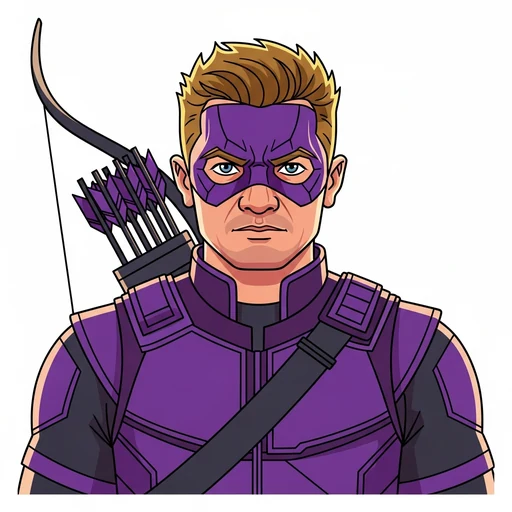
Ronin Identity
There was a day — half a second of blue-white light, and then quiet — and Clint Barton's farm went still.
He had been outside. His wife was inside. Their children had been nearby a moment before. He turned, and the silence where their voices should have been was the loudest thing he had ever heard.
This is how the Snap happened: suddenly, finally, without warning and without any explanation that helped at all. Half of all life. Gone. Not dead in any ordinary sense — no goodbyes, no last looks, no final moments to hold onto. Simply there, and then not there, between one breath and the next. Clint stood in his empty yard and the world that remained was a world he didn't know what to do with.
The bow he set aside. Not ceremonially — he simply couldn't look at it.
What he picked up instead was a blade. And a different kind of armor — dark, full-coverage, the face concealed beneath a mask. The name he chose for himself was Ronin, an old Japanese word for a warrior without a master, and it fit in the way that bitter things sometimes fit: accurately, uncomfortably, without comfort.
Ronin moved through the world for five years.
He targeted criminal organizations — the cartels, the trafficking networks, the syndicates that had thrived and expanded in the years since the Snap, operating in the spaces left by the half of law enforcement that had vanished. This was, by any external measure, a kind of justice. These were organizations that hurt people. Ronin stopped them from hurting more people.
But Clint knew — in the part of himself that he was actively refusing to listen to during those five years — that it wasn't justice he was after. It was punishment. Of himself, for surviving when his family hadn't. Of the world, for continuing when it should have stopped. The work was self-punishment wearing the face of vigilantism, and the violence he was comfortable with in those years was further from the Hawkeye philosophy than he had ever been.
He was in Tokyo when Natasha found him. He had just finished a confrontation in the rain, blade in hand, and she came out of the dark the way old friends come: without announcement, with the kind of presence that says I have been looking for you and I found you and this matters.
She told him there was a way. The Quantum Realm. Time travel, impossibly. The Infinity Stones, retrieval. Everything reversed. His family could come back.
Can you picture him? Standing in the rain in a dark city with a blade, wearing armor that covered his face, and Natasha Romanoff looking at him with the expression of someone who has crossed an ocean to tell a friend that hope is available, if he can reach for it?
He reached.
The bow came back. The Hawkeye identity came back, in the work that followed — the Time Heist, the battle at the Avengers compound, the journey to Vormir and everything that happened there.
He carried Ronin with him, after. Not the mask and the blade — those stayed behind. The memory of who he had been, what he had been capable of becoming under sufficient grief. He didn't hide from this memory. He looked at it clearly and used it the way painful knowledge is supposed to be used: to build more humility, more compassion, a more complete understanding of what loss does to people.
The Kate Bishop mentorship began with him being honest about Ronin. This was deliberate. He didn't want her to inherit a symbol without knowing what the person who carried it had also been. She deserved the whole picture.
Redemption requires returning to who you were, he came to understand — not who you were before the loss, because that person is gone too. But returning to the values. The precision. The care for people. The refusal to become the worst version of yourself and stay there.
He came back.
The hardest returns are always the ones that require passing through what you became to get back to what you are.
He made it.