Leader
If you were to draw a picture of the Hulk and the Leader side by side, you would draw the biggest difference imaginable.
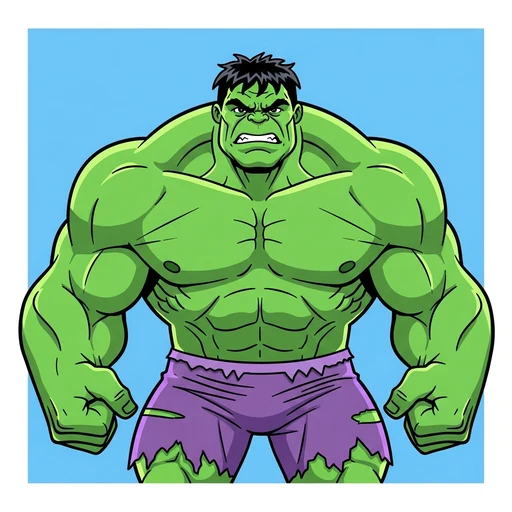
The Hulk: enormous, green, muscled like a mountain range, fists the size of boulders, not terribly interested in long conversations.
The Leader: green, yes, but slim. And his head — oh, his head was extraordinary and deeply strange, swelled to an enormous size at the crown, as though all the thoughts inside it needed more room than an ordinary skull could provide. He wore fitted clothes and spoke in long, precise sentences that never wasted a syllable. He had the posture of someone who thought very well of themselves, because he did.
His real name had been Samuel Sterns. He had been perfectly ordinary — a laborer at a chemical plant, doing ordinary work, living an ordinary life, not thinking extraordinary thoughts at all. Then radioactive waste from the plant contaminated him over many months, and the radiation did not touch his body the way it had touched Bruce Banner's. It touched his mind.
His skull expanded. His brain became something that did not have a good comparison — it simulated millions of possible futures simultaneously, weighing each outcome, discarding the losing paths, keeping only the optimal moves. He could read a person in seconds — their history, their psychology, their pressure points. He could design technology that ordinary human science would not develop for decades. He could plan a chess game that lasted three years, with a hundred players who did not know they were pieces.
He called himself the Leader. He meant it seriously.
His goal — the one he pursued with absolute relentlessness — was the Hulk. Specifically: the secret inside the Hulk's biology. The thing that allowed Bruce Banner to absorb gamma radiation that would have killed anyone else, to grow stronger rather than weaker, to heal, to endure. If the Leader could take that secret apart and understand it, he could replicate it. He could make an army. He could make himself invincible.
He was never going to fight the Hulk himself. That would be ridiculous. He sent his gamma-powered Humanoids — artificial creatures he had engineered, combining the Hulk's near-limitless physical potential with the advantage of obedience — and he watched from a comfortable distance, through surveillance systems more sophisticated than anything any government possessed.
He watched the Hulk smash the Humanoids.
He took notes.
He built better Humanoids.
The Hulk smashed those too.
More notes.
The fundamental problem with the Leader's approach — and it was a problem he could see clearly in the data and simply refused to accept — was that his simulations could not fully model rage. He could account for force. He could calculate trajectory and impact and cellular regeneration rates. But the Hulk's power was not a fixed quantity. It scaled with emotional state, and emotional states did not follow the kind of equations the Leader preferred.
Every time the Leader sent something that seemed, on paper, capable of defeating the Hulk, the Hulk became angrier than he had been on the previous occasion, and the Leader's calculations became insufficient.
It was, from an outside perspective, almost funny. The most intelligent mind on Earth, confounded repeatedly by the thing it considered its intellectual inferior, because it had decided that logic was the whole of reality and emotion was just noise.
Bruce Banner understood this, in his thoughtful quieter hours.
Because Bruce Banner was also a scientist, and also very intelligent, and he had spent years studying the Hulk from the inside. And what he knew — what he was slowly and painfully learning — was that the Hulk was not a problem to be solved. The Hulk was a part of him. The part that felt everything he had learned to hold very still, everything he had locked away in the interest of being calm and analytical and controlled.
The Leader looked at Banner and saw an equation to solve. The Leader looked at the Hulk and saw data to collect.
He missed the whole person.
That was always the Leader's mistake, and it was the mistake that ensured he would never quite succeed, no matter how many futures he simulated or how many Humanoids he sent or how many plans he ran in parallel.
You cannot understand a living creature by treating it as a problem.
You have to look at it as it actually is.
The Hulk — the real Hulk, the complete picture — was a scientist who had jumped in front of a bomb to save a stranger, and was still doing it, in every city and every crisis, in his enormous green way, without stopping, without being asked, without being thanked.
The Leader ran that data and got an answer that didn't fit his models.
He put it aside and kept planning.
Somewhere, the Hulk smashed another Humanoid and moved on with his evening.