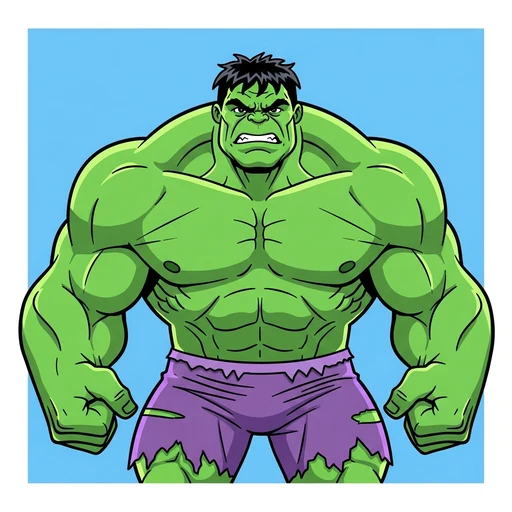
Avengers Strength
Nobody wanted the Hulk on the team.
That is not a kind thing to say, but it is an honest one. When Tony Stark and Nick Fury and the others were assembling the Avengers — gathering the best and the most capable and the ones most likely to save the world without also accidentally destroying a reasonable portion of it — the question of Bruce Banner sat in the room like a particularly awkward piece of furniture that everyone kept walking around.
He was brilliant, obviously. One of the finest scientific minds on Earth. But the other thing — the green thing — that was a complication.
Bruce knew it. He arrived quietly, without making demands, without insisting on anything, with the careful low-profile energy of a man who had spent years learning to take up as little space as possible. He sat in the science lab on the helicarrier and worked on the problem he had been asked to work on and tried very hard not to become what he spent every day trying not to become.
Then Loki came, and the Chitauri came with him, and the portal opened above Manhattan, and the city erupted into chaos.
"Hulk," Captain America said, into the communications system, his voice absolutely calm. "Smash."
And there it was. Four words. One instruction. And the implicit thing beneath them: we want you here. We need you. You belong.
Nobody had said that to the Hulk before.
He landed in the street below with a sound like a building falling, and he looked up at the alien Leviathans — enormous flying creatures the length of city blocks, armored and roaring — and he felt something he had not expected to feel in the middle of a battle.
He felt at home.
The Avengers had a formation. They had a plan. They moved around each other with the kind of trust that requires knowing that the person next to you will do what needs to be done. They covered each other. They communicated. They were, collectively, something much larger than any of them individually.
And in that formation, the Hulk was not a danger to be managed. He was the cornerstone. The thing that could take the hits that would end anyone else, and stand up, and hit back harder.
A Leviathan dove at him. The Hulk caught it with both hands. There was a moment — suspended, enormous — and then CRASH. The great creature crumpled against the street. The Hulk stood on it and looked for the next one.
Tony Stark was falling from the sky — power depleted, suit offline, dropping past the windows of skyscrapers in a long, terrible plummet. The Hulk saw him. The Hulk reached out and caught him and held him, just for a moment — Tony's armor against those green hands, safe and still — before giving him the one sharp shake that rebooted the suit and sent Tony roaring back into the sky.
Then the Hulk punched a building-sized alien warship.
The warship lost.
What happened during those hours above Manhattan was something the Hulk had never experienced in all the years of running and hiding and being hunted: he was part of something. He was valued, not feared. He was given a purpose that fit the shape of him — enormous and powerful and willing to go toward danger instead of away from it.
Natasha Romanoff — Black Widow — had a technique she called the Lullaby. A way of speaking to the Hulk in the aftermath of battle, quiet and steady and without fear, that helped the anger ease and the transformation reverse. Bruce Banner would emerge from it exhausted and wrapped in whatever clothing someone had thought to bring, blinking in the sudden normality of a post-battle world.
She was the only one who had ever looked the Hulk in the eye without flinching and just... talked to him.
It meant more than anyone quite knew how to express.
In the years that followed — in the compound, in the long stretches between crises — the Avengers made room for both Bruce Banner and the Hulk. Tony debated physics with Bruce over breakfast and was usually wrong, which he hated and kept doing anyway because he loved the argument. Steve Rogers always made sure there was enough food at dinner for someone with the Hulk's caloric needs. Thor arm-wrestled the Hulk once, and the table they used did not survive it, and everyone agreed never to speak of it, and everyone told the story at least once a week.
They were family, in the way that only people who have faced the end of the world together ever quite manage to be.
And for Bruce Banner — quiet, brilliant, careful Bruce, who had spent so many years believing the green part of him was nothing but a curse — the most extraordinary thing that happened in all of his extraordinary life was not the gamma radiation, or the Avengers, or Smart Hulk, or saving the universe.
It was learning that the most misunderstood person in the world could belong somewhere.
It was being part of a team that wanted him.
All of him.