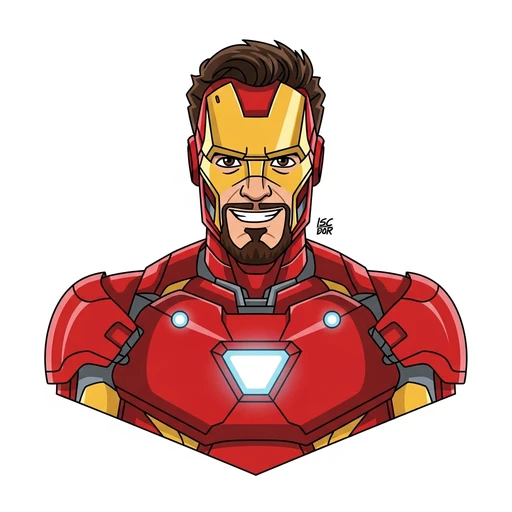
Suit Tech
Deep in the workshop in Malibu, while the Pacific Ocean crashed against the cliffs outside and the sunset turned the windows gold, Tony Stark never stopped building.
The lights in that workshop stayed on long after midnight. The holograms spun and glittered in the darkness. The coffee grew cold and then was replaced by more coffee. And the suits — the beautiful, extraordinary suits — multiplied and improved and evolved.
Let us tell you about them. Because every great suit has a story.
The Mark I was born in a cave in Afghanistan. You know this story — the one made of scrap and desperation and Ho Yinsen's sacrifice. It was heavy as a boulder and clumsy as a first step, and it was the most important thing Tony Stark ever built. Without the Mark I, there would be no Iron Man.
The Mark III was the first one he built at home, in his workshop, with the red-and-gold design he would carry forever. It was sleek and light, built of a gold-titanium alloy — strong as steel, a third of the weight. In the palms: repulsor rays, white beams of directed energy that could both push things away and send Tony flying through the sky at breathtaking speed. In the chest: the Unibeam, a wide cone of light that could blast through walls or light up the darkest battlefield like a second sun.
And then came J.A.R.V.I.S.
That was the suit's greatest companion. Not a part you could hold in your hand, but a voice in Tony's ear and a mind behind his eyes — Just A Rather Very Intelligent System. J.A.R.V.I.S. managed the suit's systems, monitored Tony's heartbeat, analyzed enemies in real time, suggested tactics, warned of incoming threats, and occasionally made very dry jokes that Tony found deeply satisfying.
"Shall I note that you are about to fly into the side of a building, sir?"
"I see it, J.A.R.V.I.S."
"Noted."
When threats got bigger, the suits got bigger too. There was the Hulkbuster — an enormous modular armor that snapped onto the outside of a regular suit like a second skin, making Tony roughly the size of a small building. Built for one purpose: containing a rampaging green somebody. It had extra repulsors. Extra plating. Extra everything.
There were suits for the deep ocean, sealed against the crushing pressure of the trenches. Suits for deep space, heated against the terrible cold. Suits that could fly to the edge of the atmosphere.
But Tony was never satisfied. He always saw the problem he hadn't solved yet.
The nanotech suit was the one that made him sigh with the deepest satisfaction.
Stored inside his own Arc Reactor — inside the device in his chest that kept him alive — were billions of microscopic machines. Nanobots. Tiny beyond imagining, each one a fraction of the width of a human hair. When Tony activated them, they poured out like a silver tide and wrapped around his body in seconds, assembling the Mark 85 from the inside out, flowing into every shape he commanded.
Need an extra weapon? Think it. Need a shield? Think it. Need to disassemble completely and fit through a hatch no human could pass through? Done. The suit was an extension of his mind now, not just his body.
And it was his mind that always mattered more.
F.R.I.D.A.Y. — the AI who came after J.A.R.V.I.S. — once told Tony that a computer could run the suit without him. That the systems were advanced enough to fly and fight on autopilot.
Tony looked at her — a voice in the air, a collection of light — and said: "Then why am I in there?"
Silence.
"Because it matters who flies the suit," he said. "What they believe. What they're trying to protect."
Pepper Potts came down to the workshop one evening and found Tony asleep in his chair, a hologram of a new suit rotating slowly above his head, one arm of it still half-designed. She turned the hologram off. She put a blanket over his shoulders.
On the workbench beside him, the Arc Reactor glowed blue. Steady. Bright. Quiet.
A machine that kept a heart beating. A heart that kept building machines. Back and forth, each one giving the other reason to continue.
The most important invention Tony Stark ever made was not the suit. It was not the Arc Reactor. It was the decision, made in a cave in Afghanistan, to turn all of his extraordinary brilliance — every circuit, every algorithm, every sleepless midnight — toward protection instead of destruction.
That was the suit around the world.
That was what it was always really for.