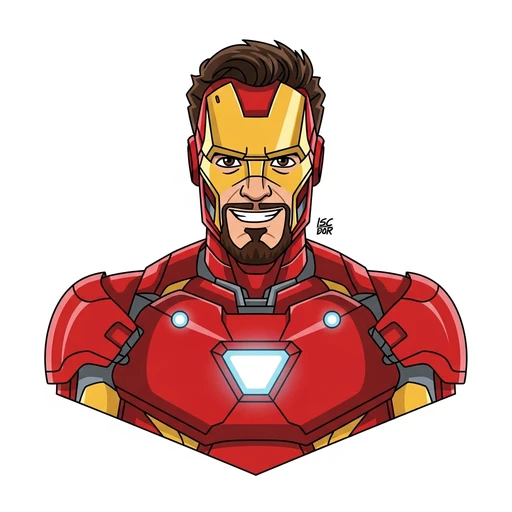
Civil War Ideals
Of all the battles Tony Stark ever fought, the saddest was the one against his own friends.
It is called the Civil War. And it did not start with a punch. It started with a piece of paper.
The paper was a set of rules called the Sokovia Accords. After many years of Avengers missions, the leaders of the world had begun to worry. The Avengers were powerful. The Avengers were brave. But sometimes, when the Avengers fought, buildings fell. Sometimes ordinary people got caught in the middle. Sometimes innocent lives were lost.
The Accords said: the Avengers must answer to the United Nations. They must have permission before they go on missions. They must be held accountable for what they do.
Tony Stark read the Accords. He read them again. And then he sat down on the floor of his workshop and put his face in his hands.
You see, Tony had been carrying a heavy weight for a long time. He had helped build a machine called Ultron that had hurt people. He had seen the rubble of the city of Sokovia. He had seen the faces of the children who had lost their parents. He had felt, deep in his arc-reactor heart, that something had to change.
He decided to sign.
He believed, with all his being, that the Avengers needed to be held to account. He believed that the world deserved a say in what super-people did in their cities. He called the Accords "a suit of armor around the Avengers" — a way to keep them safe from themselves.
But his closest friend disagreed.
Captain America — Steve Rogers, the man Tony's own father Howard had helped find decades earlier — read the same papers, and shook his head. He believed that putting heroes under the control of governments was dangerous. He believed that the safest hands were still their own. He believed, deep in his star-spangled bones, that a hero had to be free to do what was right, even when no one in power agreed.
Tony and Steve sat across a table from each other. They argued. They begged each other. They tried, both of them, to find a way through.
They could not.
The world began to split. Heroes had to choose sides. On Tony's team stood Natasha Romanoff (at first), James Rhodes — Tony's oldest, dearest friend — and the eager young Peter Parker, who Tony had personally invited because the kid had powers and Tony wanted to keep him safe and visible to the law.
On Steve's team stood Sam Wilson, Wanda Maximoff, Scott Lang, Clint Barton, and Bucky Barnes — the lost best friend Steve had finally found again.
The two teams met at an airport in Leipzig, Germany.
It was the saddest fight in the history of the Avengers.
There were big punches. There were big stunts. Spider-Man swung between hulking War Machine and Falcon's wings. Ant-Man grew suddenly into a giant. Wanda's red magic flickered against Vision's bright yellow shields. To anyone watching from far away, it might have looked thrilling.
But up close, it broke their hearts.
These were friends. Family. People who had eaten breakfast together at Avengers Tower, who had saved each other's lives many times over. And now they were facing each other across an empty tarmac, swinging at the people they loved most.
Tony tried not to hurt anyone. So did Steve. But the fight got bigger. People got hurt. Rhodey — Tony's beloved Rhodey — was knocked out of the sky and badly injured. Tony knelt by his friend's stretcher and could barely breathe.
But the war did not end at that airport.
A clever, hidden villain named Baron Zemo had been quietly pulling threads behind the scenes. He had no superpowers. He did not need any. He had something just as powerful — a deep painful secret about Tony's parents.
Years and years before, when Tony had been a little boy, his parents Howard and Maria Stark had been killed in what everyone had always believed was a car accident.
Zemo led Tony, Steve, and Bucky to an abandoned bunker deep in the cold mountains of Siberia. And there, on an old grainy security tape, he showed them the truth.
Howard and Maria had not died in an accident. They had been killed by the Winter Soldier — by Bucky — back when Bucky had been brainwashed and used as a weapon by Hydra.
Tony watched the tape. His face went white.
He looked at Steve. "Did you know?"
Steve's silence was the answer.
The grief that rose up in Tony was not really about the Accords anymore. It was the raw, unprocessed grief of a son who had just learned, in one terrible moment, what had really happened to his parents.
He swung at Bucky.
Steve stepped between them.
The fight that followed was painful to watch. Three men who should have been allies — three men who had lost so much — striking and grappling in a freezing cold bunker, none of them really wanting this. It ended with Steve standing exhausted over Tony, lowering his shield, refusing to land the final blow.
He took the shield off his arm. He set it carefully on the floor next to Tony.
And he walked away.
It was, in many ways, the end of the Avengers as they had been.
Tony lay in the cold bunker, looking up at the shield that had been left for him. He felt the silence press down. He had tried to do the right thing. He had wanted to keep his family safe. He had ended up breaking them apart instead.
The Civil War taught Tony Stark the hardest lesson of his life. That doing what you BELIEVE is right is not always the same as doing what is wisest. That technology and ideals cannot heal a wound between people who love each other — only patience and forgiveness can do that.
It would take years before Tony and Steve found their way back to each other. The scars never quite faded.
But somewhere in the cold quiet of that Siberian bunker, sitting beside the shield his friend had left behind, Tony Stark began — very slowly — to learn what forgiveness might look like.
He picked the shield up.
He carried it home.