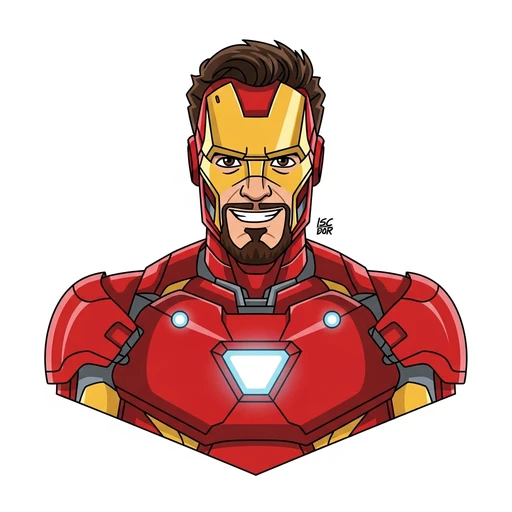
Arc Reactor Heart
In the center of Tony Stark's chest, beneath the red-and-gold metal of his Iron Man suit, beneath the soft fabric of any shirt he was wearing, beneath skin and ribs and muscle — there was a small glowing circle.
It was about the size of the palm of your hand. It glowed a soft steady blue. It hummed, very faintly, if you got close enough to listen.
It was called the Arc Reactor.
And for many years of Tony's life, it was the only thing keeping him alive.
The story of the Arc Reactor begins long before Tony, in fact. It begins with two old friends — Tony's father, Howard Stark, and a Russian scientist named Anton Vanko — who had once dreamed of a brand-new kind of energy. Clean. Endless. Powerful enough to run a city without any pollution at all. They had drawn up theoretical plans together. They had argued and laughed and dreamed.
For many reasons, the Arc Reactor never quite got finished in their lifetimes. The plans sat in a drawer.
Years later, the dream came true in the most unexpected place imaginable.
Tony had been captured, you see, on a long-ago mission in the mountains of Afghanistan. He had been hurt by shrapnel — small sharp pieces of metal that were lodged dangerously close to his heart. The bad men who had captured him wanted him to build weapons. Instead, with the help of a kind fellow prisoner named Yinsen, Tony built two things.
First, in a desperate moment to keep himself alive, he built a tiny electromagnet that he wired right into his own chest. The little magnet held the shrapnel back, away from his heart, hour after hour, day after day.
Then he built a power source small enough to fit in his chest and strong enough to run the magnet — and, eventually, a whole suit of armor.
The miniature Arc Reactor was born in that cave.
Tony walked out of the mountains alive, his chest glowing soft and blue, his eyes changed forever.
When he came home, he kept refining the design. The early Arc Reactors were clunky. They used a metal called palladium that, over time, made Tony sick. The toxin built up in his blood, like a slow shadow creeping over a beautiful day. For a while, Tony tried to hide it. He thought he was going to die. He gave away his possessions. He drove fast cars too fast. He behaved badly.
Pepper Potts and Rhodey saw through him. They always did.
The answer came from a place Tony had not expected. While going through some of his late father's old papers, Tony discovered a hidden message Howard had left behind for him. Hidden in the blueprints for the Stark Expo, in the model of a city Howard had built decades before, was the design for a NEW element — one that no one had ever synthesized, but that Howard had calculated could fuel an Arc Reactor without any of the deadly side effects.
Howard had left his son the key to saving his own life.
Tony built a small particle accelerator in his workshop. He aimed it. He fired it. And with one bright crackling moment, a new element was born in the world — one that could power the Arc Reactor cleanly, beautifully, without any poison.
He swapped out the old core in his chest. The blue glow shifted slightly, became cleaner, steadier. The toxic shadow lifted from his veins.
For the first time in his life, Tony felt his father had truly seen him. Across all the years. Across all the misunderstandings. Howard Stark had believed in his son's potential to change the world.
It was a quiet moment of reconciliation. Tony sat in his workshop and cried, just a little, for the father he had never quite known.
The Arc Reactor became more than Tony's lifeline. It became his MISSION.
He built an enormous Arc Reactor at Stark Industries headquarters, to show the world what clean energy could do. He dreamed of a future free from wars over oil. He dreamed of cities powered by the same gentle blue glow that lived in his chest. He dreamed of a world that didn't have to hurt the planet to keep its lights on.
Of course, others wanted that power for themselves. There was Obadiah Stane, who tried to take an early Arc Reactor right out of Tony's chest. There were governments around the world who tried to demand the design. There were corporations who sent spies. Tony spent decades fighting to keep the Arc Reactor in HIS hands — because he knew that in the wrong hands, it could become a weapon big enough to break the world.
In his later years, after long medical breakthroughs that Tony himself helped invent, the shrapnel was finally safely removed from his chest. The Arc Reactor was no longer keeping him alive in a literal sense. He could have let the blue light go.
But he didn't.
He kept it. He wore a sleeker, newer version of the reactor on his chest, where it powered his nanotech suits. The blue glow was no longer about survival anymore. It was about REMEMBERING.
Remembering the cave. Remembering Yinsen. Remembering the man he had been before, and the man he had chosen to become.
The Arc Reactor remained, all the way to the very end, the heart of Iron Man.
And when Pepper sometimes leaned her head on Tony's chest at night, she could hear the soft warm hum of it — like a steady purring, like a lullaby — beneath the steady beat of her husband's flesh-and-blood heart.
It was, in many ways, the brightest thing Tony Stark ever built.
Proof, scrawled on a small handmade plaque Pepper had once given him, that Tony Stark had a heart.
He always had.
The Arc Reactor just made it visible.