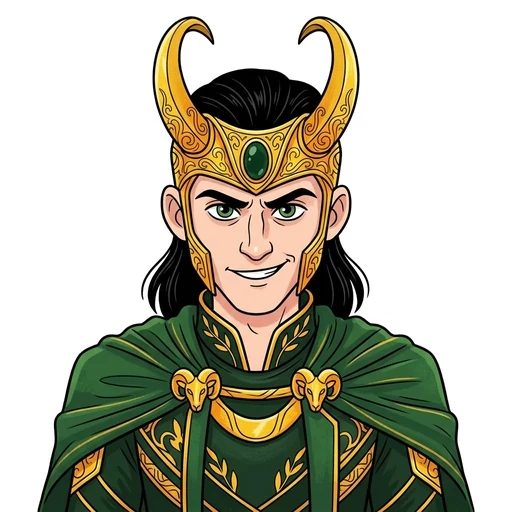
Tricks And Truth
Tonight is the last Loki story.
We have walked together through a great many of his chapters. The quiet boy in Frigga's library. The young man discovering he was a Frost Giant. The lonely god falling between worlds. The villain with the scepter. The brother throwing his other brother as a bowling ball. The bravest dagger at Thanos's throat. The orange jumpsuit at the TVA. The friend of Mobius. The other-self of Sylvie. The keeper of stories at the root of the great tree.
That is a lot of life for one Loki.
But tonight is not about any one chapter. Tonight is about the thing that runs through ALL of them. The thing that, in the end, makes Loki who he is.
Tonight is about tricks.
Because here's the surprising truth about Loki. He never stopped being a trickster.
Some heroes start their stories one way and finish them completely changed. Tony Stark stops being arrogant. Bruce Banner makes peace with his green half. Thor learns to be a king. They are different people at the end.
Loki? Loki was a trickster as a little boy. He was a trickster as a villain. He was a trickster as Mobius's friend. He was a trickster as the God of Stories. Loki was ALWAYS a trickster.
The mischief never left him.
He still turned a sandwich into a snake when Mobius wasn't looking. He still made illusions of himself stand in doorways just to make people jump and yell. He still shape-shifted into the most inconvenient person possible during important TVA meetings. He once, in the middle of a very serious budget review, became a duplicate of Ravonna Renslayer just to see how long it would take her to notice. (Long enough that there were two Ravonnas glaring at each other across the conference table before the joke ended.)
The TRICKS were part of him. He was not going to apologize for them.
What changed was what he used them FOR.
Let me show you a few small examples.
There was a day when Mobius was nearly pruned by a group of new TVA officers — officers who hadn't trusted Loki from the beginning. They cornered Mobius in a hallway, batons raised. Mobius had no weapon. Mobius had no escape. He had only his soft tie and his calm patience, and neither of those things was much good against a glowing baton.
POOF.
A shimmering Loki appeared at the other end of the hallway, made a rude gesture, and ran. The officers shouted and gave chase. The real Loki, hidden in an alcove, grabbed Mobius and pulled him into a side door. The fake Loki — pure illusion — led the officers on a chase down three floors before vanishing into thin air. The officers spent the next hour searching empty corridors for a Loki who had never really been there.
Mobius was saved. By a trick.
There was another day when Sylvie was being tracked across the timeline by a hunter who would not give up. Sylvie was hidden in her diner in Oklahoma in 1982, working her shift, hoping for peace. The hunter was getting closer.
Loki could not interfere directly. The math of the multiverse did not allow it. But Loki could slip into a different moment and whisper one little sentence into one specific TVA officer's ear. "Did you hear? Someone saw her in Budapest. Nineteen-sixty-eight Budapest. Cafe near the river." The officer mentioned it casually to the hunter. The hunter rerouted. By the time the hunter realized the rumor was false, weeks of his search had been wasted, and Sylvie's trail was cold.
Sylvie was safe. By a trick.
There was a third day, smaller than the others, but my favorite. Casey, the friendly TVA clerk, was trying to open a stuck door to a supply closet. He pulled on it. He pushed on it. He muttered at it. He went and got a wrench. The wrench was the wrong size. He stood there frowning, completely stuck.
POOF.
The wrench he was holding turned into a slightly different wrench. The right size.
Casey, who had recently learned what a fish was and was still adjusting to the discovery, peered at the wrench suspiciously. "Is — is this Loki?"
"Just use me, Casey," said a small voice from the wrench. "Just for a second. Promise."
Casey laughed and used the wrench and got the door open. The wrench turned back into Loki, who looked very pleased with himself, and walked off whistling.
Casey was helped. By a trick.
This is who Loki became.
The same mischief. The same cleverness. The same gift for illusions and shape-shifting and lies and surprises. Used differently. Used for people instead of against them.
Even his oldest and weirdest habit — pretending to be dead — turned out, in the end, to have something gentle hidden inside it.
Loki had faked his death so many times that Thor had stopped believing it. There was even a moment, years before any of this, where Thor watched Loki "die" and said dryly, "OH, no. You're really dead this time." And rolled his eyes. The death-fakes were a Loki signature.
But if you look at WHY he kept faking death — really look — you see something kind of sad and kind of sweet hiding underneath.
Loki was always trying to escape.
Not because he wanted to leave the people he loved. But because the people around him kept wanting him to be someone he wasn't. Odin wanted a different kind of son. Asgard wanted a different kind of prince. The Avengers, fairly, wanted him to stop being a villain. Even his own brother sometimes wanted him to be a tidy version of himself.
So Loki kept faking death. Kept shape-shifting. Kept disappearing. Because if he could vanish, even briefly, he could re-enter the world as someone closer to who he actually was.
By the end of his story, Loki did not need to escape anymore.
Sitting at the root of the great tree of stories, holding the multiverse in his hands, he was finally — for the first time in his three-thousand-year life — entirely himself. No costume. No false identity. No clever exit waiting in the wings. He had not died. He was not pretending. He was just Loki. All the time. Forever.
The keeper of every story, finally allowed to be his own.
There is no neat lesson at the end of Loki's tale. He was too tangled for that.
He was the boy in Frigga's library. He was the Frost Giant in the vault. He was the Mind-Stoned villain in New York. He was the secret Odin on the throne. He was the bowling ball in the corridor. He was the dagger at Thanos's throat. He was the orange jumpsuit. He was the friend in Mobius's office. He was the strange love beside Sylvie in the train car. He was the keeper of every wild new universe.
He grew up. He learned a lot. He hurt people, and he was hurt. He apologized to some of them, and he never apologized to others. He was complicated.
But he learned, slowly and painfully and beautifully, one important thing.
Being CLEVER was not the same as being GOOD.
But being clever, when you used it for the people you loved, could be a small kind of love.
A LOKI kind of love. Not the loud kind. Not the obvious kind. The kind that hid in a wrench so a friend could open a door. The kind that whispered the wrong city into the wrong ear so someone you loved could keep eating pancakes in peace. The kind that ran an illusion of yourself down a hallway so the real you could pull a friend out of danger.
Frigga, somewhere in some branch of the wild bright multiverse, would have been very, very proud.
And Loki, sitting at the root of the great tree of stories, holding every universe safe, knew it.
He smiled, just a little, just to himself.
And he held on.
Goodnight, dear listener.
You are part of a story too. A wonderful, wild, branching, full-of-surprises story. And somewhere — quietly, gently — the trickster god is holding the door open for you, while you live it.
Sleep well.
The end.