Origin
Once upon a time, in the glittering studios of Hollywood, there worked a man named Quentin Beck.
Quentin was a special-effects wizard. Give him a camera, some smoke, and a few glowing screens, and he could build you an entire alien planet, a roaring dragon, or a city crumbling under a monster's foot — all without a single real brick falling. He was brilliant at his craft, one of the best in the business. But every time the movie finished and the lights came up, the director walked onstage to take a bow, and Quentin Beck stayed backstage in the dark, unseen and unthanked.
Year after year, this happened. Quentin built the magic. Someone else got the applause.
Hoping for something different, Quentin left Hollywood and took a job with a company called Stark Industries, working on illusion technology far more advanced than anything the movies had ever used — real holograms, real hard-light projections, drones that could paint a picture in the sky. For a while, he believed this might finally be his moment.
Then, one ordinary afternoon, he was let go. Fired. Just like that.
Something inside Quentin Beck, something that had been quietly hurting for years, finally cracked. If Hollywood would not make him a star, and Stark Industries would not make him a star, then he decided he would simply have to make himself one.
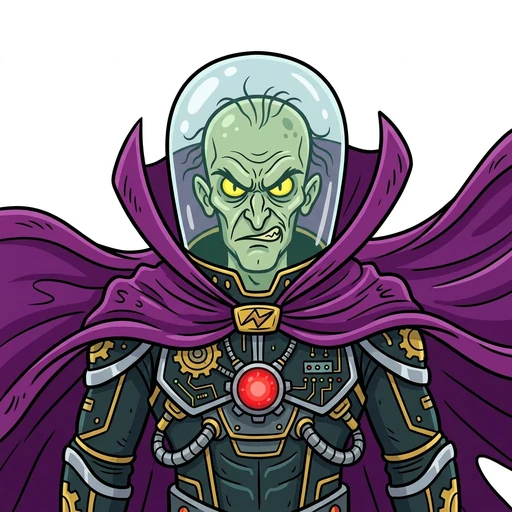
He began to build. Late at night, in a workshop far from prying eyes, Quentin designed a costume unlike anything the world had ever seen. A helmet shaped like an upside-down fishbowl, glowing faintly green in the dark. A long, flowing cape that swept behind him when he moved. Gloves lined with tiny hidden gadgets, each one a secret trick waiting to be played. When he looked in the mirror and saw the reflection staring back, he gave himself a new name.
Mysterio.
He gathered old friends from his special-effects days — clever, skilled people who understood cameras and lights and illusions just as well as he did. Together, they rigged entire city blocks with hidden drones, hologram projectors, and hissing smoke machines, turning real streets into a stage no one else could see.
And then, the show began.
Giant monsters rose from the fog — creatures made of roaring fire, howling wind, and crashing water. Mysterio called them the Elementals, and he told anyone who would listen that they had traveled from another world to destroy everything in their path. Then, wrapped in curling green smoke, he swooped in as the hero who had crossed dimensions to stop them.
The crowds gasped. The cameras rolled. Reporters shouted questions, and for one glowing, glorious moment, Quentin Beck finally heard the applause he had waited his whole life to hear. Nobody in the watching world thought to ask whether any of it was real.
Nobody, that is, except a boy named Peter Parker.
Peter — who you might know better as the Friendly Neighborhood Spider-Man — watched Mysterio's story on the news, and something about it didn't sit right. It was too tidy. Too perfect. Heroes from other dimensions didn't usually arrive with such excellent lighting.
So Peter did what he always did best. He asked questions. He followed clues. He climbed closer, past the fog and the flashing lights, until he found what was really hiding underneath all that green smoke.
Not a hero from another world.
Just a man. A talented, clever, deeply unhappy man in a homemade costume, flying his monsters on drones and projecting his illusions from hidden machines all across the rooftops.
Spider-Man pulled back the curtain right there, in front of the very cameras Mysterio loved so dearly. The drones sputtered and dropped from the sky, one after another. The glowing fire-monster flickered and vanished like a soap bubble. And underneath the fishbowl helmet, the whole world finally saw Quentin Beck for exactly who he was.
It was not the ending Mysterio had scripted. He had wanted a triumphant final scene, with himself as the hero and the credits rolling in his honor. Instead, his illusion collapsed in real time, and the crowd who had cheered for him only minutes before now understood the truth.
Quentin Beck learned, that day, a lesson that every good storyteller eventually learns: illusions can dazzle people for a little while. They can shimmer, and glow, and fool even careful eyes for a moment or two. But sooner or later, the smoke always clears. And when it does, the truth is still standing right there underneath — patient, plain, and impossible to hide from forever.
And so, in the city of New York, Spider-Man swung home that night knowing the show was over, while somewhere below, a man in a fishbowl helmet sat alone in the fading green smoke, wondering how the story had gotten away from him.
The end — for now.