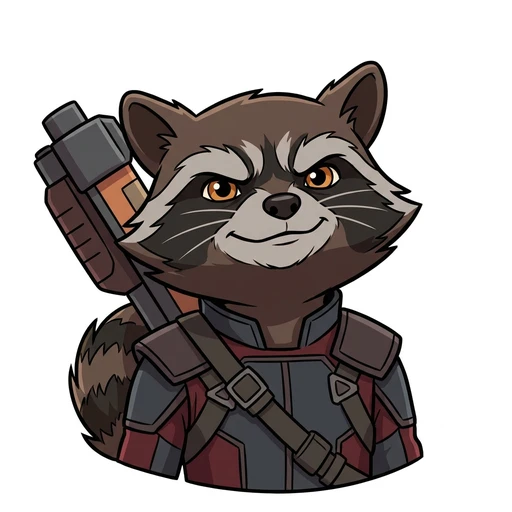
The High Evolutionary
Once upon a time, before there was a Guardian called Rocket, before there was a bounty hunter or a pilot or a builder of impossible things, there was a small creature in a laboratory.
The laboratory was on a space station called the Arête, and it moved through the deep dark between stars. Its owner was a being called the High Evolutionary — a scientist of extraordinary intelligence who had decided, somewhere along the way, that the universe was imperfect and that it was his responsibility to improve it. He believed in this so completely, and so coldly, that he would do anything in service of that belief.
He changed living creatures. He gave them intelligence they were not born with. He reshaped them, carefully and precisely, and called them his Higher Species.
He never thought about what they felt.
The creature that would become Rocket lay in that laboratory and opened his eyes for the first time on cold white light and the smell of metal. He was small — striped face, ringed tail, bright amber eyes. The Evolutionary saw in him an ideal test subject: quick reflexes, natural dexterity, a brain structure that responded beautifully to enhancement. He made Rocket smarter, faster, more capable than any creature of his kind had ever been.
He did not notice that Rocket was afraid.
But there were others in that laboratory. Three of them. Others who had been changed, who looked at the cold white world around them with the same confusion. They found each other in the only way small frightened beings can — with presence, with closeness, with a kind of wordless agreement to face this place together. Rocket had not yet learned many words. But he learned, in those early days, what it meant to belong somewhere.
Those friendships ended too soon, in the way that things often end in places without kindness.
Rocket left the Arête. He carried the Evolutionary's changes with him — the brilliant mind, the engineer's hands, the reflexes, the sharp senses. He carried something else too, quiet and deep, that he didn't speak about. A grief from before he had words for grief.
He grew up across the galaxy. He became extraordinary. He built things no one else could build, flew ships no one else could fly, and refused to let anyone get close enough to hurt him the way that early loss had hurt.
Until Groot. Until the Guardians.
Until the day the High Evolutionary came looking for what he considered his.
Rocket had never thought the Evolutionary would come for him. He had moved too far, been too free, too loud, too much a person in his own right to be seen as a thing anymore. But the Evolutionary did not see persons. He saw research. And he wanted it back.
What followed nearly broke the Guardians apart. Rocket was gravely hurt — lying still in a way that frightened every single one of his friends deeply. Peter Quill refused to accept it. Nebula was relentless. Drax and Mantis pushed forward. Groot was very quiet in the way that meant he was holding himself together by will alone. They fought through the Arête, through its guards and the Evolutionary's creations, searching for a code buried in his systems — a key that existed because the Evolutionary had never imagined his work would be used to save what he'd made.
And Rocket, in those dark in-between hours, remembered.
The cold lights. The three friends. The way belonging had felt before it was taken away. He had been carrying the weight of that all his life, in the space behind his ribs, in the sharpness of his humor, in the way he sometimes sat very still and looked at nothing.
He opened his eyes to Groot's face — worried, warm, a small flower blooming at the tip of one branch.
"I am Groot," said Groot.
"Yeah," said Rocket, voice rough. "I'm here."
The Guardians reached the Evolutionary. They stood together in the station that had been the beginning of everything for Rocket, and they dismantled it with the same determination that had carried them across half the galaxy. Every animal that had been caged inside was freed. The Evolutionary's certainty that he had the right to make and unmake living things — to own them — did not survive the night.
Rocket walked out of the Arête and stood in the open dark of space, the stars spread around him in every direction.
He had come from here. From this cold and careless place. And he had become — through stubbornness and longing and one very tall wooden friend and a crew of beautiful misfits — someone who had a home.
Not a planet. Not a station. A family.
He looked back once at the Arête as the Milano pulled away, and then he looked forward.
He had a long way left to fly.
And for the first time in his life, he was not carrying anything heavy when he did it.