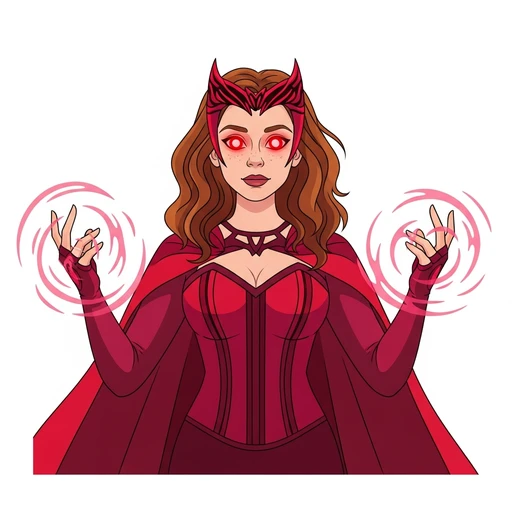
Chaos Magic
There is a kind of magic in the world that comes from books. Doctor Stephen Strange studied at Kamar-Taj, a hidden school in Nepal, learning to trace ancient symbols in the air called mudras, reading Sanskrit texts so old the pages had gone soft and yellow, mastering the borrowed power of sorcerers who had come before him. His magic was real and vast and important — but it came from somewhere outside himself. He reached for it, and it answered.
And then there is the other kind.
Close your eyes. Can you picture a color — not a color anyone named in a crayon box, but something like a deep, swirling, living red, the color of embers and of heartbeats and of something very old that has just woken up? That is the color of chaos magic. And chaos magic does not live in books. It does not live in any school or ancient order or borrowed tradition. It lives in exactly one person in all of history, written about in prophecies so old that even Agatha Harkness — who had stolen power from witches across three centuries — stepped back when she understood what she was looking at.
The Scarlet Witch.
When Wanda Maximoff walked into HYDRA's laboratory in Sokovia, it was not the Mind Stone that made her a witch. The Mind Stone found the magic that was already hers — deep inside her, waiting since before she was born — and opened the door that had been locked without a key. Out poured the red.
Doctor Strange once showed Wanda two books, side by side. One was the Book of the Vishanti — ancient, careful, the record of borrowed power. The other was the Darkhold — old leather and dark writing, the record of power taken, wrestled away, kept by force. Strange shook his head at both and said: Wanda, you are neither of these things. Your magic doesn't come from a source. It is the source.
Chaos magic answers feelings as much as thoughts. When Wanda is calm, the red energy curls from her fingers in careful spirals — gentle as smoke on a still morning. When she is afraid, the energy comes out in jagged shards — CRACK, SNAP — sparking against walls and ceilings. When she grieves — and Wanda knows grief the way some people know the faces of their oldest friends — the magic comes out as something high and humming, like a sound too large for any room to hold. It was her grief that built the bubble around Westview. Not cruelty. Not ambition. Pure, uncontrolled sorrow, pouring out of her in red waves.
That is why no teacher could ever have truly trained her. You cannot be taught to control a feeling you have not finished feeling. You can only learn, slowly, to hold it — the way you hold something very heavy not by squeezing harder but by finding your balance.
Strange warned her: you have the most powerful magic in existence, and no one to pull you back if it pulls you too far. She looked at him and said: then I will have to learn to pull myself back.
After she defeated Agatha Harkness in Westview — after she painted the runes and snapped back the stolen power and freed the town from the hex bubble she hadn't known she was writing — she went to a cabin in the mountains. It was a quiet place. Cold mornings and wood smoke and the sound of wind in the pine trees.
The Darkhold appeared on her table without her placing it there.
She could have left it closed. But Wanda had always been curious about hard things. She opened it and began to read — because understanding power, even the most dangerous kind, is not reckless. It is necessary. And she had decided: she would be the Scarlet Witch who uses chaos to protect, not to take. The world needed her to understand what she carried. It was the most personal decision she had ever made.
There was no mentor for this. No Kamar-Taj, no Book of the Vishanti, no order of sorcerers waiting with their wisdom. Just Wanda, and the cabin, and the red light curling from her fingertips in the mountain cold, asking it questions.
Just a girl from Sokovia, teaching herself to be the most powerful witch in the world. One morning at a time.