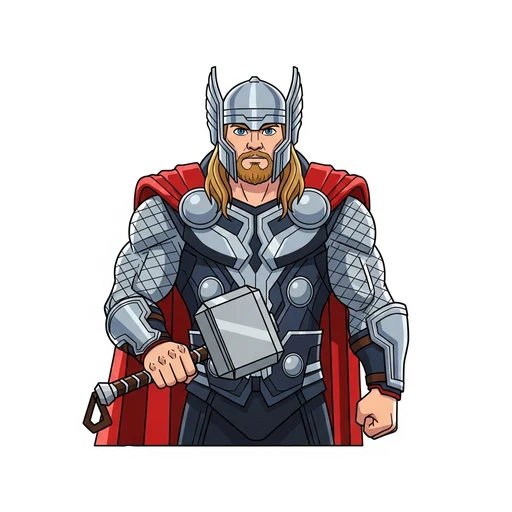
Origin
In the golden realm of Asgard — at the very center of the Nine Realms of the universe, where the towers shone like captured sunlight and the rainbow bridge arched over the edge of the world — there lived a prince.
His name was Thor Odinson. And oh, how magnificent he was.
He was tall and broad and golden-haired, with a laugh that filled every hall of the palace and a voice that carried across the training grounds where the warriors of Asgard practiced with their spears and swords. He was the son of Odin — the great All-Father, king of Asgard, wisest of all beings — and Queen Frigga, who was gentle and brilliant and loved him more than the stars. He had warrior companions: fierce Lady Sif with her dark hair and her short sword, and the Warriors Three — brave Fandral, mighty Hogun, and boisterous Volstagg with his magnificent beard.
And Thor had Mjolnir.
Mjolnir was the hammer of hammers. Forged deep in the heart of a dying star by the dwarves of Nidavellir, beaten from a mystical ore called Uru — dark and ancient and heavy with power — it was the most famous weapon in all the Nine Realms. When Thor threw it, it returned to his hand. When he spun it, he could fly. When he raised it to the sky, lightning answered. Thunder rolled across Asgard and Midgard and all the worlds between.
"Whosoever holds this hammer, if he be worthy, shall possess the power of Thor."
So spoke Odin's enchantment, laid into the metal long ago.
Thor believed, completely, that he was worthy. He was the greatest warrior in Asgard. He was brave and strong. He was ready to be king.
What he had not yet learned was what those words actually meant.
In the cold realm of Jotunheim — the frozen world of the Frost Giants, ancient enemies of Asgard — an old peace was crumbling. Odin had forbidden any Asgardian from entering Jotunheim. The truce was delicate. One wrong move could begin a war that would cost thousands of lives.
Thor did not care about any of that. Someone had dared to threaten Asgard, and Thor wanted to fight. He led Loki and Sif and the Warriors Three through the Bifrost — the great rainbow bridge that connected all worlds — and they landed on the ice of Jotunheim with their weapons drawn.
From far away, in the golden hall of Asgard, the All-Father saw.
Odin appeared on Jotunheim like a storm — vast and terrible, riding his eight-legged horse Sleipnir, his single eye burning with a fury deeper than Thor had ever seen. He stopped the battle before it became a war. And then he turned to his son.
The journey back to Asgard was very quiet.
Odin looked at Thor for a long time. And when he finally spoke, what he said was not about courage or strength or battles won. What he said was about wisdom. About the lives that would have been lost if he had not arrived in time. About the difference between fighting for something and simply loving to fight.
"You are not ready," Odin said.
Then Odin cast the enchantment. Mjolnir left Thor's hand and fell toward a new destination. Thor's power drained away like water. And Thor himself fell — down through the sky, through the realms, down and down and down — and landed in a burst of thunder in the desert of New Mexico, on the planet called Midgard.
He landed in the middle of the road. A vehicle driven by a woman named Jane Foster hit him. That was not the most dignified arrival in history.
Jane Foster was an astrophysicist — a scientist who studied the stars and the forces that connected the universe. She was curious and warm and she asked more questions per minute than anyone Thor had ever met. She helped him find his feet. She showed him coffee, which he found extraordinary ("This is delicious! Another!"), and television, which confused him, and the strange, noisy, beautiful world of human beings.
Mjolnir lay in the New Mexico desert, stuck fast. Hundreds of people tried to move it. Machines tried to pull it. None could.
And then came the Destroyer.
Loki — at home in Asgard, scheming — had sent the Destroyer: an enormous Asgardian automaton of dark metal, ten feet tall, with a visor that opened to pour a beam of fire that melted rock and scorched the earth. It walked into the little town of Puente Antiguo, and the people ran, and the buildings cracked, and Thor — powerless, mortal-weak, just a man in a borrowed shirt — walked out to face it.
Because those people needed protecting. And someone had to do it.
"If you're going to destroy these people," Thor said to the Destroyer, "you'll have to go through me."
The Destroyer picked him up and threw him across the road.
He lay still.
And then… something shifted. Something deep in the enchantment on Mjolnir stirred. Because this — right here, this moment, this choice — was what worthiness actually meant. Not strength. Not thunder. Not a thousand battles won. It was a man lying in the dust, ready to give everything he had for strangers who needed help.
Mjolnir rose from the desert. It crossed the sky like a comet. It struck Thor's hand.
BOOOOOOM. The thunder cracked across New Mexico. Lightning flooded down. Thor rose from the ground in his full armor, golden and blazing, and he lifted Mjolnir and SMASHED the Destroyer with a single blow so enormous that the shockwave flattened everything around him.
Jane Foster watched from behind her overturned van, her hair wild in the energy wind, and her mouth open in absolute astonishment.
Thor turned to face her and smiled — that enormous, golden Asgardian smile.
"I need to speak to my father," he said.
And in the sky, where no one could see it, the Bifrost bridge began to form.