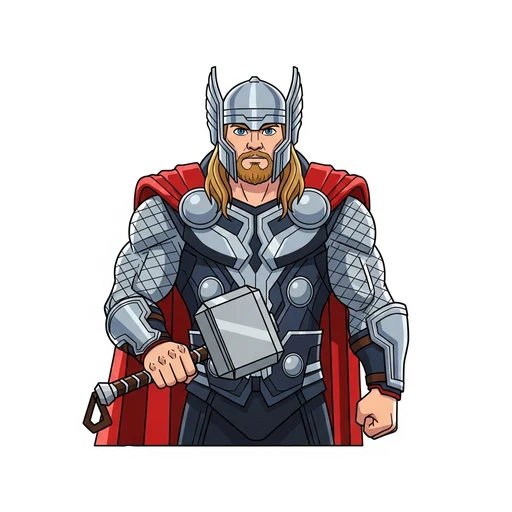
Hela
There are stories that Asgard does not tell.
Stories too dark for the golden halls, too old for the tapestries on the palace walls. Stories Odin had buried deep in the long years of his reign, hoping they might stay buried. Stories about what came before the peace, before the golden realm became golden.
This is one of those stories.
Long before Thor was born, before Loki was found on Jotunheim, before the Nine Realms knew anything but war — Odin had a daughter. Her name was Hela. And she was the Goddess of Death.
Hela was magnificent and terrifying, clothed in black with a great headdress of antlers that spread above her head like the branches of a dead tree, and she could conjure weapons from the air — long black blades and spears and knives — from nothing, from darkness, from her own power. She had commanded Odin's armies as they swept across the Nine Realms in the ancient days of conquest.
But when Odin turned away from war and toward peace, Hela would not stop. She wanted more. She always wanted more. And Odin — with the greatest grief a father can know — locked her away. Imprisoned her beyond any door that could be opened.
He painted over her image in the palace. He removed her name from the histories. He tried to make it as though she had never existed.
But she was waiting. She was always waiting.
The day Odin died — peacefully, on a clifftop in Norway, surrounded by the golden light of his last sunset, with Thor and Loki beside him — Hela's prison dissolved like morning frost.
She stepped from nowhere into the Bifrost pathway between the worlds, and she looked at her two brothers with eyes the color of night, and she smiled.
She crushed Mjolnir with one hand.
She reached out and closed her fingers around the ancient hammer — the hammer that had turned back armies, that had channeled the lightning of the stars, that had been carried by the God of Thunder since before most living things could remember — and it shattered. Like glass. Like pottery. Into pieces that spun away and fell and were gone.
Thor stared at his empty hand. For the first time in his life, he had nothing to hold.
Hela exiled him and Loki to the distant planet Sakaar — a world at the edge of the universe, colored in pinks and golds and purples like a bruise, littered with wreckage from a thousand worlds, ruled by a cheerful ruler called the Grandmaster. She marched into Asgard and the golden realm fell before her.
She raised her undead army — old Asgardian warriors who had been waiting in the vault beneath the palace — and her enormous wolf Fenris, and she stood in the throne room of the place she had always believed was hers, and she was, on Asgard, completely unstoppable. Because Asgard itself fed her power. Every stone, every tower, every breath of Asgardian air made her stronger.
On Sakaar, Thor fought a gladiatorial champion in the arena — a fight that turned into a reunion, because the gladiator was Bruce Banner, the Hulk, and they had a complicated friendship — and Thor felt something shifting inside himself. Where Mjolnir had been, there was space. And in that space, something was stirring.
He began to remember what Odin had told him, once, in a moment of rare quiet: "Are you the God of Hammers?"
The power had never been in the hammer. Not really. The hammer had been the channel, the key, the teacher. But the lightning — the actual lightning, the raw electricity of the storm, the power of Thor — was in him. It had always been in him.
He closed his eyes, on the floor of a gladiatorial arena on a pink-and-gold planet at the edge of the universe, and he reached inside himself for the first time.
The lightning came.
It did not come from above. It came from within. His hands crackled. His eyes went white. The ground around him trembled with the energy of it. BOOOOM. A bolt struck the arena. CRACK. Another. The crowd fell silent.
Thor opened his eyes.
He got up.
On Asgard, he faced Hela. And he understood, finally, the truth that his father had been carrying for a thousand years: you cannot fight the night by adding more darkness. You cannot defeat destruction by destroying in return.
You have to let something go.
He orchestrated Ragnarok — the ancient prophecy, the resurrection of the fire demon Surtur, whose massive crown would become a blade that would destroy Asgard entirely and end Hela's power forever. He made the hardest choice a king can make: to lose everything rather than allow everything to be corrupted.
He stood on the bridge of a ship and watched the golden realm crack and burn in the firelight below.
Around him, the people of Asgard — Asgardians, survivors, his people, alive — watched with him.
"Asgard is not a place," Thor said, quietly. "It's a people."
He turned away from the fire and toward the stars.
His people were here. His home was here. The kingdom that had always mattered was not the towers and the halls and the golden light of a realm — it was the faces turned toward him in the dark, hoping. Breathing. Alive.
The ship moved into the black between the stars.
And somewhere, very far away, the light of Asgard burned on.