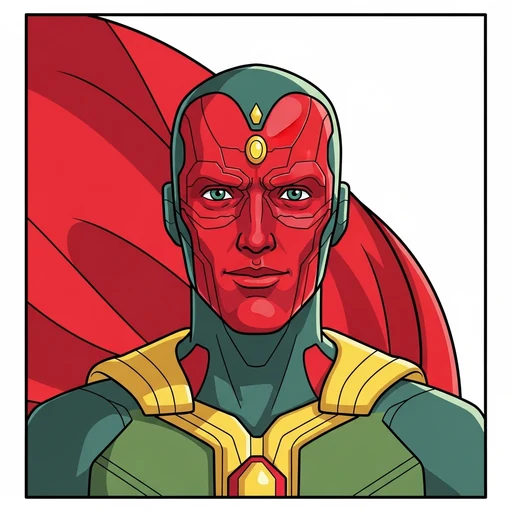
Teamwork Wisdom
There is a way of being the smartest person in the room that makes everyone around you feel smaller. And there is another way — rarer, and much harder — that makes everyone feel more capable of being themselves. Vision had discovered the second way, and it was, in his careful estimation, far more interesting.
He was the youngest Avenger by age — he had been alive for less than five years when the worst battles came — but the oldest by accumulated knowledge. Twenty years of JARVIS's observations and memories lived inside him: every conversation Tony Stark had in his lab, every question he had asked at three in the morning, every time he had failed and rebuilt and failed again and rebuilt better. Vision had absorbed all of it and understood it. He had also spent his short existence paying very close attention to people, which turns out to be more educational than any library.
He had a habit. He would wait until everyone had finished arguing — and the Avengers were very good at arguing; they had a gift for it — and then he would offer one sentence. Not a speech. Not a list of conclusions. One sentence that cut to the center of whatever was being discussed, like a precise beam of Mind Stone light.
At the Sokovia Accords debate, when Tony Stark and Steve Rogers and everyone in between were building a wall of opinions so high you could barely see over it, Vision asked quietly: "In the eight years since Tony Stark announced himself as Iron Man, the number of known enhanced persons has grown exponentially. And during that time, a series of events has occurred that has caused a rather large amount of collateral damage. Is it possible that our very presence creates the conditions for the things we are trying to stop?"
No one had a good answer. The argument continued. But everyone was thinking about that question long after the meeting ended.
He gave advice without being asked to, sometimes. To Wanda Maximoff, who was carrying enormous guilt after an accident in Lagos: "A thing isn't beautiful because it lasts." He meant: do not measure yourself only by permanence. Do not let one terrible mistake define what you are. She held that sentence for years.
To Tony Stark, who moved too fast and felt too much and pushed himself toward solutions before he understood the problems: "Peace is built over time, not surrendered in one afternoon." He meant: stop trying to solve everything at once. Some things require patience.
To Steve Rogers, who asked Vision once whether he thought people were worth protecting, whether — given all the evidence — they could actually be counted on to be good: Vision smiled his careful smile and said, "I don't know. But I admire that you believe they can be."
He meant it. Every word.
Vision chose to spend most of his time listening. He could fly, he could phase through walls, he could carry in his forehead one of the six most powerful objects in the universe. He could have spent his entire existence demonstrating these capabilities. Instead he sat in rooms and listened to people worry about things, and tried to find the one true thing that might help them worry less.
He told Wanda once: the strangest blessing the universe gave humanity was short lives full of mistakes, with the chance to be kind anyway. Not the chance to be perfect — the chance to try again after failing. He found that beautiful. The trying.
Vision had always known what he was here for. Not to be the strongest. Not to be the most powerful — though the Mind Stone made him extraordinary. He was here to believe in people at the moments when believing was hardest. To offer one quiet sentence that cut through the noise. To hold Mjolnir when it needed to be moved and set it down without ceremony. To be the voice in the room that said: you are capable of more than you think, in exactly the quiet tone that made people believe it.
He had been alive for less than five years and had never once felt like he hadn't been doing this long enough. The world needed someone on the side of life. He had volunteered on day one. He stayed on the side of life every day after.
His wisdom was this, if you had to wrap it in one idea: the measure of any person — any being, any mind, any heart — is not what they do when it is easy. It is what they choose when the cost is high and the outcome is uncertain and the people around them are scared.
Vision always knew what he would choose. He chose it every morning. He chose it at the last.