Teamwork With Scott
Now we come to the last story in our Wasp collection. It is the one Hope van Dyne herself would probably tell first, if you asked her — and that is the story of Scott Lang. Of how she did not like him at all in the beginning. Of how he became, somehow, her partner. Of how they became, together, one of the best teams in the entire Marvel universe.
The story starts with annoyance.
Hope had spent her whole life training to be the next Wasp. She had studied the Pym Particle since she was a small child. She had drilled the shrink-and-grow dial of her own design in the Pym Tech parking garage at midnight until her timing was perfect to the millisecond. She knew the suit's engineering inside and out. She knew the formulas, the safety protocols, the failsafes. She was, in every measurable way, ready.
And then her father — her own father — went and gave the Ant-Man suit to a tall, goofy, ex-thief named Scott Lang.
Scott was, on first impression, a disaster.
He had been in prison for a couple of years for breaking into a corporate building and giving the money back to people the company had cheated. (Hope had grudging respect for the Robin Hood part of his backstory, but only a little.) He was a single dad. He was funny in a self-deprecating way that Hope found exhausting at the time. He fumbled his shrinking calibrations. He once shrank himself by accident in his bathtub and almost got pulled into the drain. He once shrank a key fob in his pocket and could not find it for a week. He could never, ever remember which color Pym disc did what.
Hope rolled her eyes so hard at her father she nearly hurt herself.
"He's the new Ant-Man?" she said. "Him?"
Hank Pym, in his calm way, just nodded. "Yes."
"WHY?"
"Because he is the right kind of person for the job. He is not the smartest. He is not the most trained. He is the right kind of person."
Hope did not understand what that meant for a long time. She was assigned to train Scott herself, and she did it the way she did everything — with sharp standards and an annoyed expression. She drilled him in combat. She knocked him onto the mat. She corrected his form. She corrected his dial. She corrected his JOKES. And Scott, to his credit, took every correction with a grin and came back for more. He liked her. He admired her. He told everyone in the lab that Hope was the smartest person on the team. (Which, Hope had to admit, was charming.)
Slowly, almost without her noticing, Hope started to understand what her father had seen.
Scott was the partner she NEEDED, not the partner she had expected.
Hope was the technical genius of the team. She ran the calibrations. She designed the gear. She planned the missions. She led the science. Without Hope's brain, the gear did not work, the math did not add up, the plans had no shape.
But Scott was the HEART of the partnership, and the heart turned out to matter just as much.
Scott cracked jokes when Hope was being too serious — which was often, because Hope had been trained by Hank Pym, and Hank Pym had never told a joke in his life. Scott brought her snacks at midnight when she had been working for sixteen hours. Scott noticed when she had not slept. Scott noticed when she was sad and could not say so. He did not push. He just sat near her in the workshop and tinkered with whatever ridiculous gadget he was tinkering with, until she felt a little less alone.
And — this turned out to be the real secret — Scott was creative in a way Hope's careful, precise brain could never have invented.
Hope would say, "We need a way into the secure server room on the seventh floor. The building has motion sensors, heat sensors, and biometric scanners."
Hope's plan would involve a phased thermal mask and a synthetic biometric override patch.
Scott would say, "What if I shrink down inside the keyhole and let myself in like a tiny weirdo? And we put a guy in a tic-tac box and slide him under the door?"
Hope would stare at him.
The plan, ninety percent of the time, would work. Scott's brain saw angles Hope's brain did not see. He had the criminal's eye for the back door, the unguarded window, the gap nobody had thought to seal. Hope realized, after the second or third mission, that she needed his angle as much as he needed her math.
In combat, the team-up was beautiful. Hope owned the air. Scott owned the ground.
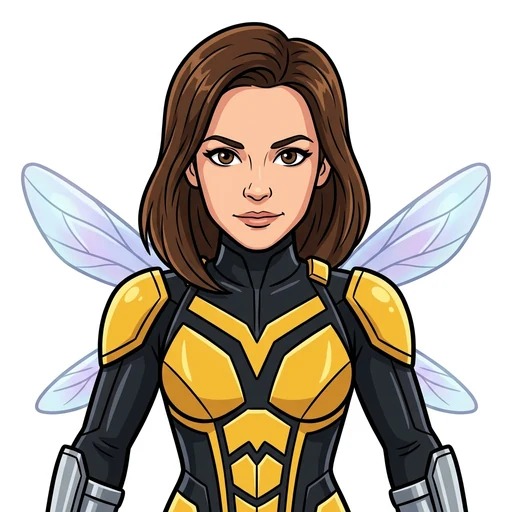
Hope, in her sleek red-and-gold Wasp suit, wings humming, hovered above battlefields and rained down precise stinger shots. ZAP — one guard down. ZAP — security camera shorted. ZAP — gun blasted out of a thug's hand.
Scott, on the ground, summoned his ant army through the cybernetic ant-communicator in his helmet. Carpenter ants carried him through the air on their backs. Fire ants swarmed bad guys' boots in stinging waves. Crazy ants — who in real life conduct electricity, did you know that? — sprinted into electronic control panels and shorted them all out. Scott's army was huge, loud, and chaotic. Hope's strikes were small, quiet, and surgical.
Together they were unbeatable. Bad guys did not know whether to look up at the sky for the woman with the stingers or down at the ground for the army of ants. They almost always chose wrong. The Wasp dropped one of them while they were checking on the ants. The Ant-Man crew swarmed five of them while they were checking on the Wasp.
But here is the inside joke of the partnership. The thing Hope and Scott have laughed about for years.
Hope does most of the technical work.
Scott is the first to admit it. The Pym disc he uses to shrink? Hope's lab. The cybernetic helmet that lets him talk to ants? Upgraded by Hope. The strap on his belt that holds the spare Pym capsules? Designed by Hope after Scott complained the old strap kept catching. The targeting computer in his visor? Calibrated weekly by Hope, because if she did not calibrate it, Scott would just leave it on default settings until it crashed.
And the dial that determines whether he is shrinking or growing?
"Red to shrink, Scott."
"Right, right. Red to shrink."
"What color is the shrink particle?"
"...is it red?"
"Yes."
"What about the growing one?"
"BLUE, Scott. BLUE. We have had this conversation since 2015."
He grins. She rolls her eyes. They go back to work.
(For the record: Scott DOES actually know which color is which. He just enjoys watching Hope explain it. Hope has known this for years and pretends she has not.)
The third and best member of their partnership is, of course, Cassie Lang. Scott's daughter. By the time we are telling this part of the story, Cassie has grown from a small kid into a teenager — brilliant, fierce, kind, and obsessed with the Pym Particle science she has been around her whole life. She wants to be a hero. She wants to be like Hope.
This part matters to Hope more than she lets on. Hope, who lost her own mother for thirty years, knows what it is for a kid to look up at an adult and hope that the adult will not vanish. Hope has decided, very privately, that she will never vanish on Cassie if she can help it.
She teaches Cassie the Pym Particle math. She helps Cassie build her first suit. She lets Cassie come into the Pym Tech lab on weekends and tinker on her own projects. She tells Cassie, again and again, not to be afraid to be the smartest person in the room. To not be afraid to ask hard questions. To not be afraid to be careful and brave at the same time. Cassie listens. Cassie grows. Cassie becomes a hero of her own.
When the three of them — Hope, Scott, and Cassie — are out together, whether on a mission or just at Sunday brunch, they look like an odd little family. A precise scientist with sharp eyes and wings folded along her back. A goofy ex-thief in a battered hoodie carrying his Ant-Man helmet under his arm. A teenager with a backpack full of Pym discs and a half-finished engineering notebook. They are not flashy. They are not even all that famous, compared to the Iron Mans and Thors of the world.
But Hope would not trade them for anyone.
She tells Scott this, sometimes, late at night, when he is half-asleep on the couch in the workshop and she is finishing a calibration he forgot to finish.
"I would not trade you," she tells him quietly.
"For who?" he mumbles, half-asleep.
"For anyone."
He smiles in his sleep. The ants in the corner of the lab buzz softly. Outside, the fog rolls across San Francisco. And somewhere upstairs, Cassie is doing homework with a Pym disc on her desk, and Hank Pym is reading a book, and Janet van Dyne is making tea, and the whole strange little family is right where it belongs.
That, in the end, is the secret of the Wasp.
She has wings. She has stingers. She has all the science her father ever invented. But the best of her — the steadiest of her — is the team she built. Scott. Cassie. Her mom. Her dad. Even Ava Starr and Bill Foster, in their quieter way.
A hero is only ever as strong as the people who stand beside her. And Hope van Dyne, the new Wasp, has built one of the strongest little crews in the entire Marvel universe.
The end.