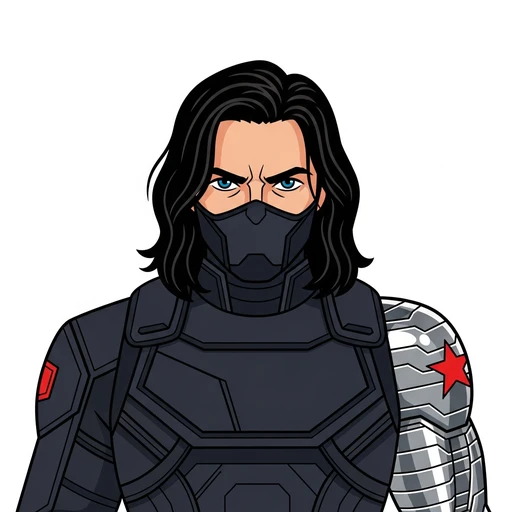
Brooklyn Boys
Long before there was a Captain America, and long, long before there was a Winter Soldier, there were just two boys in Brooklyn, New York.
The year was 1930-something. Cars were boxy. Radios crackled in every kitchen. The bridges over the East River glowed orange at sunset, and the milkman came around at six in the morning with bottles that clinked in the back of his cart.
James Buchanan Barnes — everyone called him Bucky — lived in a tall, narrow brownstone with his mother, his father, and his three little sisters. His father, George Barnes, worked at the Brooklyn Navy Yard, hauling crates and unloading ships until his shoulders ached. His mother, Winifred, kept a tidy little kitchen that always smelled like soup. Bucky was the oldest. He was tall for his age, with dark hair that fell into his eyes, and a half-grin that made grown-ups assume he was up to something. Sometimes he was.
A few blocks away lived Steve Rogers, a small and very thin boy with a mother named Sarah. Sarah was a nurse. She worked the night shift at a tuberculosis ward in a big city hospital, which meant she came home at sunrise looking exhausted and worried. Steve's father had passed away before Steve was old enough to remember him. Steve got sick easily — asthma, scarlet fever, a heart that didn't quite keep up with the rest of him. He was the smallest boy in his class.
And he had the biggest mouth.
The first time Bucky met Steve, Steve was getting pushed around behind the Brooklyn Heights library. A boy twice his size had decided to take Steve's lunch money. Steve, against all good sense, had put his fists up and said, "I can do this all day." He couldn't. He was about to get knocked flat.
Bucky came around the corner with his hands in his pockets, took one quiet look at the scene, and walked over. He didn't yell. He didn't swing first. He just stood next to Steve and said, "Pick on someone else." The bigger boy looked at Bucky. Bucky was tall. Bucky looked steady. The bigger boy left.
Steve dusted himself off. Bucky looked at him for a long second and said, "You always start fights you can't win?"
"Sometimes I win them," Steve said.
Bucky grinned. "I'll bet you do, pal."
That was the beginning of everything.
From that afternoon on, the two boys were inseparable. Bucky's family folded Steve in like he belonged. Mrs. Barnes set a plate for him at dinner whenever Sarah was working the night shift. Bucky's little sisters adopted Steve as a kind of second brother, even though he was skinnier than the broom. Steve learned how to play stickball in the alley. Bucky learned how to listen when Steve wanted to talk about books.
They walked to school together down Flatbush Avenue, Bucky carrying his books and half of Steve's, Steve too proud to admit he was tired by the third block. They cheered for the Brooklyn Dodgers — Ebbets Field was their cathedral. Steve couldn't afford tickets, so Bucky pretended to win them in coin flips. He had not. He saved his nickels for weeks. He took Steve to every home game he could.
In summer, they went to Coney Island. They ate Nathan's hot dogs. They walked the boardwalk. They rode the Wonder Wheel until Steve felt fine and the Cyclone until Steve definitely did not. After the Cyclone, Steve was very, very quiet on the way home. Bucky carried his lemonade. He never told a soul, not when they were kids, not when Steve was six feet of solid muscle, not when Steve was Captain America posing for war bonds. Some things were just between best friends.
On Friday nights, they went to the movies at the little theater on Atlantic Avenue. Adventure serials — Flash Gordon, Buck Rogers in the 25th Century, gangster pictures, anything with a man in a hat doing the right thing. Bucky always sat on the aisle to stretch his legs. Steve always sat right next to him, head tipped back, eyes wide, mouthing the heroes' lines along with the screen.
That was their world. Brooklyn. Friday nights. Stickball in the alley. Soup at the Barnes table. Two boys planning a future neither one could really see yet.
Then came the hardest year.
Sarah Rogers, Steve's mother, had been a nurse on the tuberculosis ward for too long. She caught the disease herself. She fought it for a long time. And one cold winter, she passed away.
Steve sat on the steps of the funeral home afterward, his hat in his hands. He didn't know where to go. He had no other family in the city. He could go back to his apartment, but it would be empty. He could go to the Barnes house, but he didn't want to impose. He just sat. The afternoon got colder. The sky turned the color of an old penny.
Bucky walked up the block. He saw Steve on the steps. He didn't ask questions. He didn't make speeches. He just walked over and sat down next to him, close enough that their shoulders touched.
After a long quiet minute, Bucky said, "You're coming home with me tonight. Mom's got a bed made up. Don't argue."
Steve tried to argue.
Bucky waved him off. Then he looked at Steve, very serious, and said the words that would echo through everything that ever came after:
"I'm with you to the end of the line, pal."
Steve looked at him.
"End of the line," he said back.
That was the promise. And neither of them knew yet how far that line would stretch — across an ocean, through a war, into ice, into seventy lost years, into a metal arm and a serum and a shield and a fall and a long, slow walk home. They didn't know any of that on the funeral home steps in Brooklyn.
They just knew they were not alone.
And they never, ever would be.