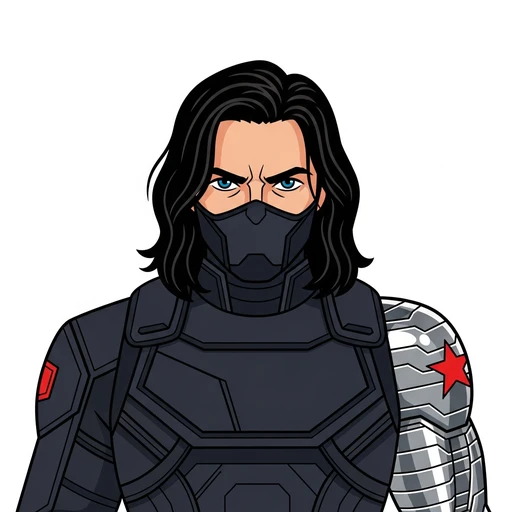
The Amends List
There is a special kind of courage that no one ever gives a medal for. It is not the courage of running into a burning building, or facing a monster with a sword. It is the quieter courage of going back to people you have wronged and telling them the truth.
This is the story of Bucky Barnes learning to do that. One name at a time.
After Wakanda, after Shuri turned off the trigger words, after Thanos and the Blip and the long strange years that followed, Bucky finally came home to Brooklyn. He found a tiny rented apartment near the riverfront. It had a single window, a small kitchen, a bed, and a fire escape where pigeons argued in the mornings. It was the first place he had ever lived all by himself.
Bucky also had to start seeing a therapist. The United States government had decided that if he wanted to walk around like a regular citizen, he had to meet weekly with a court-appointed counselor named Dr. Christina Raynor. Dr. Raynor was not impressed by superheroes. She was not impressed by being one hundred and six years old. She was not impressed by having a vibranium arm. She wanted him to do the actual work.
She gave him three rules.
One — no acting against the people who had once hurt him. Revenge was off the table. That part of his life was over.
Two — no breaking the law. He was on parole. The whole country was watching.
And three — make amends to the people he had hurt, while he was the Winter Soldier and HYDRA had been driving the body. Not pretending it hadn't happened. Not paying it off with money. Real, slow, honest amends.
She handed him a small spiral notebook.
Bucky took the notebook home. He stared at it for two whole days. He did not want to open it. He had spent seven years in Wakanda quietly farming goats, partly because facing the names on this page was the hardest thing he could imagine doing. But Dr. Raynor was right. He could not begin his real life until he had cleaned up the mess of the false one.
So on a rainy Tuesday afternoon, with the rain tapping the window and the pigeons quarreling on the fire escape and a fresh black pen from the corner bodega in his hand, Bucky Barnes opened the notebook to page one and started writing.
He wrote slowly. The memories came back in fragments — a face in a stairwell, a voice through a doorway, a hand reaching for him in the snow. He wrote each name in plain block letters. Some he knew right away. Some he had to work for. Some he could only describe — "the security guard at the safe house in Odessa, gray mustache, glasses." He filled the first page. He filled the second. He kept writing. When he finally set the pen down, both sides of the first three pages were covered in three neat columns of names.
His hand was shaking.
He brought the notebook to Dr. Raynor the next morning. She read it carefully. She did not gasp. She did not flinch. She did not lecture. She closed it, set it on her desk, looked at him with steady eyes and said, "Good. Now we work."
The work was harder than any fight Bucky had ever been in.
Each name was its own slow project. Some he could help directly. A man named Aaron Cleary in Detroit had lost his father to a Winter Soldier mission decades earlier. Bucky tracked Aaron down, learned that Aaron's mother was buried under medical debt, and quietly arranged for the debt to vanish. Aaron never knew where the help came from. Bucky did not tell him. Some amends don't need a name attached. The help is the thing.
A woman named Leah Behrens in Berlin had lost her older brother. Bucky learned that Leah's grown daughter had been searching for her brother's missing wristwatch — an old family heirloom — for almost twenty years. Bucky had been the one to take it. He still had it, in a drawer of an old safehouse in Bucharest. He flew there. He retrieved it. He mailed it to Leah's daughter through a friend with no return address. The daughter cried for an hour when it arrived. Leah lit a candle that night. Bucky crossed the name off in his notebook.
But some names could not be handled in the background. Some required the hardest amends of all — telling the person, to their face, what had happened. Walking into their living room and saying: I was there. I am the reason your son did not come home. I am sorry. I am so very sorry.
Bucky was not good at that part.
He was good at fighting. He was good at being quiet. He was very, very bad at speaking aloud about what he had done. The words would dry up in his mouth. He would find himself, instead, doing kind things in the person's life — bringing groceries, fixing fences, sitting at their dinner table — without ever quite saying the truth.
Dr. Raynor caught him at it one afternoon. She read his weekly log and said, "Bucky. You're hiding in kindness."
He started to argue.
She held up one hand. "You don't get to skip the honest part because it's the scary part. That's the whole work."
Bucky sat with that for a long minute. He realized she was right. He had been letting himself off the hook. Kindness was easier than confession.
He put the name back on the active list. He went back the next day. He sat with the person on a park bench, and he told them the truth.
The person was furious. The person cried. The person told Bucky to leave and never come back. Bucky stood up and walked away. He did not argue. He did not apologize again. He just left.
And here is what he discovered, sitting on a stoop three blocks away with his hands on his knees:
He felt lighter.
Not happy. Not forgiven. Not finished. Just lighter. Like he had set down a stone he had been carrying for seventy years without knowing it. The truth — even when it was rejected — had a weight that the secret had not.
That is when he understood what amends actually were.
Amends are not about being forgiven. They are not a transaction. You do not confess your wrong and receive forgiveness like change from a cash register. The other person owes you nothing. They might forgive you. They might not. They might never speak to you again. None of that is up to you.
The only part that is up to you is whether you tell the truth.
The honesty is the work. The honesty is the whole work.
Once Bucky understood that, the notebook started to move faster.
Some names came with notes — "called his sister, gave her the photo, she said thank you." Some names came with no notes at all — the silence of people who had asked him to leave and never look back. Bucky respected those silences. He did not chase forgiveness. He did not push. He let people be where they needed to be.
The notebook lived in the inside pocket of his jacket. It went with him everywhere. It got rained on. It got coffee-stained. The corners got soft. The pages curled at the edges. He bought a second pen. He bought a third pen. He kept going.
Dr. Raynor watched him do the work, week by week. She did not tell him he was a good man. She did not tell him he was a bad man. She just nodded when he made progress and pressed him when he avoided the hard parts. That was her gift, and it was a real one.
One spring afternoon, Bucky crossed off the last name on the active list. He sat at his kitchen table with the notebook in front of him. The rain was tapping the window again, just like the day he had started. He flipped through the pages — names with lines through them, names with quiet notes, names with nothing beside them. A long, slow record of one man's honest year.
He did not feel triumphant.
He did not feel finished, either. There would always be more. He was an old man with a long history. New names would surface. Old people would have new needs. The work was not really a list. The work was a way of living.
But that day, with the notebook closed on the kitchen table and the rain on the window and the pigeons fussing on the fire escape, Bucky Barnes felt something he had not felt in seventy years.
He felt like a person.
Not a weapon. Not a ghost. Not a mission asset. A person. Imperfect and tired and still standing, with his own pen, in his own apartment, in his own home town.
He picked up the phone. He called Sam Wilson.
"Hey," he said. "You busy?"
Sam laughed on the other end. "Always. What's up?"
"Just wanted to say hi," Bucky said.
And that, all by itself, was the bravest thing he had said all year.