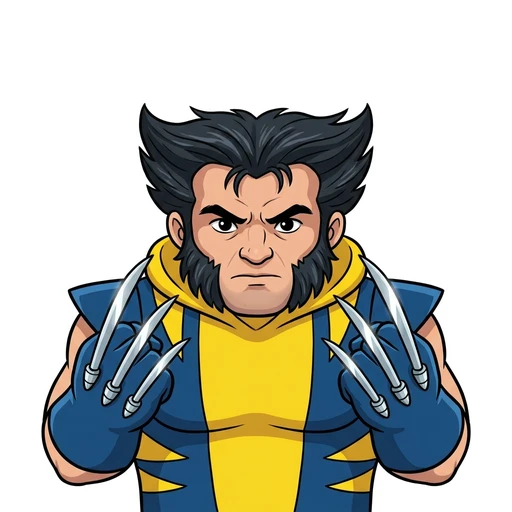
Weapon X
Once upon a time, in the coldest, quietest part of Canada, there was a secret that Logan did not yet know about himself.
Deep in the Canadian Rockies — where the mountains rise up like giants and the snow is so thick it muffles every sound — there was a hidden facility. It had no name on the door. It had no sign on the road. The people inside worked in silence, in rooms full of cold metal instruments and humming machines. They called their project Weapon X.
For a very long time, those scientists had been gathering reports about a man who could not be harmed. A man whose wounds closed like water closing over a thrown stone. A man who had fought in wars and walked away when others could not. They had been watching from a distance, making notes, drawing plans.
And then, one day, they stopped watching.
They captured Logan and brought him to that cold facility in the mountains.
Now. This part of the story is the hard part — the part that Logan carried with him for a very long time afterward. So breathe slowly, and remember: the story ends somewhere warm.
The scientists had discovered something remarkable: a metal called adamantium. It was one of the strongest materials in the known world, dense and silver and unyielding, and the scientists had learned how to make it flow like liquid and then harden like stone. They wanted to use it to coat Logan's skeleton — every bone, every rib, every one of his natural claws.
They believed this would make Logan into a weapon. And they were right, in a way. They were just wrong about who the weapon would belong to.
The procedure was the most difficult thing Logan had ever endured. But even in that cold room, Logan's healing factor — the quiet miracle hidden in his blood — was working. It had always worked, through every wound and every battle of his long life. It worked now, too, mending and fighting and keeping him alive through every moment.
When it was over, Logan's skeleton was wrapped in gleaming adamantium. Every bone, coated in metal that would never break. And his claws — three on each hand — were no longer just sharpened bone. They were bright, permanent, extraordinary. SNIKT. There they were.
But something else had happened too. The trauma of the procedure had jumbled Logan's memories. He could not find the edges of who he was. He could not remember his name. He ran — out of that cold facility, out into the wilderness, into the howling white dark of a Canadian winter.
He ran until the trees were behind him and the snow was up to his knees and the sky above was nothing but black and stars.
He did not know where he was going.
He only knew he was free.
Then — very gently, like the first hint of spring — help arrived.
Professor Charles Xavier was a man who had spent his whole life believing that extraordinary people deserved kindness, not laboratories. He ran a school in Westchester, New York, called Xavier's School for Gifted Youngsters. And when Professor Xavier found Logan — gruff, confused, wild-eyed, standing in the snow with his claws out and his heart in pieces — Xavier did not step back.
He stepped forward.
"I know who you are," said Professor Xavier. "And I know what you could be."
It took time. It always does. But at Xavier's school, surrounded by people who understood what it meant to be different and powerful and afraid — Logan began to remember. Not everything. Not all at once. But piece by piece, the way a puzzle comes together on a rainy afternoon, the edges of himself came back.
And the adamantium? It was part of him now, and it would always be. But it was his. Not Weapon X's. Not a program's. His own, just like his claws and his healing factor and the good heart he had always carried underneath all that roughness.
So if you ever wonder why Wolverine sometimes seems a little quieter than the other X-Men — a little more careful, a little more watchful — now you know.
He knows what it is to lose yourself, and to find your way back.
That is not weakness. That is wisdom.
Sleep gently, little one. Even the strongest hearts need rest.