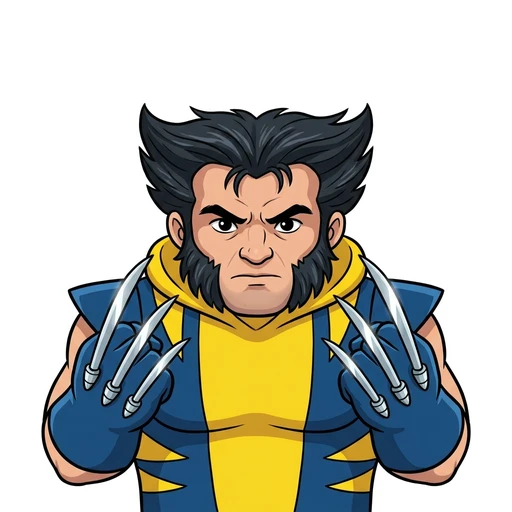
Adamantium Claws
Once upon a time, a young student at Xavier's School for Gifted Youngsters asked Logan a question that no one had ever asked him quite so directly before.
The student's name was Jubilee, and she had bright eyes and a habit of getting to the point. She had been at the school for three months, which was long enough to have stopped being surprised by most things, and short enough that some things still surprised her very much.
One afternoon, she found Logan in the workshop — a big, clean room full of tools and workbenches at the back of the school building — and she sat down on the edge of a worktable and said:
"Can I ask you something about your claws?"
Logan looked up from the piece of equipment he was adjusting. He set down the wrench. He gave her the particular look that meant he was listening, even if he wasn't going to say so.
"Go ahead."
"Were they always metal? Like — were you born with them like that? Silver?"
Logan was quiet for a moment. He pulled up a stool, turned it around, and sat down on it backward, folding his arms over the back.
"No," he said. "They weren't always metal."
And he told her.
The claws, he explained, were bone at first. Pure bone — dense and curved, three to each hand, tucked away between his knuckles where no one could see them until the very first time they came out. That had been a long time ago, on a stormy night in Alberta, Canada, and it had frightened him considerably. A natural mutation, just like his healing factor, just like his sharpened senses. Something his body had always been capable of, waiting for the right — or the wrong — moment.
For years afterward, the bone claws had been his secret. He used them as rarely as possible. They were strong, and they were useful, and they were part of him — but he had no particular desire to advertise them. In the lumber camps of British Columbia, in the wild country he passed through, in the years of wandering that came after, he kept them folded away. Most people never knew they existed.
"What changed?" Jubilee asked.
"Weapon X," Logan said simply.
He had already told her the broad strokes of that story — most students at Xavier's school knew the outline, because Professor Xavier believed in being honest about difficult things. But he had not told her what it had meant for the claws specifically.
The adamantium — that extraordinary metallic alloy, dense as a collapsed star, harder than almost any material science had found or invented — had been bonded to every bone in his body. Every rib, every vertebra, every metatarsal. And when the process was complete and Logan had come back to himself in that cold facility, he had extended the claws for the first time and found them transformed.
They were silver now. Not ivory. Not bone-white. Silver, gleaming and permanent, catching the light the way a mirror does on a bright day.
And they were nearly indestructible.
Jubilee looked at his hands, which were resting on the back of the stool, perfectly relaxed, showing nothing. She tried to imagine those claws folded away inside them. It seemed impossible, and yet here he was.
"Does it hurt?" she asked. "When they come out?"
Logan thought about this — thought about it genuinely, which he appreciated she deserved. "Used to," he said. "Less now. Heals faster than it used to bother me."
Jubilee nodded slowly. She looked at his knuckles, which were perfectly ordinary-looking. Three small lines. That was all.
"What do you use them for?" she asked. "Like — in real life. Not just fighting."
Now Logan smiled. It was the particular small smile he used when a question was better than expected.
He had used the adamantium claws to cut ropes when his teammates were trapped. To slice through a locked metal door in a building where the key had been lost and the person inside needed to get out. To deflect blasts and blocks and thrown objects, holding his forearms up like the world's most effective shield. He had cut a path through a collapsed section of forest road in northern Westchester after a storm, clearing the way for vehicles that needed to get through. He had used them as anchors, driving them into rock faces to hang on when climbing. He had, once, very carefully and very slowly, cut a tiny piece of wire out of a piece of electronics that had seized up, because he had better fine control of the claws than any of the tools in the workshop.
Jubilee laughed at that last one. "You fixed electronics with your claws?"
"Carefully," said Logan.
They sat quietly for a moment, the workshop full of late afternoon light.
"Professor Xavier says the claws are an instrument," Jubilee said finally, "not a weapon. He said that in the first week."
"He's right," said Logan.
"But you decide," said Jubilee. "When they come out. It's not automatic."
"Always my decision," said Logan. "Every time."
Jubilee looked at him — at the gruff face and the wild hair and the absolutely ordinary-looking hands resting on the back of that stool — and she thought about what it meant to carry something extraordinary your whole life, quietly, and only use it when it was needed.
She thought it was rather a good way to be.
"Okay," she said, and slid off the worktable. "Thanks."
"Any time," said Logan.
She was halfway to the door when she heard it — SNIKT, quiet and clean — and turned to see three silver claws extended from his right hand, the afternoon light catching them like water.
He was testing the extension, making sure the mechanism was smooth. A daily habit. Like sharpening a pencil before you sit down to write.
She smiled. He folded them back in. She went back to her room.
And in the workshop, the late light lay warmly across the workbench, and everything was quiet and right.
Sleep gently, little one. The most useful things are often the ones you keep very, very quiet.