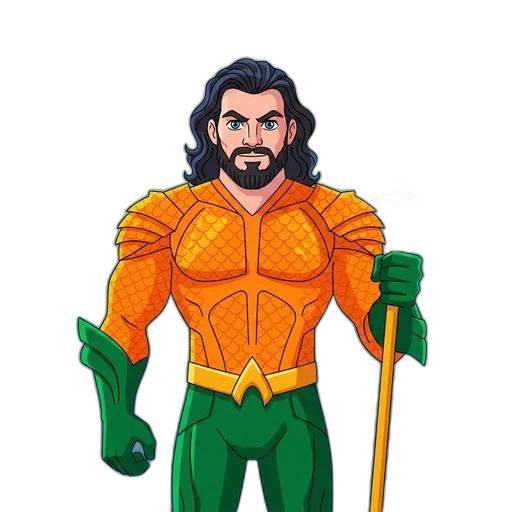
Trident Of Neptune Atlantis
If you dove from the surface of the Atlantic Ocean and kept going — past the sunlit zone where the water is turquoise and clear, past the twilight zone where the light becomes purple and dim, past the midnight zone where it is completely dark and most creatures glow their own cold light — you would eventually reach a depth where the pressure of the water above you is extraordinary, and the silence is complete, and the darkness is total.
Keep going.
Past the hadal zone. Past the abyssal plain. Into the deepest fold of the Atlantic where the ocean itself seems to hold its breath.
And there, settled on the sea floor as naturally as a city grows from the earth, is Atlantis.
Can you picture it? It is nothing like the ruins you might imagine — crumbled and barnacled and forgotten. Atlantis is alive. Its towers rise from the floor in sweeping curves of coral and glass, the walls grown from a living material that has been tended for ten thousand years and glows with its own soft blue-green light. Bridges arc between them like the ribs of some enormous creature. The streets are wide and clean, and in them, the people of Atlantis move with the unhurried ease of beings for whom water is simply home — swimming with the same casual efficiency that surface people walk, rising to the higher levels and descending to the lower ones, stopping to talk in slow-moving currents that carry their words.
Children play in the kelp forests that border the palace grounds, darting in and out of the tall green fronds, trailing glowing sea turtles. In the markets, merchants exchange goods on the backs of great rays, whose wing-beats keep them hovering in place like living countertops. The vehicles of Atlantis are shaped like fish — not imitating fish, but actually shaped with the same mathematical precision that makes fish so efficient in the water, and powered by the same current-energy that powers the towers.
At the center of it all, in the great throne room of the royal palace, is the Trident of Neptune.
It hangs above the throne in its place of honor when Arthur is not carrying it — a great golden weapon, taller than a man, its three prongs forged from a metal that the surface world does not have a name for, that has never rusted in ten thousand years of ocean exposure, that hums very faintly in the hands of someone who is authorized to hold it.
Its power is the ocean's power. Arthur can raise a wave with it. He can still a storm. He can forge a path through the sea — a corridor of calmed water in any direction, walkable even by those who cannot breathe underwater. He can channel energy through it in a pulse that travels through water the way sound travels through air: in every direction simultaneously, felt at once by every creature in range.
This is why the Trident is more than a weapon. It is the symbol of authority over the sea. The sea creatures of the Atlantic and the Pacific and the Indian Ocean and the Arctic all recognize it — not because they have been taught to, but because the Trident carries, in its vibrations, something they respond to at the most basic level. Something that says: this is the one in charge of the whole of it, the one who is responsible for all of you.
Mera rules alongside Arthur in the palace. Her hydrokinesis — the ability to shape water itself into any form, hard as glass or sharp as a knife — complements the Trident's authority with something more tactical and immediate. The two of them together are the balance that Atlantis has always needed: the broad authority and the precise power, the king and the queen, the trident and the wave.
Arthur stands in the throne room sometimes, in the early hours before the city wakes fully, and looks at Atlantis through the great windows. The towers glow. The corridors are quiet. Somewhere in the kelp forest, a school of fish moves in the synchronized drift of something that has no leader and needs none.
He thinks of the lighthouse in Amnesty Bay. The beam sweeping the Atlantic in its slow, patient arc.
Two lights in two darknesses. Both saying the same thing: come home, I can see you, you are not lost.
He carries both of them with him, the lighthouse and the palace. Both are home. Both are him. A true king, his father once told him — not in words, but in the example of a whole life — does not claim his power.
He tends it.