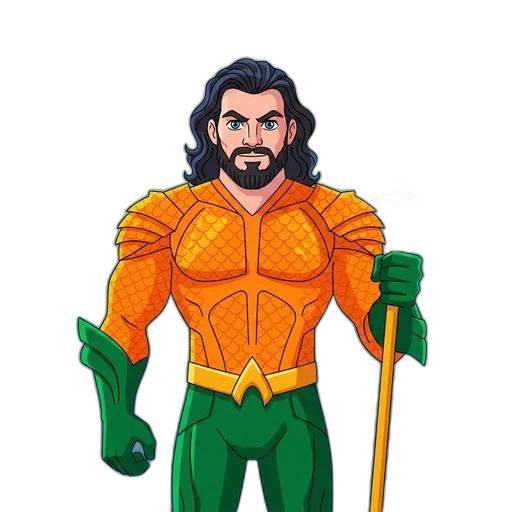
Justice League Ocean Patrol
The call came in on a Saturday, which was not unusual. Most calls came in on days when they were inconvenient.
A cargo vessel in the North Atlantic had sent a distress signal — caught in a storm system that had developed faster than any forecast had predicted, waves topping twenty meters, the ship's engine taking on water. Forty-three crew aboard.
Arthur was in the water before the League finished the briefing.
He arrived at the stricken vessel in under four minutes, covering seven hundred miles of Atlantic at a depth that let him travel faster than the surface chop would allow. He surfaced near the ship's stern and held on to the hull with one hand, taking the measure of the storm. The waves were extraordinary — massive, deep-ocean swells built up over days of open water, arriving at the ship like walls of dark glass. The rain was horizontal. The wind made a sound that went past sound into vibration.
Arthur put the Trident in the water.
He felt the storm through the Trident the way you feel a conversation through a phone — a translation, not the thing itself, but enough to work with. He could not stop a storm this size. But he could shape the water immediately around the ship — guide the worst of the swells around it rather than into it, smooth the sea in a radius of a hundred meters while the full violence of the storm continued beyond that radius.
SPLASH — a wave that had been about to break over the bow redirected sideways, folded into the chop rather than crashing down. WHOOSH — another one rerouted. The ship steadied slightly. Not calm — not calm, not even close — but manageable.
The pumps could work with manageable.
From the bridge, the captain watched through rain-blurred glass. He saw a figure in the water beside his ship, one hand on the hull, one hand holding something gold that caught no light because there was no light to catch. He saw the waves — the impossible, lethal waves — turn. He had been at sea for thirty years and he had never seen waves turn.
He got on the radio. "This is Captain Reyes of the Meridian Star. We have — we have assistance. Aquaman is —" He stopped. Started again. "We're going to be okay."
On the League comm, Superman checked in from the coast of Portugal, where he was monitoring the storm's inland edge. "Do you need anything?"
"Keep the coastal flooding managed," Arthur said through the water-resistant comm. "I've got the ship."
He stayed with it for four hours. Not heroically — not the way it sounds in stories. Actually: four hours in a cold Atlantic storm, holding position with his legs and monitoring the currents with one hand while keeping the other on the Trident, reading the sea the way his father had taught him to read the Maine coast, feeling the movements before they arrived and positioning the water accordingly.
The storm moved northeast. The ship held together. At first light, a Coast Guard cutter reached the Meridian Star and the crew was safe.
Arthur dove.
On his way home to Atlantis, he took a different route than usual — swinging south through the waters of the tropical Atlantic, where a coral reef had been showing stress signals in the monitoring systems he'd set up in cooperation with a marine biology team at the University of Miami. He checked it. The bleaching he'd been worried about was stable. He made a note. He checked in with the sea turtles that nested on a particular beach in the Lesser Antilles — still there, eggs healthy. He checked the migration route of a humpback whale family he'd been tracking for six years. They were on time, moving northwest.
He arrived at Atlantis in the afternoon, while the blue-green light of the towers was doing the thing it did at that time of day — catching the bioluminescent plankton in the current and scattering it through the corridors in drifting sparks. He was hungry. Mera was in the council chamber, finishing a meeting about the trade routes with the Xebel kingdom.
She looked up when he came in. She took one look at him — the cold-Atlantic look, the storm-hours look — and dismissed the council without ceremony.
"Tell me," she said.
He told her. The storm, the ship, the forty-three crew, the Captain Reyes on his radio saying we're going to be okay. The reef check. The turtles. The humpback family.
Mera listened, watching him, the way she always listened: entirely, with the full weight of her attention, which was considerable.
"Heroism," she said when he finished, "is as much about caring for the world as it is about fighting for it."
"That's what I keep saying."
"I know," she said. "I learned it from you."
In the kelp forest outside the palace, a sea turtle drifted in the current, unhurried and ancient, its shadow moving slow and deliberate across the ocean floor below.
Aquaman watched it through the window. He felt the weight of the sea around him — seven hundred million cubic miles of it, every inch his responsibility, every creature in it his ward.
He had been given no choice in this. He had been born into it.
He had chosen it anyway. Every day. He chose it.
That, he thought, was the difference between duty and devotion.
He turned from the window and went to find something to eat.