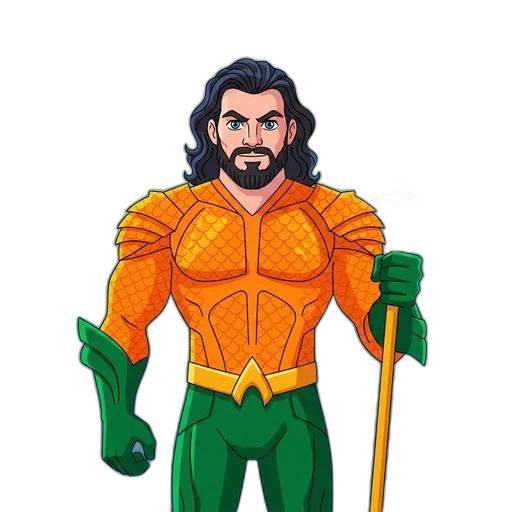
Mera Partnership
The whirlpools appeared on a Tuesday, which nobody had predicted.
There were seven of them, spaced across the trade routes between the seven kingdoms — the underwater shipping lanes that moved goods from Atlantis to Xebel to the Brine to the Drift and back again. Not natural whirlpools, which have a certain organic character to them, the rotation gradual and responsive to the current. These were precise. Perfect spirals of force that began suddenly and maintained their shape with the consistency of something engineered.
Arthur felt them through the water before the reports came in. Mera had already mapped two of them by the time he was pulling on his gear.
"Mercenaries," she said. She had already located three of them via hydrokinesis — her ability to sense and shape water letting her read the artificial signatures in the current. Her jaw was set. "Xebel splinter cell. They're using sonic technology."
"High-pressure cannons?"
"From the signature, yes." She looked at him. "They're going to target me first."
"I know," Arthur said. "They should."
She raised an eyebrow.
"You're the bigger threat," he said. "They know that."
Mera was, in the particular taxonomy of Atlantean power, something different from Arthur. His strength was physical, his authority oceanic, his Trident the symbol and expression of royal power. Mera's power was hydrokinesis — the Xebelian ability to take water and make it do what she decided it would do, and she had taken this ability further than anyone in Xebel's history. She could make water hard as glass, shaped as a spear, or a shield, or a lattice of crystalline force that stopped sonic energy cold. She could read the currents the way a musician reads a score: entirely, with immediate comprehension, responding in real time.
They moved through the trade routes in formation — Arthur on the front line, drawing the mercenaries' attention and the front edge of their sonic fire, while Mera mapped and protected and repositioned from the flank. BOOM — a high-pressure sonic blast hit the water to Arthur's left, and he felt it as a physical impact, a compression wave that would have rattled lesser biology. KRANG — the Trident deflected the next one. Behind him, Mera raised a hard-water shield that caught the third.
"Two o'clock," Mera said quietly. He moved. She moved the opposite direction. They did not need to discuss this — they had trained together long enough that the coordination was automatic, two minds that had worked in close proximity for years settling into something faster than communication.
SPLASH — Mera shaped a crystalline spear from the surrounding water and sent it spinning through a sonic cannon mounted on a mercenary's chassis. The cannon went dark. The mercenary turned toward her. Arthur was already there — KRANG — the Trident in the mercenary's path, stopping the charge cleanly.
The battle moved through the trade route in three stages — the first engagement driving the mercenaries out of formation, the second pressing their retreat, the third closing the exits they'd prepared. Mera had mapped the escape routes while fighting the first wave. She was good at thinking in three directions simultaneously.
It ended with the mercenaries in Atlantis's custody and the seven whirlpools dissolving as their generators went offline, the water relaxing back into its natural patterns with the particular sigh of something returning to what it should be.
Arthur and Mera sat on a ledge of coral in the kelp forest on the edge of the trade route, letting the current move past them. The bioluminescent plankton drifted through the dark water like slow breathing stars.
"They thought targeting you would draw me out of my approach," Arthur said.
"It would have," Mera said, "if you weren't very good at staying in your approach."
"I know what you're doing when you move left."
"You know what I'm doing when I move in any direction," she said. "That's the point."
This was the architecture of their partnership, built across years of working alongside each other through things that would have ended most partnerships: the trust that did not need to be established in the moment because it had been established in a hundred previous moments. The knowledge of each other's thinking that made communication optional. The understanding that the Trident and the wave were not different things but the same force expressed in two ways.
Atlantis needed both of them. Not one and then the other — both simultaneously, the way the ocean needed both the current and the depth.
In the kelp forest, the plankton moved in their slow drift. Something large and dark moved through the fronds on the far side — a blue-fin tuna, unhurried, following its own route through the green.
Mera watched it. "I had a report this morning about the northern routes," she said. "Another ship dragging its net."
"I saw it," Arthur said. "I'll go tomorrow."
"We'll go tomorrow," she said.
He looked at her.
She looked back.
"The ocean," she said, "is quite large. Two people are better than one."
He put his hand over hers on the coral ledge. The current moved. The plankton drifted. The kelp swayed in its slow, continuous dance.
Two kings. One kingdom. All of it, tended.