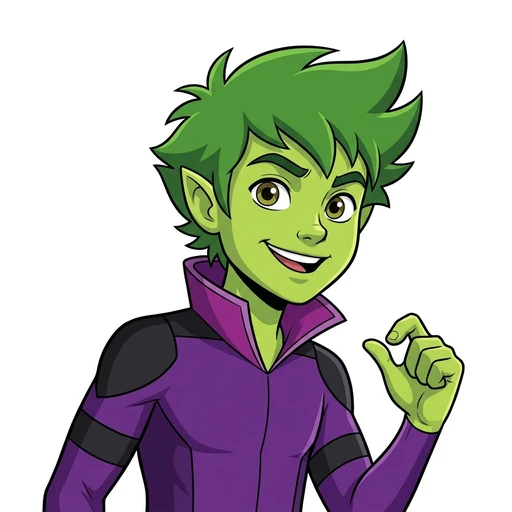
Friendship With Raven
Once upon a time, two very different people became very good friends.
This is not unusual as stories go. But the particular way it happened, and the things that made it work, are worth telling carefully.
Raven was quiet. Not quiet in the way of having nothing to say — she had a great deal to say, and when she said it, it was precise and worth hearing. She was quiet in the way of someone who knew that words had weight and chose to spend them deliberately. She had enormous powers — shadow-travel, empathy, dark energy that could lift objects across a room — and all of those powers drew from emotion, which meant she kept her emotions at a very careful distance. She meditated every morning. She had, in the first week at the Tower, found the corner of the common room with the best reading light, and that corner was hers now by the quiet agreement that happens without anyone having to say so.
Garfield Logan did not have a quiet corner. He made impressions of team members when they weren't in the room. He told puns — an apparently inexhaustible supply — and laughed at them himself when no one else did. The first time he made a joke in Raven's direction, she looked at him for two seconds and returned to her book.
Most people would have taken that as a signal.
Garfield took it as research.
He started keeping a catalog in the back of his mind. What almost made Raven react. A dry observation about something mundane — closer. A specific absurdist scenario — a little closer. The impression of Robin explaining why the mission debrief paperwork needed three copies in triplicate: Raven's mouth moved. Just the corner. Just for a moment, before she put it back.
He catalogued that very carefully.
What Raven gave him in return, he did not expect and did not have words for at first. She noticed things. She read with the full weight of her attention, and that attention extended outward to the people nearby in small, reliable ways. She could tell, without asking, when Garfield had come back from something difficult. She did not ask. She simply continued to exist in the same space, readable her book, available without announcement. He had discovered, over the first months in the Tower, that this was enormously valuable.
There was a day — cold, late autumn — when Garfield climbed to the Tower roof after a hard mission and sat at the edge, feeling uncertain. Not about who he was, exactly. But sometimes, when things have been difficult, the ground under your identity shifts slightly. He sat there and the city moved below him and he did not have an answer ready.
The roof access opened. Raven came out with her book. She looked at him for one moment, then sat down two feet away and opened to her page.
She did not say: are you all right? She read. He sat. The bay was silver with evening light. Twenty minutes, or perhaps thirty.
He was, by the end of it, entirely himself again.
She closed her book.
She said, in her particular level voice: "You know what you are."
He thought about it. Really thought about it, the way the question deserved.
"Green," he said.
She said: "That too."
Then she stood, tucked the book under her arm, and went back through the roof access.
He stayed another minute, looking at the city. Then he followed her inside, where the Tower was warm and Cyborg was cooking something good and Starfire was telling Robin about something she'd seen above the bay.
They remained, by all visible measures, entirely different. Her room was orderly; his was not. She rose early to meditate; he practiced T-rex roars in the hallway. But the team had learned something. When something subtle needed to be noticed — a quiet struggle, a pattern in an enemy's behavior — look to the corner where Raven was reading.
And look for the green boy two feet away, pretending to read his comic book.
He was not reading his comic book.
He was paying attention.
Raven had noticed that in the second week. She had simply decided not to tell him yet. She would know when to.