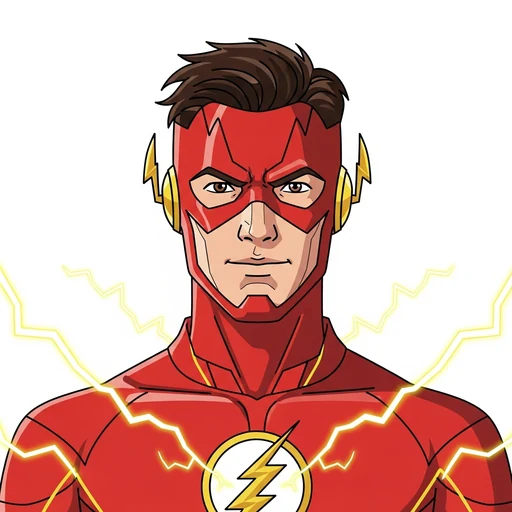
Reverse Flash Rivalry
There is a version of the Flash's story where everything is different.
In that version, Barry Allen does not have a warm, ordinary childhood in Central City. In that version, his mother is not there. His father is wrongly blamed. Barry grows up with a grief that he has to carry alone, and it shapes him, and he becomes who he is partly because of it — learning to run toward things rather than away from them, learning that speed is meaningless without purpose.
Someone from the future made that version happen.
His name is Eobard Thawne, and he came from the 25th century, and he was obsessed with the Flash in the way that shadows are obsessed with light — unable to exist independently of it, defined entirely by its presence, both drawn to it and working ceaselessly to extinguish it. He had studied Barry Allen across centuries of records. He had reconstructed the accident in his own time, standing in a laboratory full of chemicals in a thunderstorm that he had manufactured, waiting for a bolt that he had calculated. He connected himself to the Negative Speed Force — a dark mirror of the Speed Force, drawn not from creation but from entropy — and wrapped himself in yellow where Barry wore red.
Then he traveled backward through time to make Barry's life as painful as possible.
This is, if you think about it carefully, a very strange way to express admiration. Thawne thought it was the opposite of admiration. He thought he hated Barry Allen. He was wrong. What he felt was something more complicated and more sad than hatred — the feeling of someone who wanted to be the hero and couldn't, who looked at someone else being the thing he most wanted to be and felt it as a wound that never closed.
Barry understood this. He didn't forgive it — the things Thawne had done were too large and too cruel for anything so simple as forgiveness — but he understood it. And understanding it gave him something Thawne could never have: clarity.
Their battles were unlike anything else in Barry's experience. They moved at speeds where the world around them stopped — not slowed but stopped, frozen in the instants between heartbeats, buildings and streets and falling leaves hanging absolutely still while two red-and-yellow figures moved through the paused world like thoughts. Chronal energy crackled at the edges of their trails — the evidence of time travel meeting itself, timelines bumping against each other. The air smelled like lightning and old books.
Thawne's particular advantage was not speed — he matched Barry almost exactly — but temporal knowledge. He had studied Barry's history and knew his choices. He could move to the moment before Barry's decision and already be positioned for its consequence.
Barry's particular advantage was something harder to explain: he actually ran toward what he was running toward. Thawne ran away from something. And running toward creates a different kind of commitment, a different quality of presence in the moment. Barry's feet hit the ground with intention. Thawne's feet were always halfway somewhere else.
The Multiverse — those alternate realities that branched off from every major choice, every pivotal moment in history — was the battlefield for their longest and most consequential confrontations. Barry had learned from the Cosmic Treadmill how to navigate it. Thawne had the advantage of having studied every branch. Their passes through alternate Central Cities, through timelines where events had gone differently, were a kind of argument: Thawne insisting that Barry Allen was a tragedy, and Barry insisting, by continuing to run, that he was not.
Iris was the reason Barry always came home from the Multiverse. He didn't always know the way — temporal navigation is inexact, and even the Cosmic Treadmill's calibrations could be thrown off by the kinds of chronal disturbances Thawne created. But there was always, at the deepest part of the Speed Force, a thread. Warm and steady, like a light in a window. It pointed toward Central City. It pointed toward the diner on Fifth and the slightly sticky menus and the coffee that was properly hot.
He followed it home every time.
The yellow suit and the red suit still flash across time somewhere, in some conflict or another. This is the nature of their rivalry — it does not resolve, it continues. Each confrontation changes both of them slightly, adjusts the terms, sends them both away with new information.
But Barry Allen always runs home afterward.
And Thawne, who has no home to run to, keeps chasing the thing he cannot become.
The shadow that follows the light. And the light, undimmed, going on.