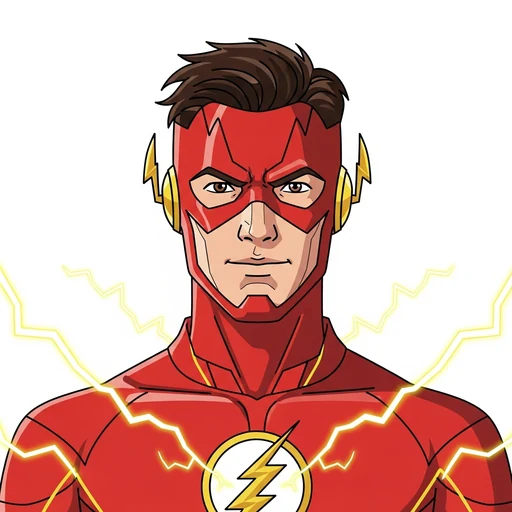
Central City Museum
On a Saturday morning in Central City, the line outside the Flash Museum stretches around the corner and halfway down the block, mostly because there is a school group from the Bayside district that has arrived all at once in three buses, and the museum staff, who are very organized and very kind, are managing the situation with admirable calm.
Barry Allen is standing third from the left in the general admission line, wearing a jacket over his CCPD shirt, his hands in his pockets, watching the school group with the expression of someone trying very hard not to be recognized.
He is not recognized. He never is, in civilian clothes. This continues to be one of the great comforts of his life.
The Flash Museum is, by any reasonable measure, an extraordinary building. Its architecture celebrates speed in a way that makes you feel faster just standing inside it — the curves of the walls, the forward lean of the exhibits, the way light moves through the skylights as if it too is in a hurry. Children run through it at top speed, which the museum has decided to accept as thematically appropriate.
Barry walks through it at a regular person's pace.
He visits because he wants to hear what the city thinks of him. Not what the journalists write — he reads the papers, he knows what they write. He wants to hear what the eleven-year-old in the red jacket says to his friend when they're standing in front of the display case with the original CCPD forensics equipment that Barry Allen used before his life changed. He wants to hear what the two grandmothers say to each other in the Hall of Speed, and what the exhausted parent pushing a stroller says when her toddler points at the lightning bolt emblem on a display panel and says, emphatically, "FAST."
He hears a lot.
He hears a teacher from the Bayside school telling her students about the day the Flash stopped a runaway chemical tanker from reaching the residential districts, and he hears the part she leaves out — that it had taken him four passes, that he had overshot the first time, that it had been genuinely alarming for several minutes — and he appreciates, actually, that she leaves it out. The story she's telling is about courage and community, and those things are true even without the four-passes detail.
He hears two teenagers near the Hall of Rogues argue about whether Captain Cold is secretly a good guy, and the argument is thoughtful and nuanced and lasts longer than he expects.
He hears a small girl tell her mother that she wants to be a forensic scientist when she grows up because of the sign near the entrance that explains what forensic scientists do.
This last one keeps him warm for approximately a week.
The replica Cosmic Treadmill is in the center of the museum's main hall, on a raised platform, illuminated from all directions by soft light. It is built from the original blueprints — Cisco had helped, and had been delighted by the project — and at the touch of a button, it runs at a speed that creates visible vibrations in the air around it. Children press the button many, many times. The museum has replaced the button mechanism four times since opening.
Barry presses it once. He watches the vibrations. He thinks about the real one in STAR Labs, humming in its corner with its faint warmth.
He thinks about Jay Garrick, who has been doing this longer than he has, who showed him the Speed Force's currents on a day when Barry had lost his way, who wears a winged helmet and speaks with the patience of someone who has had forty years to figure out what he thinks. He thinks about the next speedster after him — whoever that will be, wherever they are, the person who will stand in a storm someday and feel the lightning choose them and not know yet what it means.
He will be there for that person. The way Jay was there for him.
Barry buys a small Flash keychain from the gift shop on his way out. He doesn't need it — his keys are already on a ring. He buys it because the teenager behind the counter recognizes his jacket from a CCPD event and starts talking, very excitedly, about forensic science, and he wants to give her his full attention, and the conversation goes on until a small herd of fifth-graders comes in and the teenager needs to get back to work.
She says thank you as he leaves. He says thank you back.
Outside, the school buses are still parked by the curb, the Bayside group reassembling in the afternoon light, loud and cheerful and full of ideas. Barry walks past them, hands in pockets, keychain in his jacket.
The city knows the Flash. The Flash knows the city. This is the agreement, unstated and permanent: the city invests its hope in the red streak, and the red streak shows up, every time, without fail.
A hero's greatest legacy is not the battles won.
It is the line of kids outside the museum on a Saturday morning, arguing cheerfully about whether Captain Cold is secretly a good guy, on their way in to see what made someone want to run toward the world instead of away from it.
That's the legacy. That's enough. That's everything.