Origin
In the borough of Brooklyn, in New York City, in the years when the world was at war, there was a boy named Steve Rogers who wanted more than anything to serve his country.
He was not a big boy. He was thin as a winter branch, and his chest was narrow, and when the winter wind came off the harbor, he coughed. He had asthma, and a heart condition, and poor eyesight, and the doctors at the military recruitment office had looked at his paperwork and stamped it — REJECTED — so many times that the stamp had worn a permanent groove.
But Steve Rogers kept trying.
He went back to the recruitment office again. He filled out the form differently — listing a different hometown, thinking maybe this one would work. The officer behind the desk looked at him, then at the form, then at him again.
From the doorway came a voice.
"I'll take him."
The man who spoke was Dr. Abraham Erskine. He was a gentle man with a German accent and spectacles and the particular kind of calm that belongs to people who have thought very deeply about what matters. He had been watching Steve through the window of the recruitment office. Not Steve's chest measurement or his weight or his eyes. He had been watching the way Steve held himself — the way he stood up straight despite everything, the way he didn't flinch, the way there was something in his face that was harder and more real than any set of muscles.
Dr. Erskine was looking for a good man. Not a strong man. A good man.
"Why do you want to fight so badly?" Erskine asked, later, on the night before the experiment.
Steve thought about it carefully. "I don't like bullies," he said. "I don't care where they're from."
Erskine smiled.
The next morning, in a secret laboratory in Brooklyn — a place called Project Rebirth, run by the Strategic Scientific Reserve, with the backing of a young inventor named Howard Stark — Steve Rogers was placed into a cylindrical chamber of metal and glass. He was given injections: the Super-Soldier Serum, administered by Dr. Erskine with steady hands. Part through a needle, part in a capsule that tasted of nothing he could name.
Then Howard Stark engaged the Vita-Ray array.
Light — not quite like anything else, not sunlight or lightning but something between — flooded the chamber. The serum activated. The process began.
Steve clenched his teeth. He breathed. It hurt. But Steve Rogers had spent his whole life in a body that did not cooperate with what he needed it to do, and he had learned — better than anyone — how to endure.
The chamber opened.
And out stepped Steve Rogers — but taller now, and broader, and stronger than any person in that room, stronger than any soldier on the training grounds, with a straight spine and clear lungs and arms that could lift more than the machines that had measured him that morning.
Everyone in the room was staring.
Steve looked down at himself. He stretched his hands open. He breathed in — a long, clear breath, all the way to the bottom of his lungs, the kind of breath he had never been able to take before.
And then the gunshot rang out. And Dr. Abraham Erskine fell. A saboteur had been watching, had waited for the serum to be used, and had taken the only person who knew how to make it again.
Steve chased the killer all the way to the harbor, faster than he had ever run — faster than should have been possible — and stopped him. But the serum formula was gone. Dr. Erskine was gone. There would never be another super-soldier.
Only Steve.
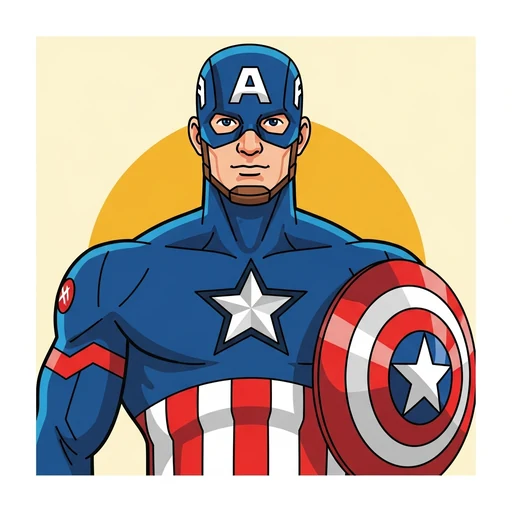
He was given a uniform — red, white, and blue, with a white star on the chest — and a round shield that Howard Stark had found in his workshop, made of a metal called Vibranium from far away in Africa, stronger and lighter than anything else on Earth. When Steve first picked it up, it felt right in his hand. Natural. Like it had been waiting for him.
And Captain America went to war.
Not because he was the strongest, even though he was now among the strongest. Not because he had a great shield, even though the shield was extraordinary. But because he could not stand to see the innocent be hurt, and because someone had to stand up and say so.
He rescued soldiers from behind enemy lines, infiltrated HYDRA strongholds, turned the tide of battles that everyone had believed were already lost. The world watched a boy from Brooklyn become a legend.
But Steve Rogers, inside the uniform, always stayed the same boy from Brooklyn.
That was the whole point.