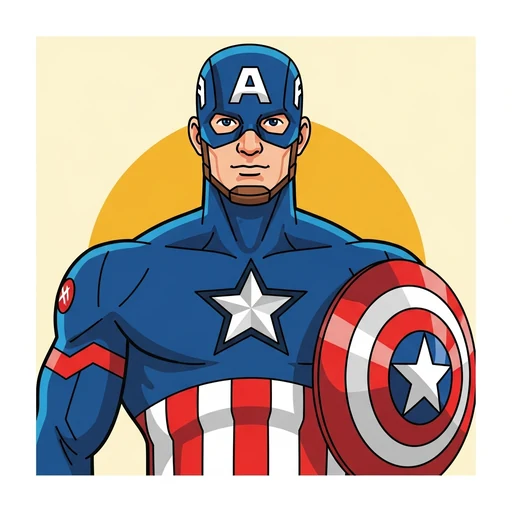
Red Skull
There was a man who wore the face of a monster, and his name was Johann Schmidt.
He was called the Red Skull, and when you see why, you understand it immediately: his face was a deep, terrible crimson, pulled tight like a mask with no nose and hollow places where ordinary eyes would be. It was his true face — the price he had paid for an imperfect version of the same Super-Soldier Serum that had made Steve Rogers Captain America. Where the serum had found a good man and made him better, the serum had found Johann Schmidt and amplified everything that was already terrible in him.
The Red Skull led an organization called HYDRA. HYDRA believed that the world needed to be ruled by force — by terror, by weapons, by whoever was strong enough to take what they wanted and hold on to it. Their insignia was a skull, and their greeting was a salute, and their motto was about how you cut off one head only to have two grow back, which they thought was clever.
Johann Schmidt was not interested in the ordinary weapons of World War II. He was interested in something much older and much more powerful.
The Tesseract.
Close your eyes and picture a cube the size of your closed fist, glowing with a blue light so bright it seemed to pulse like a heartbeat, so intense it made the air around it shimmer like heat rising from summer pavement. That was the Tesseract — a cosmic object of ancient power, one of the rarest and most dangerous things in the entire universe, more energy in that single glowing cube than in any bomb humanity had ever built.
Schmidt found it hidden in a monastery in Norway, where it had rested for centuries in the dark, pulsing its patient blue light into the cold air. He picked it up with one hand and looked at it and smiled his terrible smile.
He was going to use it to build weapons. And then with those weapons he was going to build an empire.
Captain America had different ideas.
The confrontation between them was a clash that went beyond fists. Red Skull sneered at Captain America's shield, at the star on his chest, at the very idea that a boy from Brooklyn could matter against forces as ancient and powerful as the Tesseract. He was psychologically brilliant in a dark way — he would look for the thing that would crack your spirit before he ever swung a punch. He would tell you that everything you believed was foolish, that courage was weakness dressed up in a costume, that the world would always belong to people like him.
Steve Rogers had heard versions of that argument before. Back in Brooklyn, the bullies always had reasons. Always had explanations for why the smaller kid deserved what they got. Why power made you right. Why the strong only owed anything to themselves.
Steve had never believed a word of it then, and he didn't believe a word of it now.
He had seen what HYDRA's weapons did to ordinary people. He had carried soldiers out of burning buildings and walked across fields where the wrong kind of strength had been used. He had held the hands of men who were afraid.
He raised his Vibranium shield.
The battles that followed — through HYDRA strongholds carved into mountain ranges, through hidden fortresses and armored trains and snow-covered valleys — were some of the most dangerous of the war. Red Skull was brilliant. He stayed always one step ahead, retreating to plan something grander, something more catastrophic. You would think you had stopped him and find out he had been planning around that stop for months.
But the Red Skull had a fatal misunderstanding. He believed that fear and force were the final facts of reality — the last things standing when everything else was stripped away.
Captain America believed something else was the last thing standing.
Connection. Trust. The way people held together when everything was at its worst, the way they helped strangers, the way they put themselves between harm and someone who needed protecting. Not because it was logical. Because it was right.
In the end, the Tesseract itself resolved the confrontation with the Red Skull — the cosmic object with a will of its own, or something like it, that seemed to object to being treated as merely a tool for domination.
Johann Schmidt vanished in a blaze of blue light.
Steve Rogers stood in the aftermath and felt the weight of the victory and the weight of everything it had cost.
The war was not over. But one of its darkest chapters had closed.
He picked up his shield. He kept going.
That was what Captain America always did.