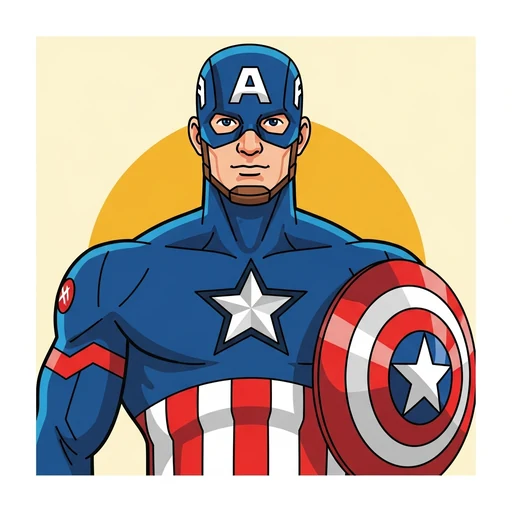
Avengers Leadership
When the Avengers needed someone to lead them, they did not vote. They did not hold a meeting. They did not draw up a list of qualifications and check boxes.
They looked at Steve Rogers.
And Steve Rogers said: "Alright. Here's the plan."
He was not always the loudest in the room. Tony Stark was louder. Thor was more magnificent. Bruce Banner was more technically brilliant. Natasha Romanoff — Black Widow — had more secrets and more skills in her smallest finger than most people had in their entire careers. Clint Barton — Hawkeye — could read a battlefield from a rooftop with a coolness that seemed almost supernatural.
But Steve had something different. He had the capacity to see each of them — really see them, not for what they could do but for who they were — and to make each one feel that they mattered in a way no one else could replace.
When Bruce Banner was afraid of what the Hulk might do, Steve looked at him steadily and said: "I'm counting on the Hulk. We need him." Not as a problem. As a teammate.
When Tony Stark arrived at a meeting in the wrong mood — the argumentative, brilliant, abrasive mood that Tony fell into when he hadn't slept and had been in his workshop for three days — Steve didn't match him. He said: "What do you see that we're missing?" Because Tony always saw something they were missing.
When Natasha came back from a mission that had cost more than it was supposed to cost, Steve didn't ask what went wrong. He asked: "Are you okay?" He waited for the real answer. He gave her the silence to find it.
This was the nature of Steve Rogers's command. He led by going first — by being the one who stepped into danger before he asked anyone else to. He led by listening. By being honest, even when honesty was uncomfortable, especially then.
In a battle, his tactical mind was extraordinary. He had an almost architectural sense of space — he could look at a complicated, fast-moving situation with threats coming from a dozen directions and see the shape of it, see the places where the right move in the right sequence would turn a crisis into a manageable problem. His voice in his teammates' earpieces was calm and clear.
"Widow, your left. Thor, take the carrier. Stark, I need you on the east bridge in thirty seconds. Bruce — you might want to get angry now."
"I'm always angry," Bruce said, and became very large and very green.
The alien army did not have a good day.
In the spaces between battles — in the compound, in the quiet evenings when there were no alarms and no threats and the team ate dinner together around a table large enough for heroes and their considerable appetites — Steve was different. He told stories about Brooklyn. He asked about people's families. He remembered every birthday. He learned Thor's favorite Midgardian food (pasta with too much cheese) and Tony's least favorite topic (anything that required him to acknowledge being wrong) and what made Bruce Banner laugh, which was dry, unexpected jokes delivered completely seriously.
He built the team the same way he had learned to use the shield: patiently, with practice, with the understanding that you had to know the angles.
There were hard days. Days when the right choice was not clear, when reasonable people with good hearts looked at the same problem and came to completely different conclusions. Those days tested the team in ways that no Chitauri army could. Those were the days that shook them.
But they came back. The team fractured and they came back. They disagreed and they came back. Because that is what teams do, when the foundation has been built properly: they hold through the shake, and they come back.
Steve Rogers believed in that. He believed in it the way he had believed, as a skinny boy from Brooklyn, that standing up to bullies was worth the bruises. Not because it always worked out perfectly. Because the alternative — giving up, looking away, deciding it wasn't worth the effort — was simply not something he could do.
Peggy Carter, who had believed in Steve before anyone had reason to, had said it clearly once, in the early days: "The right partner makes the whole mission possible."
Steve thought about that, sitting at the head of the Avengers table, looking at the faces around him — brilliant and complicated and brave and occasionally insufferable and entirely, completely irreplaceable.
The right team makes the whole world possible.
He looked around the table.
"Alright," he said. "Here's the plan."