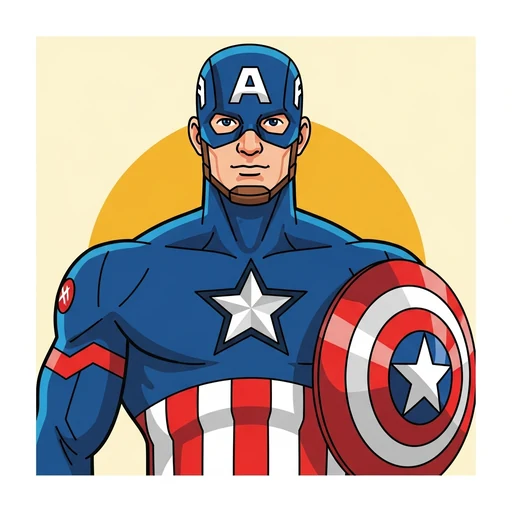
Vibranium Shield
Let us take a moment and talk about a circle.
Not an ordinary circle — not a wheel or a coin or a plate. A circle of metal, perfectly round, thirty inches across, decorated in red and white rings with a white star in the center and a deep blue field around it. Light as a good coat but stronger than almost anything else on the surface of the Earth.
Captain America's Vibranium shield.
Howard Stark found it in his workshop, already made — he had used every gram of Vibranium he possessed, a metal from deep in Africa, to forge this one object, and then set it aside under a worktable as if he didn't quite know what it was for yet. When he showed Steve Rogers into the room full of prototype shields in 1943, Steve picked up one and found it too heavy, another and found it too rigid. Then he saw the round one — the disc — leaning against the table.
He picked it up. He held it by the straps on the inside.
It was lighter than it had any right to be — lighter than a shield made of ordinary steel at that thickness would have weighed. But solid. Absolutely, completely solid, the way something made right is solid, the way a good door fits a good frame.
Howard Stark cleared his throat. "That's a prototype. It's worth more than—"
Steve looked at him.
"It's yours," Howard said.
Here is what Vibranium does: it absorbs kinetic energy. When something hits the shield — a fist, a bullet, a cosmic energy blast from an alien weapon, a blow from a god — the shield does not send that energy back into Steve's arm. It doesn't crack. It doesn't dent. It drinks in the force like a sponge drinking water and dissipates it in every direction harmlessly. The harder you hit the shield, the more the shield cares nothing about how hard you hit it.
It also does something wonderful when thrown.
Steve learned this slowly, with years of practice — with training sessions that left him covered in bruises when the shield didn't bounce back quite right, and then with the gradual accumulation of a skill so finely developed it seemed impossible. He learned the angles. He learned the geometries. He learned the exact spin and the exact release point for a throw that would strike one target, bounce off a wall, strike another target, and return to his hand — like a boomerang designed by a mathematician.
CLANG. The shield hit a steel girder. CLANG again — a HYDRA soldier's weapon. CLANG — a wall. Then Steve's hand was out and it was back.
No one else could do it. No machine could replicate the feel of it, the intuition for it. After decades, the shield was so deeply part of how Steve Rogers moved through the world that it was not separate from him. It was an extension of his arm. An extension of his will.
It could stop bullets from a machine gun without Steve flinching. In a battle against Thor — early in their acquaintance, when they were still sorting out whether they were going to be friends — Mjolnir struck the shield and the shockwave leveled the forest around them. Steve was still standing. The shield was fine.
Thanos's double-edged sword — a weapon designed to destroy nearly anything in the universe — managed to chip it. Steve held his ground anyway.
On D-Day and beyond, in HYDRA strongholds, in the streets of Manhattan and Washington and Wakanda, on rooftops and in ruins and in falling spacecraft, the shield held. Every scratch on it told a story. Every dent that wasn't there because Vibranium doesn't dent told a story too — about the bullet that didn't reach the person behind Steve, about the blow that stopped before it could do the harm it intended.
But Steve Rogers himself would tell you this: the shield matters less than the person carrying it.
The shield stopped bullets. Steve was the one who ran toward them in the first place. The shield bounced off walls and came back to his hand. Steve was the one who threw it, over and over, in the direction of the thing that needed to be stopped.
A shield is just a shield. What makes it a symbol of justice is the heart of the soldier who carries it.
Steve Rogers carried it across oceans and decades and the vast cold of space. He carried it in the name of every person who needed protecting and couldn't protect themselves. He carried it for Brooklyn, and for Bucky, and for Peggy Carter who had believed in him when he was thin as a winter branch, and for Dr. Erskine who had looked at a boy everyone else had rejected and seen exactly who he was.
He carried it until someone worthy could carry it after him.
Because that, too, is what a good shield is for: not just stopping what comes at you, but passing on what matters.