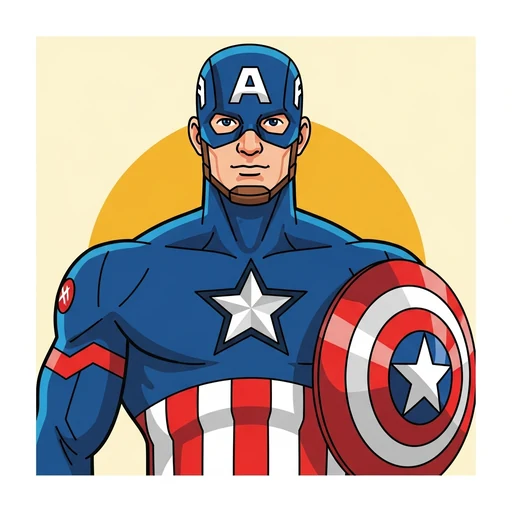
Agent Carter
If you ask Steve Rogers — really ask him, in a quiet moment, when his shield is leaning against a wall and his eyes have gone soft with memory — who shaped him most, he will not say the scientist who gave him the serum. He will not say the army that made him a soldier. He will not even, perhaps, say his best friend Bucky.
He will say Peggy.
Margaret "Peggy" Carter was a British intelligence officer in the time of the Second World War. She had dark hair, bright red lipstick, and a way of looking at a person that made them stand up straighter without quite knowing why. She was clever. She was brave. She was fearless in a time when many men around her did not yet understand that women could be all of those things.
When Steve Rogers — small, asthmatic, rejected by every army recruiting station in the country — finally got accepted into a secret experimental program, Peggy Carter was the one in charge of training him.
The other recruits laughed at him. The drill sergeants shook their heads. "He'll never make it," they muttered. "Too skinny. Too weak. Pick somebody else."
Peggy did not laugh. Peggy watched.
She watched the moment a fake grenade was thrown into the training yard, and every other recruit ran for cover. She watched Steve — small, skinny Steve — throw himself on top of it to shield the others, his thin arms wrapped around what he thought was a real explosive.
Peggy looked at her commanding officer. "That one," she said quietly. "That is your soldier."
From that moment on, Peggy believed in Steve. Long before the serum. Long before the shield. She saw the GOOD MAN inside the skinny boy, and she held onto that vision so firmly that Steve himself began to believe it.
After the serum, after Steve became Captain America, Peggy did not become an admirer. She became a PARTNER.
She was not a voice on the radio. She was right beside him on the front lines, in the briefing tents, in the long planning sessions before each mission with the Howling Commandos. She gave the orders. She made the calls. She knew, in advance, the terrain of every battlefield Steve was about to enter. When Cap charged into Hydra's strongholds, it was almost always Peggy's strategy he was carrying out.
She challenged him constantly. She refused to let him grow lazy or arrogant. She asked him, after every mission, "What could you have done better? Who did you fail to protect? What did you learn?" And Steve, who had grown up being underestimated, learned from her how to keep growing without losing his soul.
Peggy was, for Steve, the proof that the world he was fighting for was real. A world where competence and integrity mattered more than what you looked like or where you came from. A world where a woman in red lipstick could outthink any general in the room. A world worth saving.
They fell in love. Quietly, the way real love often happens — between strategy meetings, behind closed doors, in stolen moments when no one else could see.
They made a date. The Stork Club, a famous old dancing place in New York. Eight o'clock on the dot. Steve promised her he would be there to teach her to dance — though, as he admitted with a grin, he had no idea how to dance himself.
He never made it.
You know that part. The plane. The ice. The long cold sleep.
For seventy years, the memory of Peggy Carter was the lantern that kept Steve's spirit warm beneath the Arctic ice. He did not know he was sleeping. He did not know he was anywhere at all. But somewhere deep in him, when his body finally thawed and the doctors finally woke him, the very first words out of his mouth were not "Where am I?"
They were "I had a date."
When Steve woke up in the modern world, he learned with both joy and heartbreak that Peggy was still alive. She was very old now. Her hair was white. Her hands trembled. But her eyes — when Steve sat down at her bedside for the first time — were still HER eyes. Bright. Sharp. Loving.
She gasped when she saw him. "Steve," she whispered.
And he held her hand and he cried, gently, because some reunions are too beautiful for any other sound.
In her remaining years, Peggy taught Steve about the world she had helped build after he had vanished. She had founded a vital organization called S.H.I.E.L.D. She had stood up to corruption in the agencies they had both served. She had lived a long full courageous life. She had married, had children, had grandchildren. She had not waited for Steve. He was glad. He had wanted her to live.
Even as her memory began to slip in her last years, even on the days when she forgot who he was for a moment and then remembered with delight and surprise, Peggy gave Steve something he could not get anywhere else. She reminded him of the principles they had fought for. She reminded him that being a hero meant doing what was right even when it was unpopular. She reminded him that the dance was still owed.
When at last she passed away, peacefully, in her sleep, Steve attended her funeral. He stood quietly at the back of the church. He listened. He grieved.
And then, after a long time, he went back to work.
To this day, when Captain America has to make a difficult decision — a decision where everyone around him is saying one thing and his heart is whispering another — he closes his eyes and asks himself, simply, "What would Peggy do?"
The answer always comes.
She was his strategist. His partner. His best girl. And in the deepest way, she was the very heart of Captain America.
Some night, Steve still believes, there will be a dance.
He has not forgotten.